Hello. This final lesson brings the course’s biology and evidence tools together. A GLP-1 news headline can contain a real finding and still claim more than the study shows. You will learn to write a short evidence verdict that separates the result actually observed from the broader benefit being proposed, names the uncertainty, and specifies what research could resolve it. The aim is to interpret claims, not to choose a prescription.
Turn the headline into a claim a study could test
Consider the headline “Semaglutide cures alcohol addiction.” Before deciding whether it is true, make its implied claim precise. Cures might mean fewer drinks during a laboratory session, fewer heavy-drinking days, sustained abstinence, or improved long-term health. Those are different outcomes. Likewise, a result for one dose of semaglutide in a particular group does not automatically establish a benefit for every GLP-1 receptor agonist or everyone with an addiction.
For any headline, identify five boundaries: which drug, which people, compared with what, measured by which outcome, and over what period. Then identify the study design. Random assignment can support a causal interpretation of an outcome within the trial’s boundaries; an observational association may be important but leaves more room for differences between the groups to explain the finding. Neither design makes an unmeasured outcome established.
Numbers need boundaries too. “Risk fell by 20%” is a relative statement; its practical size depends on how many people faced the outcome to begin with. The Winton Centre’s short video gives a useful way to translate such claims into expected numbers of people affected.
Relative vs Absolute risks: Why Relative Risks Are Misleading, and How To Communicate Absolute Risks
Watch “Relative vs Absolute risks: Why Relative Risks Are Misleading, and How To Communicate Absolute Risks” from the Winton Centre to see why a striking relative figure can be hard to interpret alone.
Watch the baseline example, where a doubled risk is set beside the original risk. Then watch expected frequencies for a way to express a difference as additional cases per 100 people. The examples are not about GLP-1 medicines; focus on the reporting method.
A verdict need not calculate an absolute effect when the necessary event rates are unavailable. It should say that the absolute effect cannot be judged from the reported relative figure alone, rather than inventing a baseline.
A positive signal is not the same as an established treatment
The alcohol-use-disorder trial provides a good test of headline discipline. It randomized 48 adults to once-weekly semaglutide or placebo for nine weeks. The participants had alcohol use disorder but were not seeking treatment for it. Its primary assessment was how much alcohol participants consumed in a controlled laboratory session; weekly drinking and craving provided additional outcomes.
Once-Weekly Semaglutide in Adults With Alcohol Use ...
Read the trial report by Hendershot and colleagues in JAMA Psychiatry to distinguish its randomized finding from claims about an addiction treatment.
On p. 395, read the abstract from the passage beginning “Of 504 potential participants assessed” through the conclusions. Note the participant count, laboratory primary outcome, weekly outcomes that changed, and those that did not. Then find “Limitations” near the end of the Discussion on pp. 402–403. Read the limitations, paying particular attention to treatment duration, drinking severity, and the authors’ reason for calling for larger trials.
The pattern matters more than any single bar. In the trial, semaglutide reduced alcohol consumed during the post-treatment laboratory task and was associated with lower drinks per drinking day and weekly craving relative to placebo. Heavy-drinking days also declined more over time. But the study did not detect an effect on average drinks per calendar day or on the number of drinking days. Only 25 participants had complete data for the main laboratory consumption analyses, further narrowing how confidently to generalize that result.
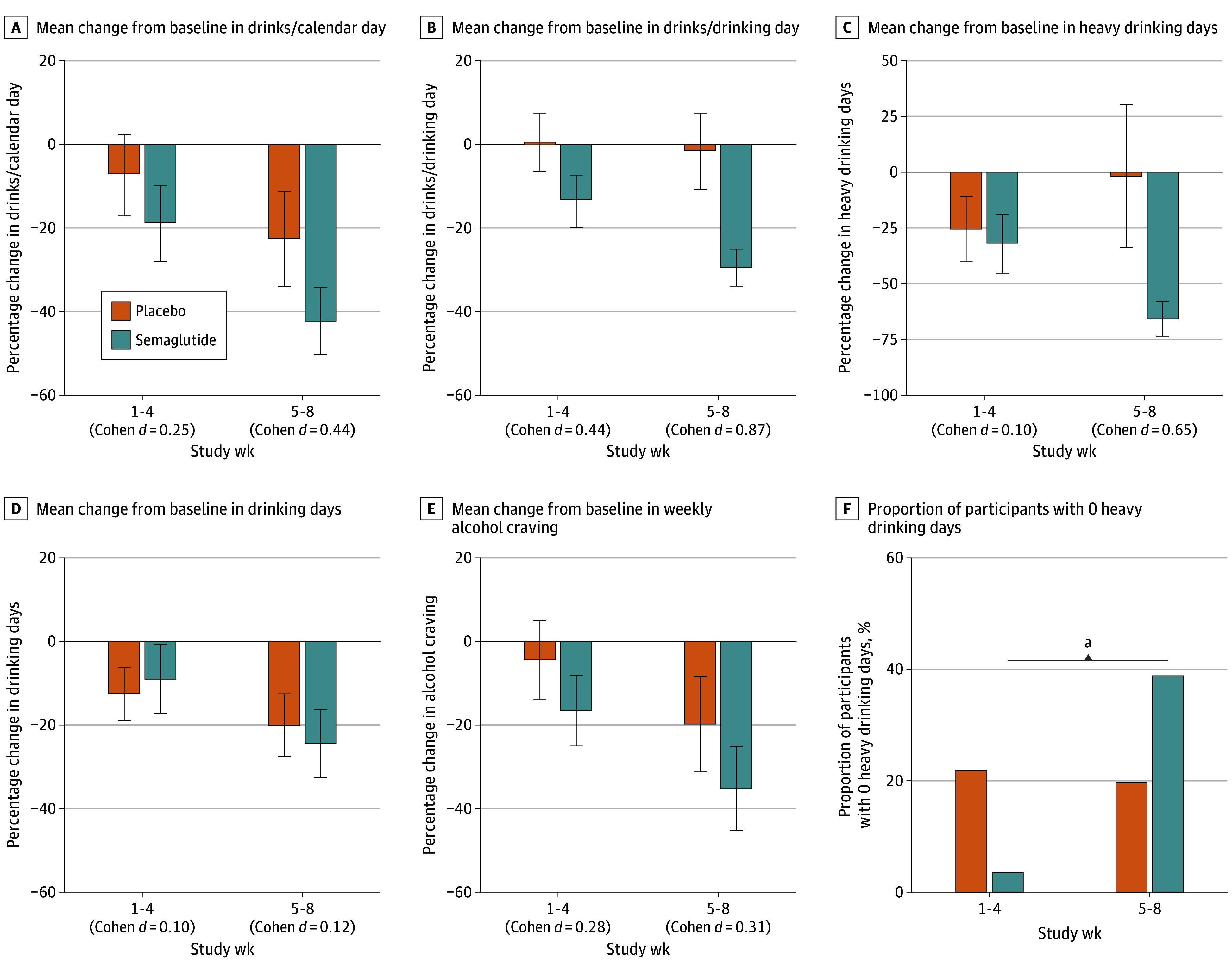
A verdict on “Semaglutide cures alcohol addiction” could read:
Verdict: A small randomized trial found that, over nine weeks, semaglutide reduced alcohol consumed in a laboratory task and improved some measures of drinking quantity and craving in adults with alcohol use disorder who were not seeking treatment. It did not show fewer drinking days or establish sustained abstinence, lasting health benefits, or a “cure.” Larger, longer trials should test clinically meaningful drinking outcomes in treatment-seeking as well as other participants, while assessing tolerability and whether benefits persist.
Notice the wording “found” rather than “may have found” for the outcomes the trial measured, but “did not establish” for the much broader claim. The verdict neither dismisses the signal nor promotes it into a settled clinical benefit.
When studies seem to disagree, check whether they asked the same question
Dementia headlines present a different challenge. Observational studies have associated GLP-1 receptor agonist use with lower rates of subsequent dementia. Meanwhile, two large randomized trials—EVOKE and EVOKE+—tested whether oral semaglutide slowed decline in people who already had early Alzheimer’s disease. Prevention of a future diagnosis and treatment of existing disease are not interchangeable questions.
The following video sets out that distinction. Use it as an explanation of the claims, then check the trial findings in the study summary below.
GLP-1s and Dementia: What the Latest Alzheimer’s Research Really Shows
Watch “GLP-1s and Dementia: What the Latest Alzheimer’s Research Really Shows” from Beyond the Scale: My GLP-1 Journey for its explanation of why an observational prevention signal and a treatment-trial result can coexist.
Start with observational limits, which explains why lower dementia rates among medicine users do not by themselves prove a drug effect. Watch the trial question for what EVOKE and EVOKE+ tested. Finish with prevention versus treatment; treat earlier protection as a hypothesis, not a benefit the trials demonstrated.
The trial summary below is a sponsor-produced slide deck reporting results published in The Lancet. Read it for the specified designs and estimates, rather than treating either a hopeful mechanism or a disappointing headline as a substitute for the measured clinical outcomes.
Efficacy and safety of oral semaglutide 14 mg (flexible dose) in early ...
Read this summary of the EVOKE and EVOKE+ oral-semaglutide trials to see what the randomized comparison established and why biomarker results do not settle a clinical claim.
On slide 4, under “Introduction,” read the rationale: it moves from observational associations to the question tested in people with early Alzheimer’s disease. On slides 4–5, under “evoke and evoke+ trial designs,” read the allocation and treatment; note that the specified primary clinical comparison was at week 104. On slides 11–12, under “Clinical efficacy results,” locate the tables beside the CDR-SB and daily-function graphs. Read the endpoint estimates and their 95% confidence intervals, focusing on whether either trial demonstrated slower clinical decline. Finally, on slide 15 under “CSF biomarker results,” find the biomarker summary. Compare those changes with the clinical results rather than treating them as equivalent outcomes.
Neither trial demonstrated that oral semaglutide slowed the measured cognitive and functional decline at the primary, week-104 comparison. The daily-function results make a useful visual check: both treatment and placebo groups worsened, and the estimated differences at week 104 were small, with confidence intervals spanning no difference.

The later points on a graph do not replace the prespecified week-104 comparison. Nor does “no demonstrated benefit” prove that every possible GLP-1 medicine, dose, or prevention strategy has no cognitive effect. The trials answer a substantial but specific question about treating established early Alzheimer’s disease with oral semaglutide.
The deck also reports changes in several cerebrospinal-fluid biomarkers in a smaller substudy. These may inform biological hypotheses, but a biomarker moving in a hoped-for direction is not proof that people think or function better. Here, that distinction is especially concrete: biomarker changes appeared without demonstrated clinical benefit in the main trials.
A concise dementia verdict could therefore say:
Verdict: Observational studies link GLP-1 receptor agonist use with lower subsequent dementia rates, but those comparisons do not establish that the drugs prevent dementia. In EVOKE and EVOKE+, randomized oral semaglutide did not demonstrate slower cognitive or functional decline in people with early Alzheimer’s disease, despite changes in some biomarkers. Whether earlier use prevents dementia, in whom, and by how much remains uncertain. Research addressing prevention would need to measure new diagnoses and meaningful cognitive outcomes over an appropriate period, rather than infer protection from biomarkers alone.
Build your own short verdict
Aim for roughly 100–140 words. The strongest structure is four compact moves:
- Translate the claim. Name the drug or drug class, population, and outcome the headline implies.
- State the established result. Give the study design and the outcome actually observed—including an important null result where relevant.
- Mark the boundary. Explain what remains uncertain because of study size, follow-up, comparison group, outcome choice, or the difference between association and causation.
- Name a resolving study. Specify who should be studied, what meaningful outcome should be measured, and for how long; include safety when evaluating a proposed new use.
“Established” need not mean “a benefit was found.” It can mean that a well-designed trial did not demonstrate a proposed benefit in its studied population. Conversely, an intriguing randomized signal can be real within a short trial without establishing a lasting treatment. If a claim concerns cancer prevention or a rare safety event, the same framework applies, but the needed follow-up may be much longer: rodent findings, human observational associations, and rare events recorded during trials answer different questions.
Before finishing a verdict, check that every strong verb has earned its place. “Was associated with,” “reduced in this trial,” “did not demonstrate,” and “remains untested” convey different levels and kinds of evidence. Replace any unqualified “GLP-1 drugs” conclusion with the particular medicine and population when the supporting study tested only those.
Conclusion
An evidence verdict is not a vote for or against a medicine. It is a compact account of what was measured, what the result supports, where the claim exceeds it, and what would close the gap. The alcohol trial shows how to preserve a promising short-term signal without calling it a cure; EVOKE and EVOKE+ show how to respect a negative treatment result without pretending it tested every prevention hypothesis. That habit of matching each claim to its evidence is the course’s final tool for reading the next GLP-1 headline.