Welcome back. The previous lesson separated an observational association with lower dementia risk from randomized trials that did not show a benefit for treating early Alzheimer’s disease. Cancer claims demand the same discipline, with an added complication: a cancer diagnosed soon after a medicine is started may have begun developing years earlier.
This lesson examines the thyroid warning on GLP-1 receptor agonists, what human studies can and cannot say about that risk, and why evidence about cancer prevention is a separate question. Allow about 40–45 minutes for the readings and lesson.
The warning begins with a finding in rodents
A prominent warning on semaglutide’s prescribing information concerns thyroid C-cell tumors. C cells are a particular type of thyroid cell; medullary thyroid carcinoma (MTC) is the cancer associated with them. This is more specific than “thyroid cancer,” a category that also includes more common types such as papillary cancer.
Read the warning as a statement about two different levels of evidence: what happened in animals, and what remains unknown in humans.
highlights of prescribing information - accessdata.fda.gov
Read the FDA-hosted prescribing information to see both the basis of the boxed warning and its carefully stated uncertainty about human risk.
In FULL PRESCRIBING INFORMATION, find subsection 5.1, “Risk of Thyroid C-Cell Tumors.” Read the warning and explanation from its opening animal-study finding through the paragraph on the uncertain value of routine monitoring. Focus on the distinction between an observed rodent effect, reports in treated humans, and proof of a human causal effect.
In mice and rats exposed over much of their lives, semaglutide increased C-cell tumors, including at exposures relevant to human use. It would be inaccurate to dismiss the finding simply as a result of enormous doses. It would be equally inaccurate to say that a tumor caused in a rodent has therefore been shown to occur because of the drug in a person. The label explicitly says the human relevance is unknown. It also notes that postmarketing MTC reports cannot establish or exclude a causal relationship.
That uncertainty has a practical regulatory consequence: the semaglutide product in this label is contraindicated for people with a personal or family history of MTC or with multiple endocrine neoplasia syndrome type 2 (MEN 2). A contraindication is a precaution about use in a specified group, not a finding that the drug has been proved to cause MTC in humans. Conversely, an uncertain human effect is not a reason to disregard the warning. This lesson is about interpreting evidence, not determining whether any individual should take a medicine.
What a large human study measured
To investigate human risk, researchers can compare people who start a GLP-1 receptor agonist with people who start another diabetes medicine. Choosing an active comparator makes the groups more alike in their need for treatment than comparing users with everyone who does not use a GLP-1 medicine. It does not make treatment assignment random.
The following study examined diagnosed thyroid cancer of any type. Keep that outcome distinct from the rodent finding about C-cell tumors and from the narrower question of human MTC.
Glucagon-like peptide 1 receptor agonist use and risk of ...
Read the BMJ cohort study for its comparison, its numerical result, and the limits of the result for rare cancer subtypes.
On p. 1, read the “Introduction” passage from the origin of concern to the sentence about the warning. Then go to “Discussion,” subsection “Principal findings” (p. 6), and read from the subtype interpretation. On the same page, inspect Table 2 from the main and medullary rows; compare the event counts and confidence intervals. Finally, in “Strengths and limitations” (p. 7), read from the follow-up limitations.
The study compared more than 145,000 people starting a GLP-1 receptor agonist with about 292,000 starting a DPP-4 inhibitor. During a mean follow-up of 3.9 years among GLP-1 users, there were 76 diagnosed thyroid cancers in the GLP-1 group and 184 in the comparator group. Because the groups differed in size and follow-up time, those counts alone are not the comparison to use. The study’s adjusted rates were 1.33 versus 1.46 cases per 10,000 person-years, respectively.
Its adjusted hazard ratio for any thyroid cancer was , with a 95% confidence interval of to . The estimate did not show an increased rate in GLP-1 users over the period studied. The interval, however, is compatible with anything from a lower rate to a rate approximately 31% higher than in the comparator group. On this study’s absolute scale, the upper limit corresponded to about 0.36 additional cases per 10,000 person-years. “No substantial increase detected” is more faithful to these results than “zero risk proved.”
The MTC result is less conclusive. Table 2 records just four MTC cases in the GLP-1 group and 11 in the comparator group. Its hazard-ratio estimate was , but the 95% confidence interval ran from to . That wide interval cannot establish an increase, yet it cannot tightly rule one out either. A study can be large overall and still have little precision for a rare subtype. The more precise result for all thyroid cancers must not be substituted for the much less precise MTC result.
Diagnosis, detection, and the passage of time
Cancer studies have a timing problem that many shorter-term outcomes do not. A diagnosed cancer may have been developing before a person began treatment. Starting a new medicine may also bring more clinical attention and more opportunities to discover an existing thyroid condition. This is detection bias: a difference in finding disease, rather than necessarily a difference in causing it.
Researchers therefore look at when diagnoses occur and sometimes use a lag period, setting aside early follow-up to examine later diagnoses. A lag is informative but not a perfect repair. It removes early events from the analysis and cannot reveal every cancer that might emerge far in the future.
Glucagon-like peptide 1 receptor agonist use and risk of ...
Return to the BMJ study to see how the researchers used timing to test possible explanations for an observed association.
In the methods discussion of additional analyses (p. 2), read from the lag-period explanation. Then, in “Discussion,” subsection “Comparison with other studies” (p. 7), find the paragraph about the earlier French study. Read from the comparison and timing interpretation. Notice that the authors offer confounding and increased detection as explanations, rather than claiming to have proved either one.
This helps explain why human studies have not all appeared to agree. A study comparing GLP-1 users with nonusers reported a higher thyroid-cancer association, but those groups may differ in ways related to cancer diagnosis or risk. In the BMJ study, an apparent elevation confined to the first year was also considered consistent with increased detection. Neither pattern proves that all early cancers were pre-existing; it identifies a credible alternative to attributing every diagnosis to a newly started drug.
Even reassuring results have a time boundary. The BMJ study’s mean GLP-1 follow-up was 3.9 years, although some participants were followed longer. Its findings weigh against a substantial increase in diagnosed thyroid cancer over the observed period. They cannot settle every possible effect after much longer exposure or latency. Shorter randomized trials are valuable because assignment to treatment is random, but when cancer is rare and may take years to become detectable, they can also produce few events and imprecise safety estimates.
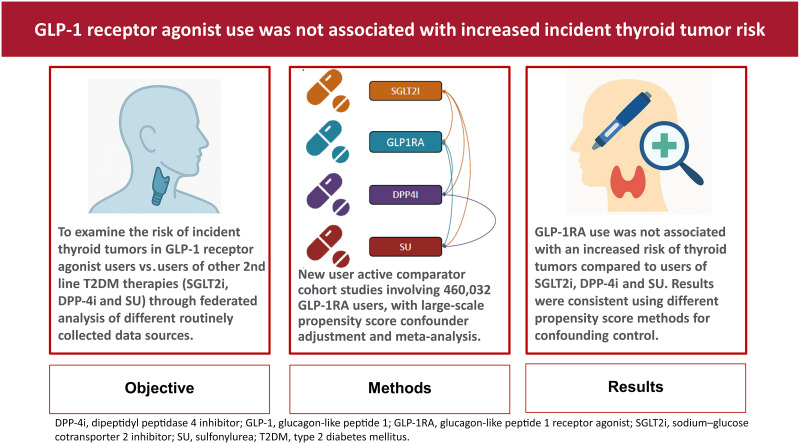
The graphical abstract below summarizes a different observational analysis. It depicts comparisons with several other diabetes-drug classes and reports no association with increased incident thyroid tumors. It reinforces why active comparators are useful, but the graphic supplies neither the follow-up detail nor subtype-specific precision needed to declare the MTC question closed. Its participants and results should not be combined with the BMJ study’s numbers as though they came from one cohort.
A safety finding is not a prevention finding
Cancer-risk headlines sometimes make a second leap: if a study does not find an increase—or finds fewer cancers among users—GLP-1 medicines must prevent cancer. Neither inference follows.
First, “no increase detected” is not the same as “a decrease demonstrated.” The BMJ estimate for thyroid cancer lies close to no difference, and its confidence interval includes both lower and higher rates. Second, even a clear observational association with fewer cancers would require careful interpretation. People prescribed different medicines may differ in baseline cancer risks, diabetes severity, weight history, other treatments, and how often they undergo investigations. Statistical adjustment can reduce measured differences, but it cannot guarantee that an association is a drug-caused preventive effect.
A plausible biological story is useful for deciding what to study, not for announcing a result. GLP-1 medicines can change weight and metabolic health, which might in turn affect some cancer-related processes. Whether a particular drug reduces the incidence of a particular cancer, in a particular population, over a meaningful span of time needs evidence directed at that question. Thyroid safety data do not establish prevention of thyroid cancer, much less prevention of cancer as a whole.
A defensible verdict therefore names the outcome and time frame:
Rodent studies establish a thyroid C-cell tumor signal and justify the warning. Human observational evidence, including a large active-comparator study, has not shown a substantial increase in overall diagnosed thyroid cancer over roughly four years of mean follow-up. Rare MTC and possible longer-latency effects remain less certain. These safety findings do not demonstrate cancer prevention.
That wording leaves room for future evidence without turning uncertainty into either alarm or a guarantee of safety.
Conclusion
Keep three questions separate when reading a GLP-1 cancer claim: What tumor was studied? In which species or population? Over how much time? Rodent C-cell tumors explain the warning; human studies provide increasingly useful but time-limited safety evidence; and an observational pattern of fewer diagnoses would not, by itself, prove prevention. Rare MTC events and cancer latency are especially important limits on confident claims.
In the final lesson, you will bring these distinctions together in a short evidence verdict on a GLP-1 news claim—identifying what is established, what remains uncertain, and what study would address the uncertainty.