Welcome back. In our last lesson, you saw how the Chinese system for dates follows a consistent "big-to-small" logic. Today, we'll continue with this theme as we move to the next smaller unit of time: the clock. You'll find that telling time in Mandarin is similarly structured and, given your background, you'll likely appreciate its almost algorithmic nature.
The objective for this lesson is to master telling time. By the end of our session, you will be able to use the words 点 (diǎn) for 'hour', 分 (fēn) for 'minute', and 半 (bàn) for 'half past'. We will also address a crucial and specific rule: how to correctly say 'two o'clock'.
The Basic Formula for Time
Just as dates follow a set order, time on the clock follows a simple formula that reads like a digital display. The core components are 点 (diǎn), which literally means "dot" and marks the hour, and 分 (fēn), which means "minute".
The structure is:
Number + 点 (diǎn) + Number + 分 (fēn)
For example, 3:15 is read as "three hour, fifteen minute": 三点十五分 (sān diǎn shí wǔ fēn).
To get a firm grasp of this foundational concept, please read the first part of the following guide.
This article from Nemorize provides a clear and structured explanation of how to tell time.
Please read the section titled "Core Concept 1". Pay close attention to the Basic Time Structure and the definitions of 点 (diǎn), 分 (fēn), and 半 (bàn). The time expression table provides excellent examples.
The Special Case of "Two O'Clock": 两点 (liǎng diǎn)
In our first lesson on numbers, you learned two words for "two": 二 (èr) and 两 (liǎng). While 二 (èr) is used for counting in sequence (e.g., one, two, three...) and in larger numbers (e.g., 22, èr shí èr), 两 (liǎng) is used when specifying a quantity of "two" of something.
When telling time, the hour is treated as a quantity. Therefore, for "two o'clock," you must use 两 (liǎng).
- Correct: 两点 (liǎng diǎn) - Two o'clock
- Incorrect: 二点 (èr diǎn)
This rule applies only to the hour. For minutes, you still use 二 (èr). For example, 2:02 is 两点零二分 (liǎng diǎn líng èr fēn), and 2:12 is 两点十二分 (liǎng diǎn shí'èr fēn).
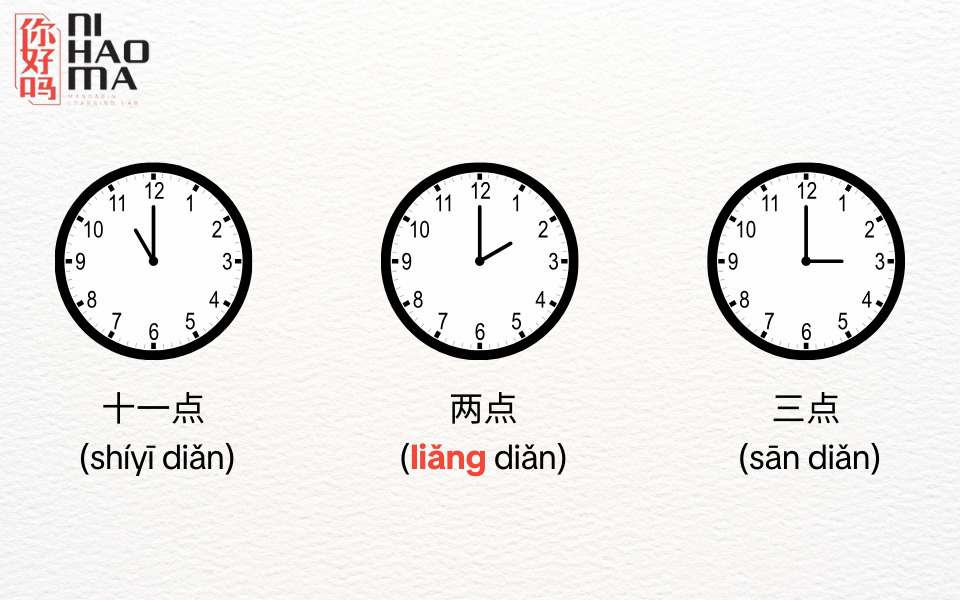
This image provides a clear visual contrast. Notice how 2 o'clock is uniquely written as 两点 (liǎng diǎn), while 11 and 3 o'clock use their standard numbers.
To solidify this important rule, let's revisit the Nemorize article and focus on the common mistakes section.
This section isolates the most common errors beginners make, which is an efficient way to reinforce the correct patterns.
Please read the subsection Mistake #2. This directly addresses the 两点 rule we just discussed.
For auditory reinforcement and pronunciation practice, this video from Harbin Mandarin is very clear.
Telling Time in Mandarin Chinese | Beginner Lesson 10 | HSK 1
This video provides clear, spoken examples of telling time, which is essential for your listening skills.
Please watch the section explaining how to say the hour, from o'clock. Then, pay close attention to the explanation of 两点, which provides more examples.
The Shorthand for ":30": 半 (bàn)
For times that are exactly 30 minutes past the hour, Chinese has a convenient shorthand: 半 (bàn), which means "half". Instead of saying "thirty minutes" (三十分, sān shí fēn), it is much more common to say "half".
The structure is:
Number + 点 (diǎn) + 半 (bàn)
For example, 4:30 is 四点半 (sì diǎn bàn). This is simpler and more natural than saying 四点三十分 (sì diǎn sān shí fēn), although the latter is not technically incorrect.
This infographic provides a quick visual summary of the key time-related words, including 半 (bàn).

Now, let's return to the Harbin Mandarin video to hear the pronunciation and usage of 半 (bàn).
Telling Time in Mandarin Chinese | Beginner Lesson 10 | HSK 1
This video will now complete the picture by explaining 'half past' and how to state minutes.
First, watch the explanation of 半 for 'half past'. Then, continue with the section on stating the minutes using 分. The remainder of the video provides excellent practice combining all these elements.
Putting It All Together
You now have all the components to tell any time in Chinese. Let's summarize the patterns:
- On the hour: Number + 点 (diǎn)
- 7:00 → 七点 (qī diǎn)
- 2:00 → 两点 (liǎng diǎn)
- Exact minute: Number + 点 (diǎn) + Number + 分 (fēn)
- 9:15 → 九点十五分 (jiǔ diǎn shí wǔ fēn)
- 1:05 → 一点零五分 (yī diǎn líng wǔ fēn) - Note the use of 零 (líng) for minutes 01-09.
- Half past: Number + 点 (diǎn) + 半 (bàn)
- 10:30 → 十点半 (shí diǎn bàn)
Finally, to review everything and hear it in the context of asking for the time, you can watch this video from Everyday Chinese.
Telling the Time in Chinese – Day 38: What time is it now?现在几点了?| Learn Chinese for Beginners
This video provides a comprehensive review of all the concepts we've covered in this lesson.
You can watch the entire video (5 minutes) for a full recap. It covers asking the time, and reinforces the use of 点, 两点, 半, and 分 with many examples.
Conclusion
In this lesson, you have learned the systematic and logical way to tell time in Mandarin Chinese. The structure is straightforward and builds directly on your existing knowledge of numbers.
Key Takeaways:
- The basic time-telling formula is Hour (点) + Minute (分), like reading a digital clock.
- 半 (bàn) is the common shorthand for 30 minutes, as in 三点半 (sān diǎn bàn) for 3:30.
- The most important exception to remember is for 2 o'clock, which is always 两点 (liǎng diǎn), not èr diǎn. This rule only applies to the hour.
Next Lesson Preview:
Now that you can state dates and clock times, the next logical step is to place them within the context of a day. In our upcoming lesson, we will learn the vocabulary for different parts of the day, such as 上午 (shàngwǔ) for 'morning' and 下午 (xiàwǔ) for 'afternoon', as well as the essential words 今天 (jīntiān), 昨天 (zuótiān), and 明天 (míngtiān). This will allow you to form much more specific and useful sentences about when events happen.