Welcome to your first lesson in the "Numbers, Dates, and Time" module. Today, we will focus on building a foundational skill for your HSK 1 journey: recognizing and pronouncing numbers from 0 to 99. The Chinese number system is remarkably logical and consistent. Once you learn the first ten numbers and the word for ten, you can construct all other numbers up to 99 using a simple, predictable set of rules. This compositional principle will be the key to your learning today.
Mastering numbers is not just about counting; it's a prerequisite for many practical topics you'll encounter in the HSK 1 exam and in daily conversation, such as telling time, stating dates, asking for prices, and giving your age. Let's begin by learning the fundamental building blocks.
The Building Blocks: Numbers 0 to 10
Everything starts with the numbers from zero to ten. These are the only unique number words you need to memorize for this lesson. The rest is just combination.
First, take a look at this infographic. It provides a clear overview of the numbers 0 through 10, showing the Arabic numeral, the Chinese character, and the Pinyin pronunciation.

Now, let's solidify this with a more detailed resource that you can refer back to.
Numbers as Graphical Components in Chinese
Please read the first part of this article from DigMandarin. It provides a clean table of the numbers from 0 to 10.
Focus on the table under the heading Basic Numerals 0–10. Try to associate each character with its Pinyin and tone. For example, 一 is yī (first tone), and 十 is shí (second tone).
With the characters and Pinyin in mind, pronunciation is the next crucial step. Mandarin is a tonal language, so getting the tones right is as important as the sounds themselves. The following video offers excellent, clear pronunciation drills.
Numbers in Chinese 1-10, 1-20 and 1-100 | Chinese Numbers 1 to 10, 1 to 20 and 1 to 100 | HSK1
This video from ChineseFor.Us is designed to help you practice pronunciation through repetition. The instructor uses hand gestures for numbers, which can aid memory.
Watch the practice for numbers 1-5 from the beginning. Repeat after the speaker. Next, practice numbers 6-10 from this section. Finally, practice all numbers from 1-10 together in the section from this consolidation part. Pay close attention to the speaker's advice on distinguishing the sounds of sì (四, four) and shí (十, ten).
The System: Constructing Numbers 11-99
Now that you have the 11 essential characters (0-10), you can generate almost any other number. The system is based on a straightforward base-10 logic. This is not about memorizing 99 words, but about applying a simple algorithm.
The image below breaks down the structure for numbers from 11 up to 100. Notice the "Read as" column, which deconstructs each number into its mathematical components.
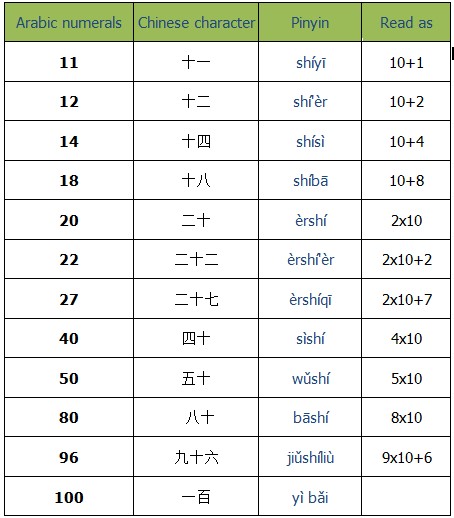
Let's break down the rules explicitly:
-
Numbers 11-19: The structure is
十 + digit.- 11 is "ten-one" → 十一 (shí yī)
- 12 is "ten-two" → 十二 (shí èr)
- ... and so on up to 19, 十九 (shí jiǔ).
-
Multiples of 10 (20, 30, ..., 90): The structure is
digit + 十.- 20 is "two-ten" → 二十 (èr shí)
- 30 is "three-ten" → 三十 (sān shí)
- ... and so on up to 90, 九十 (jiǔ shí).
-
All other numbers (21-99): You simply combine the rules. The structure is
(tens-digit + 十) + ones-digit.- 21 is "two-ten one" → 二十一 (èr shí yī)
- 56 is "five-ten six" → 五十六 (wǔ shí liù)
- 99 is "nine-ten nine" → 九十九 (jiǔ shí jiǔ)
The following reading reinforces this logic.
Numbers as Graphical Components in Chinese
Return to the DigMandarin article and continue reading about how numbers from 11 to 99 are formed.
Read the section titled Numbers 11–99. This section clearly lays out the assembly rules we just discussed. Pay attention to the examples provided, like 21, 35, and 48.
Now, let's practice this with the video.
Numbers in Chinese 1-10, 1-20 and 1-100 | Chinese Numbers 1 to 10, 1 to 20 and 1 to 100 | HSK1
The same video provides a clear explanation and drills for these larger numbers.
Watch the explanation of the pattern for 11-100 from this segment. Then, test your recognition skills with the practice drill from this challenge, where random numbers between 11 and 99 appear on screen.
An Important Distinction: 二 (èr) vs. 两 (liǎng)
You've seen two characters for the number two: 二 (èr) and 两 (liǎng). They are not interchangeable. While we will cover their usage in more detail as we encounter measure words and time, the basic rule is important to learn now.
- 二 (èr) is used for counting in sequence (一, 二, 三...) and in larger numbers where '2' appears as a digit (e.g., 22, 二十二; 52, 五十二).
- 两 (liǎng) is used when quantifying nouns with a measure word (e.g., "two people," "two books") and in certain specific cases like telling time (两点, liǎng diǎn, for "two o'clock").
For the HSK 1, you primarily need to recognize this distinction.
Numbers as Graphical Components in Chinese
This short section in the DigMandarin article gives a concise summary of when to use each form of '2'.
Read the section on èr vs. liǎng. The examples for 'two people' (两个人) and 'two o'clock' (两点) are directly relevant to future HSK 1 topics.
A quick note on the pronunciation of 一 (yī): its tone can change depending on the word that follows it. For example, in 一百 (yì bǎi, 100), it becomes a fourth tone. We will cover these tone sandhi rules systematically in a later lesson, but it's good to be aware that this happens. For now, focus on pronouncing the numbers as you've learned them in this lesson.
Key Takeaways
- The Chinese number system is highly logical and based on a small set of building blocks: the characters for 0-10.
- Numbers from 11 to 99 are constructed using simple, consistent rules based on the character for ten: 十 (shí).
- 11-19: 十 + digit (e.g., 十一, shí yī)
- 20, 30, etc.: digit + 十 (e.g., 二十, èr shí)
- 21-99: digit + 十 + digit (e.g., 二十一, èr shí yī)
- There are two words for 'two': 二 (èr) for counting and as a digit in larger numbers, and 两 (liǎng) for counting objects and in specific contexts like time.
Next Lesson Preview
You have now built a critical foundation. In the next lesson, we will immediately put these numbers to use by learning how to state dates (year, month, day) and the day of the week. You'll see how the characters 一, 二, 三... are used to form Monday, Tuesday, Wednesday, and so on.