Introduction
In our last session, we added a powerful set of eight action verbs to your toolkit, allowing you to describe daily activities like eating, drinking, and reading. We also established a core principle: Chinese verbs do not change form, which simplifies the grammatical system considerably.
Today, we continue to build on that foundation by focusing on actions related to transactions and work. The goal is to learn to recognize and use three more essential HSK 1 verbs: 买 (mǎi - to buy), 工作 (gōngzuò - to work), and 做 (zuò - to do/make). Mastering these will enable you to talk about shopping, your profession, and general activities, moving you another step closer to full HSK 1 competency. We will pay special attention to the relationship between 做 and 工作, a distinction that is crucial for correct usage.
Verb 1: Buying and Selling
Let's begin with the verb for a very common activity: buying.
- 买 (mǎi): to buy
This is a straightforward verb that fits directly into the Subject-Verb-Object (SVO) sentences we've been practicing. Take a look at the flashcards below; you can see 买 on the bottom left, depicted by someone holding groceries.
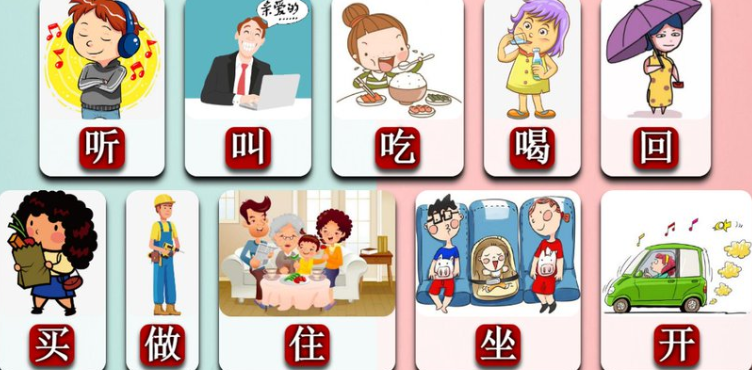
To see its formal definition and an example, please consult the following PDF resource. This document is a list of HSK 1 verbs, and you will find 买 under the "General verbs" heading.
This PDF provides a concise list of HSK 1 verbs with examples.
Locate the section titled 一般动词 General verbs. Find the entry for mǎi 买 and read its definition and example sentence.
As you saw, you can form simple sentences like:
- 我买书。(Wǒ mǎi shū.) - I buy a book.
- 我想买东西。(Wǒ xiǎng mǎi dōngxi.) - I want to buy things.
From an analytical standpoint, it's useful to learn a word by understanding its opposite. The verb "to sell" is 卖 (mài). Notice that the only difference in pronunciation is the tone: mǎi (buy) is the 3rd tone (falling-rising), while mài (sell) is the 4th tone (falling). This kind of tonal distinction is a fundamental aspect of Mandarin. Both words are required for the HSK 1 exam.
Verb 2 & 3: Doing and Working - 做 (zuò) vs. 工作 (gōngzuò)
Next, we'll tackle two verbs related to work and action: 做 (zuò) and 工作 (gōngzuò). These can be confusing for beginners, but the distinction is logical.
做 (zuò): The General "Do" or "Make"
Let's start with 做 (zuò), which is a versatile verb meaning "to do" or "to make." You can see it on the flashcard image next to 买, represented by a construction worker. It is used for a wide range of activities.
To get a strong intuition for how 做 is used, please watch the following video from "Learn Chinese With Maggie." It is dedicated entirely to this important verb.
Most Important Chinese Verb - Learn Chinese [Beginner]
This video provides an excellent breakdown of the many uses of the verb 做 (zuò).
Focus on these key segments: First, watch the introduction to understand its basic meaning. Next, see how it's used for making things, specifically cooking with the phrase 做饭 (zuò fàn). Finally, watch the section on using 做 to talk about professions, such as 做老师 (zuò lǎoshī) - to be a teacher.
As the video shows, 做 is a transitive verb, meaning it almost always needs an object to complete its meaning.
- 做饭 (zuò fàn) - to make food / to cook
- 你做什么? (Nǐ zuò shénme?) - What are you doing?
工作 (gōngzuò): The Specific "Work" or "Job"
Now let's look at 工作 (gōngzuò). This word is interesting because, like many words in Chinese, it can function as both a verb ("to work") and a noun ("job").
- As a verb: 工作 (gōngzuò) means "to work" in the sense of having a job or being employed.
- As a noun: 工作 (gōngzuò) means "a job" or "work."
For a clear definition and examples, let's turn to the official HSK 1 vocabulary list and the verb PDF.
New HSK 1 Vocabulary List 2026: All 300 Words (PDF)
This resource contains the full HSK 1 vocabulary list with clear examples. We will use it to understand 工作 and how it relates to 做.
In the main table, find entry #63 for 工作 (gōngzuò) and read its definition and example. Then, scroll down to the "Survival Phrases" section. Under the 💼 Workplace heading, review the first two phrases that use 做 and 工作 together.
Synthesis: Putting It All Together
The key to distinguishing 做 and 工作 lies in their roles.
工作as a verb is intransitive; it describes the state of working and doesn't take an object. For example:我工作。(Wǒ gōngzuò.) - "I work."做is a transitive verb that means "to do" and requires an object. That object can be the noun工作.
This leads to the most common question about professions:
你做什么工作? (Nǐ zuò shénme gōngzuò?)
- 你 (nǐ): you
- 做 (zuò): do (verb)
- 什么 (shénme): what
- 工作 (gōngzuò): job (noun/object)
This structure is perfectly logical: "You do what job?". Understanding this pattern of a general verb (做) acting upon a more specific noun (工作) is a powerful tool for deconstructing Chinese sentences.
Practice
Let's test your recognition of these new verbs with a few example sentences. Try to translate them yourself before looking at the English.
-
我买一个苹果。
- (Wǒ mǎi yí ge píngguǒ.)
- I buy an apple.
-
我妈妈在做饭。
- (Wǒ māma zài zuòfàn.)
- My mom is cooking. (Note:
在indicates an ongoing action, which we will cover in the next module).
-
我爸爸不工作。
- (Wǒ bàba bù gōngzuò.)
- My dad does not work.
-
他做什么工作?
- (Tā zuò shénme gōngzuò?)
- What job does he do?
Conclusion
In this lesson, you have added three more high-frequency verbs to your vocabulary, focusing on transactions and work. You can now recognize and understand 买 (mǎi - to buy), 工作 (gōngzuò - to work/job), and 做 (zuò - to do/make).
Key takeaways:
- 买 (mǎi) is a simple verb for "to buy" that uses the standard SVO structure. Its counterpart, 卖 (mài - to sell), is differentiated by tone.
- 做 (zuò) is a versatile transitive verb for "to do" or "to make," used in phrases like
做饭(to cook) and做老师(to be a teacher). - 工作 (gōngzuò) can be a verb ("to work") or a noun ("job").
- The question 你做什么工作? (Nǐ zuò shénme gōngzuò?) clearly illustrates the relationship between
做(verb) and工作(noun).
In the upcoming lessons, we will complete this module by learning how to connect nouns using 和 (hé - and) and how to negate verbs using 不 (bù - not). This will enable you to form more descriptive and detailed sentences with the growing list of verbs you have mastered.