Introduction
Welcome to your next lesson. So far, you have built a solid foundation by learning to construct basic sentences, talk about yourself and others, and handle numbers, dates, and time. Your progress has been systematic, focusing on the core components needed for the HSK 1 exam. In this lesson, we will significantly expand your ability to describe actions by focusing on eight fundamental verbs related to daily activities.
The learning outcome for this lesson is to recognize the HSK 1 action verbs: 吃 (chī), 喝 (hē), 看 (kàn), 听 (tīng), 说 (shuō), 读 (dú), 写 (xiě), and 睡觉 (shuìjiào). We will start with a crucial grammatical principle about Chinese verbs that simplifies things considerably. Then, we will introduce the verbs themselves, using a combination of video and text to build strong audio-visual associations. Finally, we'll practice using these verbs within the Subject-Verb-Object (SVO) sentence structure you've already mastered.
A Core Principle of Chinese Verbs
Before we dive into the new vocabulary, let's address a key feature of Chinese grammar that will be a welcome simplification. In many languages, verbs change form based on tense (I walk, I walked) or person (he walks). In Mandarin Chinese, this does not happen. Verbs have a single, unchanging form.
This is a fundamental rule with no exceptions, which should be satisfying from a systems-thinking perspective. To understand this point clearly, please read a brief explanation from the article "139 Verbs in Chinese."
139 Verbs in Chinese || A Complete Guide & FREE Quiz
This article provides an excellent overview of common verbs. We'll start with a key grammatical point it makes.
Please scroll down to the "Chinese Verbs – FAQ’s" section. Read the first two paragraphs, from the explanation of non-conjugation to the end of the SVO example. This simple rule—that verbs don't change—is a cornerstone of Chinese grammar.
This means your task is simplified: you only need to learn the verb's base form, like 吃 (chī), and it remains the same whether you are talking about the past, present, or future, or about yourself (我 wǒ) or someone else (他 tā). Context, time words (like 昨天 zuótiān - yesterday), and particles (which we'll cover later) provide the temporal information, not the verb itself.
Your New Toolkit: Eight Essential Action Verbs
Now, let's build your vocabulary of action verbs. We'll use a "comprehensible input" approach first, where you will see the actions performed while hearing the words. This helps to create a direct link between sound and meaning.
Watch the selected clips from the video "Beginner Chinese | 25 VERBS you'll daily use" by Mandarin with Gisele. The presenter uses gestures to demonstrate the meaning of each verb. Focus on associating the sound of the word with the action.
Beginner Chinese|25 VERBS you'll daily use (comprehensible input; HSK1-3)
This video uses actions to teach verbs, which is an excellent way to internalize their meaning.
Watch the following short segments. The characters and Pinyin will be shown on screen. 看 (kàn): to look, watch, or read. 听 (tīng): to listen. 说 (shuō): to speak or say. 读 (dú): to read (specifically, to read aloud). 写 (xiě): to write. 睡觉 (shuìjiào): to sleep.
Now that you have a feel for these verbs, let's solidify your knowledge with a structured reference. The same article we used earlier, "139 Verbs in Chinese," provides clear tables and examples. We'll also add the two very common verbs the video didn't focus on: 吃 (chī) - to eat, and 喝 (hē) - to drink.
139 Verbs in Chinese || A Complete Guide & FREE Quiz
This resource will provide the character, Pinyin, and English meaning for each verb in a clear format.
Refer to the tables in these two sections: In the section "Action Verbs", find the entries for 吃 (chī), 喝 (hē), 看 (kàn), 写 (xiě), 读 (dú), and 睡觉 (shuì jiào). In the following section, "Social Interactions", find the entries for 说 (shuō) and 听 (tīng). For each verb, pay close attention to the character, the Pinyin with its tone, and the English meaning.
Distinguishing 看 (kàn), 读 (dú), and a Note on 见 (jiàn)
You've now encountered two verbs related to "reading": 看 (kàn) and 读 (dú).
- 看 (kàn) is a general verb for "looking" or "watching." You use it for watching TV (
看电视 kàn diànshì), looking at a person (看他 kàn tā), or reading a book silently (看书 kàn shū). - 读 (dú) specifically means "to read aloud." You use it when you are vocalizing the text, like in
读书 (dú shū), which can mean either "to read aloud" or "to study/attend school."
This brings up another important distinction related to 看 (kàn). The character 看 denotes the action of looking, but not necessarily the result of seeing. For the result, Chinese often uses the character 见 (jiàn). They are frequently combined.
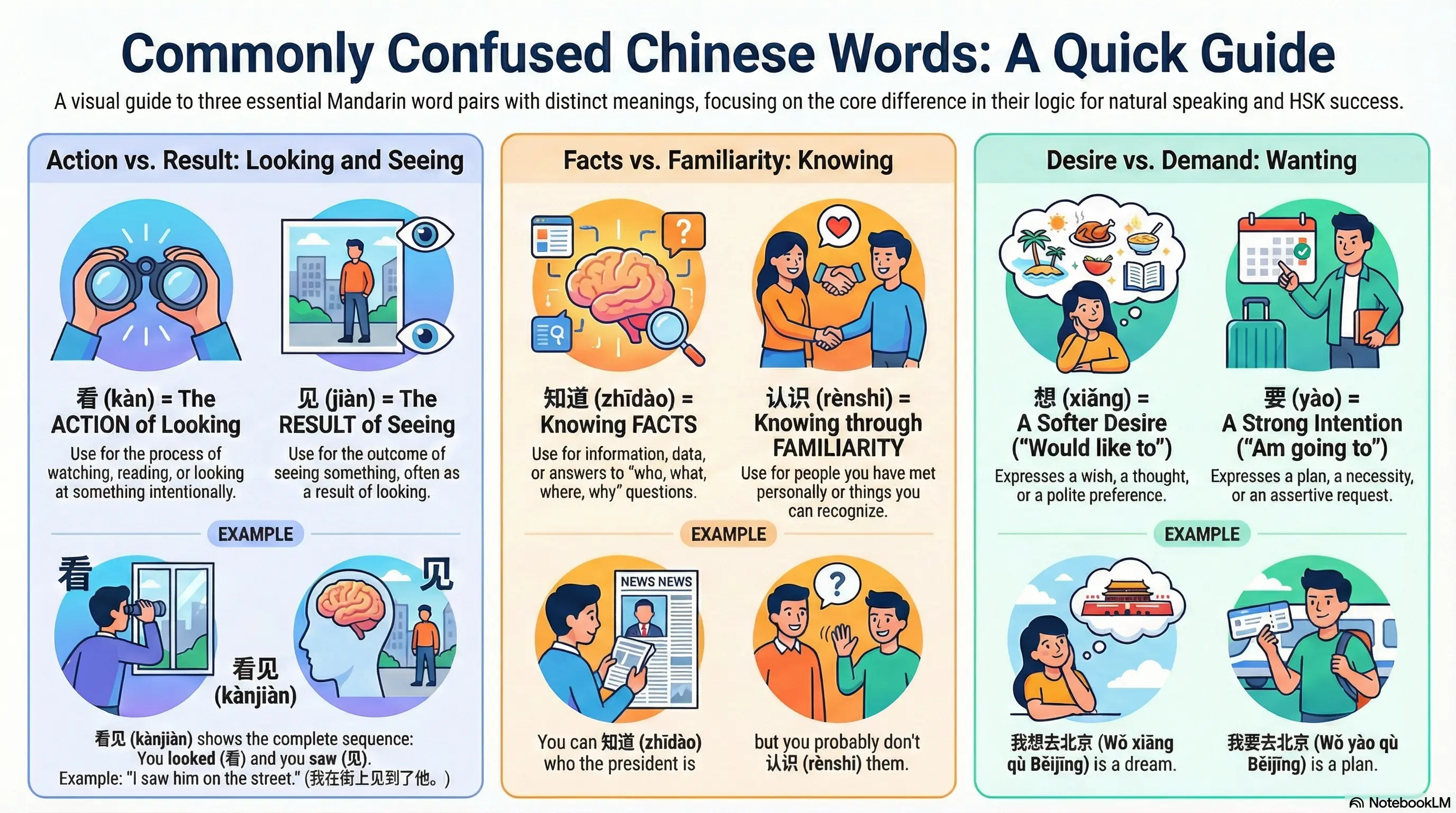
You don't need to master 见 (jiàn) right now, but recognizing this action-result pattern is a powerful analytical tool that will clarify many verb constructions in Mandarin.
Putting Verbs into Action: SVO Sentences
Let's integrate these new verbs into the Subject-Verb-Object (SVO) sentence structure you already know. Remember the pattern: Subject + Verb + Object.
Here are some examples using your new verbs and vocabulary from previous lessons:
- To eat: 我 吃 米饭。 (Wǒ chī mǐfàn.) - I eat rice.
- To drink: 她 喝 茶。 (Tā hē chá.) - She drinks tea.
- To read/look at: 我 看 书。 (Wǒ kàn shū.) - I read a book.
- To speak: 他 说 汉语。 (Tā shuō Hànyǔ.) - He speaks Chinese.
- To write: 我 写 字。 (Wǒ xiě zì.) - I write characters.
A Note on 睡觉 (shuìjiào)
The verb 睡觉 (shuìjiào) is what's known as a separable verb or a verb-object compound.
- 睡 (shuì) is the verb "to sleep."
- 觉 (jiào) is the noun "sleep."
So, 睡觉 (shuìjiào) literally means "to sleep a sleep." Because 觉 (jiào) already functions as the object, you do not add another object after it. You simply say:
- 我 睡觉。 (Wǒ shuìjiào.) - I sleep.
You would not say "我睡觉床" (Wǒ shuìjiào chuáng) for "I sleep in a bed." This structural insight into how characters combine to form logical units is a key part of mastering Chinese vocabulary.
Conclusion
In this lesson, you have added eight essential action verbs to your vocabulary, enabling you to describe a wide range of daily activities. You can now recognize and understand the meaning of 吃 (chī), 喝 (hē), 看 (kàn), 听 (tīng), 说 (shuō), 读 (dú), 写 (xiě), and 睡觉 (shuìjiào).
Key takeaways from this lesson include:
- Verbs don't conjugate: Chinese verbs have one form, regardless of the subject or tense.
- SVO structure: These new verbs fit directly into the Subject-Verb-Object pattern you are familiar with.
- Vocabulary Nuances: You learned the difference between
看 (kàn)(to look/read silently) and读 (dú)(to read aloud), and were introduced to the action-result concept with看 (kàn)vs.见 (jiàn). - Verb-Object Compounds: You analyzed
睡觉 (shuìjiào)as an example of a common verb structure in Chinese.
In our next lesson, we'll continue to expand your action vocabulary by focusing on verbs related to transactions and work, such as 买 (mǎi - to buy) and 工作 (gōngzuò - to work). We will also learn how to use the word 和 (hé) to connect nouns, allowing you to create more complex lists and descriptions.