Welcome back. In our last lesson, you mastered the set of personal pronouns that are essential for identifying who is doing or being something in a sentence. Now, we'll put those pronouns to work by learning how to construct one of the most fundamental sentences in any language: the "A is B" identification sentence.
Today's objective is to form basic identifying sentences using the verb 是 (shì) and to negate them using 不是 (bú shì). This will enable you to make simple statements of identity, such as "I am a teacher" or "He is not a student," which is a cornerstone of basic communication.
Identifying People and Objects with 是 (shì)
The verb 是 (shì) is the Chinese equivalent of the English verb "to be" in its identifying sense (am, is, are). The sentence structure is straightforward and follows a Subject-Verb-Object order that is identical to English.
The basic formula is: Subject + 是 (shì) + Noun
Let's look at the character and its structure first.
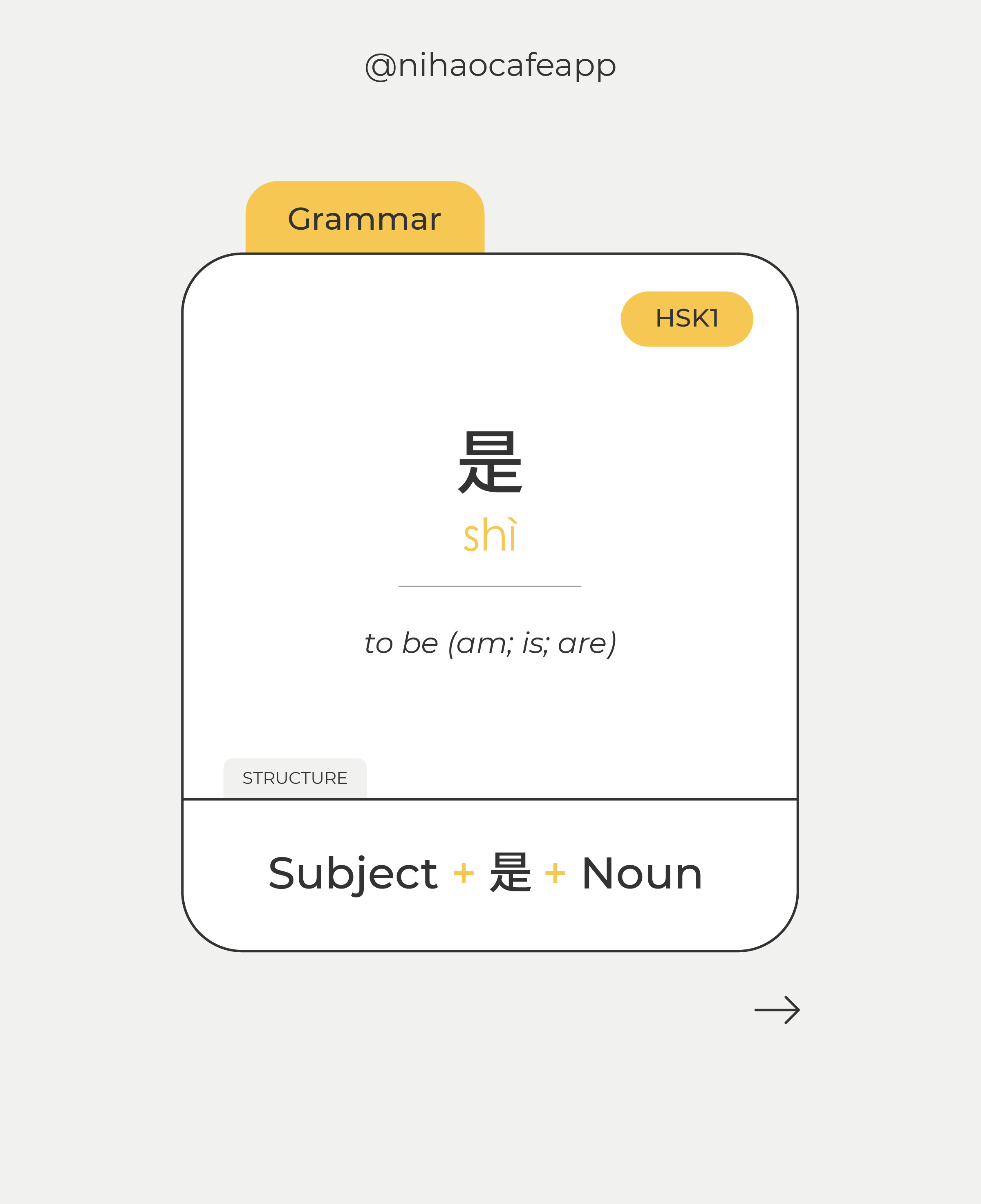
As you can see, the structure is clean and logical. A key feature of Mandarin grammar, which you may find efficient, is that verbs do not conjugate. The verb 是 (shì) remains the same regardless of whether the subject is "I," "you," or "they."
Let's combine this with the pronouns from the last lesson:
- 我是学生。(Wǒ shì xuéshēng.) — I am a student.
- 你是老师。(Nǐ shì lǎoshī.) — You are a teacher.
- 他是学生。(Tā shì xuéshēng.) — He is a student.
To hear this structure and reinforce the concept, please watch this short segment. The speaker explains the basic sentence format and the important point about verbs not changing form.
Chinese Sentence Structure ~ Learn Basic Grammar!
This video from ABChinese provides a clear, concise explanation of the basic Chinese sentence structure using 是 (shì).
Watch the section from where the presenter breaks down the "I am a student" example. Pay attention to the direct Subject-Verb-Object correspondence with English and the comment on the absence of verb conjugation.
Now, let's solidify this with a written resource. The following article provides more examples and clearly lays out the A-是-B sentence pattern.
Basic Chinese Grammar // A Simple Guide To Grammar (& Quiz!)
This article from LTL Mandarin School gives a great overview of fundamental grammar points. We'll focus on the section explaining 是 sentences.
Please read section 3, titled "The 是 (shì) Sentence". This section formally presents the Subject + 是 + Object structure and provides several clear examples. Note the point it makes about the subject and object not being reversible.
Negating Sentences with 不是 (bú shì)
Now that you can make a statement of identity, the next logical step is to negate it. In Chinese, you negate most verbs by placing the adverb 不 (bù) directly before them.
The structure is: Subject + 不 (bù) + Verb
When we apply this to our 是 (shì) sentences, we get: Subject + 不是 + Noun.
However, there is a crucial pronunciation rule you must learn, known as tone sandhi.
- The original tone of 不 is the fourth (falling) tone: bù.
- When 不 (bù) comes before another syllable that is also a fourth tone, 不 changes to the second (rising) tone: bú.
Since 是 (shì) is a fourth-tone syllable, the combination 不是 is always pronounced bú shì.
This rule makes pronunciation smoother. Saying two fourth tones in a row (bù shì) is abrupt; the bú shì contour flows more naturally.
This image provides a great visual summary of both the grammatical structure and this tone change rule.

So, our example sentences become:
- 我不是学生。(Wǒ bú shì xuéshēng.) — I am not a student.
- 你不是老师。(Nǐ bú shì lǎoshī.) — You are not a teacher.
Let's return to the video from ABChinese. The presenter gives an excellent explanation of how to use 不 and clearly demonstrates the tone change for 不是.
Chinese Sentence Structure ~ Learn Basic Grammar!
This next segment of the video explains negation, focusing on 不 and its important tone change rule.
Please watch the section from on negating sentences. Listen carefully for the change in pronunciation from bù to bú when she says wǒ bú shì xuéshēng.
Finally, to consolidate your understanding of negation with 不, please read the following guide. It focuses specifically on this character, its placement, and the tone change rule.
Say Not in Chinese: Negative in Chinese with 不 Bu - ChineseFor.Us
This lesson from ChineseFor.Us is dedicated to the negative adverb 不. It provides a focused explanation of its use.
Read the introduction and the section titled "Grammar 1: Negative in Chinese with 不". Pay close attention to the rule about placing 不 directly before the verb and the example table, which clearly shows the affirmative sentence 他 是 我弟弟 being negated to 他 不 是 我弟弟, highlighting the change.
Conclusion
In this lesson, you've acquired a fundamental tool for communication in Mandarin. By combining the pronouns from our previous session with the structures learned today, you can now make and negate basic statements of identity.
Key Takeaways:
- The A-是-B Structure: You can form identity sentences using the
Subject + 是 (shì) + Nounpattern. - Verb Invariance: The verb 是 (shì) does not change, regardless of the subject.
- Negation with 不是: To negate an identity sentence, you use the structure
Subject + 不是 (bú shì) + Noun. - Tone Sandhi for 不: You learned the critical pronunciation rule that 不 (bù) changes to a second tone (bú) when it precedes a fourth-tone syllable like 是 (shì).
You now have the ability to form statements. The next logical step is to ask questions. In our upcoming lesson, we will learn how to use the final particle 吗 (ma) to transform the sentences you learned today into simple yes/no questions, such as "Are you a student?".