Welcome to our first lesson in Module 3. Having built a solid foundation in the sounds of Mandarin with Pinyin and tones, we will now begin to assemble these sounds into meaningful words and sentences. This is where communication truly starts.
Our objective for this lesson is to learn and use the core personal pronouns: 我 (wǒ), 你 (nǐ), 您 (nín), 他 (tā), 她 (tā), 我们 (wǒmen), 你们 (nǐmen), and 他们 (tāmen). These words are the fundamental building blocks for talking about yourself and others, and they will appear in nearly every conversation you have.
The System of Chinese Pronouns
One of the most efficient features of the Chinese pronoun system is its simplicity regarding grammatical roles. Unlike English, which uses different words for subjects and objects (e.g., "I" vs. "me," "he" vs. "him"), Chinese uses the exact same pronoun for both. This elegant consistency simplifies sentence construction significantly.
Let's begin with the singular forms.
Singular Pronouns: 我, 你, 您, 他, 她
First, let's meet the most common personal pronouns. You have already encountered the Pinyin and tones for some of these in our pronunciation practice.
- 我 (wǒ): I / me (third tone)
- 你 (nǐ): you (singular, informal) (third tone)
- 他 (tā): he / him (first tone)
- 她 (tā): she / her (first tone)
Notice an interesting and important feature: 他 (tā) and 她 (tā) are pronounced identically. The distinction exists only in writing. In conversation, the meaning is derived entirely from context.
The written distinction comes from the character's radical—the component that often provides a clue to its meaning.
- 他 (tā) contains the "person" radical: 亻
- 她 (tā) contains the "woman" radical: 女
This concept of radicals as semantic metadata is a core principle of the Chinese writing system.
For "you," there is also a polite form used to show respect, similar to formal address in other languages.
- 您 (nín): you (singular, formal) (second tone)
You use 您 (nín) when addressing elders, teachers, or anyone in a position of authority. The character itself reflects this: it's the character for "you" (你) with the "heart" radical (心) underneath, implying respect that comes from the heart.
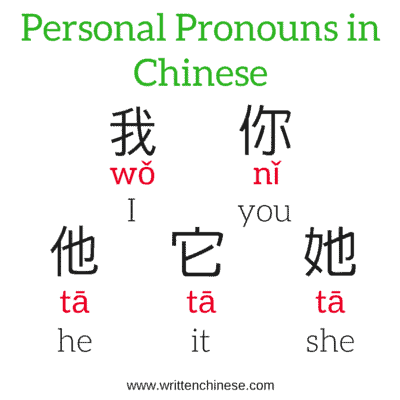
The image below provides a great visual summary of these basic pronouns. It also includes 它 (tā) for "it," which follows the same pronunciation pattern.
Making Pronouns Plural: The Suffix 们 (men)
Creating plural personal pronouns follows a simple, consistent rule: you add the suffix 们 (men) to the singular form. This suffix is always pronounced with a neutral tone.
This creates a logical and predictable system:
- 我 (wǒ) + 们 (men) → 我们 (wǒmen): we / us
- 你 (nǐ) + 们 (men) → 你们 (nǐmen): you (plural)
- 他 (tā) + 们 (men) → 他们 (tāmen): they / them
The pronoun 他们 (tāmen) is used for groups of males or for mixed-gender groups. There is a specific written form for all-female groups, 她们 (tāmen), which uses the "she" character but is pronounced identically. For HSK 1, the key is to recognize that 他们 (tāmen) is the default for "they."
Let's take a moment to hear all these pronouns spoken by a native speaker.
The Personal Pronouns in Mandarin Chinese | Beginner Lesson 5 | HSK 1
This short video from Harbin Mandarin provides clear pronunciation for each of the pronouns we are learning today. Listen carefully to the tones and the neutral tone on 们 (men).
Please watch the following clips to practice your listening and pronunciation: I / me: wǒ You: nǐ He / She: tā Plural forms: wǒmen, nǐmen, tāmen
Consolidating Your Knowledge
Now that you have the basic structure, let's solidify this knowledge and learn a few important nuances by reading a concise guide.
Chinese pronouns – forms, usage, pronoun drop, and examples
This article from Preply provides a clear, comprehensive overview of the personal pronouns and their usage. It will reinforce what we've covered and introduce some common pitfalls for beginners.
Please read the following sections carefully: First, examine the table under the heading "Chinese personal pronoun forms". This table neatly summarizes the singular and plural forms. Note that it includes 咱们 (zánmen), an "inclusive we," and pronouns for "it" and "all-female they," which are useful for context but are not part of today's core HSK 1 vocabulary list. Next, read the short subsection on second-person forms. This will reinforce the distinction between the informal 你 (nǐ) and the polite 您 (nín). Then, read the subsection on third-person forms, which explains the crucial point that 他, 她, and 它 sound identical in spoken Chinese. Finally, review the section "Chinese pronoun mistakes". This is highly practical, as it highlights common errors such as mixing up the written forms of 他/她 and the incorrect way to form a polite plural "you."
Self-Assessment
To ensure you have mastered today's vocabulary, try the brief exercise in the article you just read. In the section "Complete the sentences," you will find four questions under the sub-heading
After you've written down your answers, scroll down to the bottom of the article to check your work in the
Conclusion
In this lesson, you've taken a significant first step into Chinese grammar by mastering the core personal pronouns. These are the words you will use constantly to anchor your sentences.
Key Takeaways:
- Core Pronouns: You can now recognize and understand 我 (I/me), 你 (you), 您 (you, polite), 他 (he/him), and 她 (she/her).
- Pluralization Rule: You know how to form plural pronouns by adding the neutral-tone suffix 们 (men), creating 我们 (we/us), 你们 (you, plural), and 他们 (they/them).
- System Efficiency: You understand two key features of the Chinese pronoun system: pronouns do not change form for subject or object, and third-person pronouns (他, 她, 它) are only distinguished in writing, not speech.
- Radicals as Clues: You've seen how radicals like 亻, 女, and 心 provide semantic clues about a character's meaning.
With these pronouns as your subjects, you are now ready to start building complete sentences. In our next lesson, we will introduce the verb 是 (shì), which means "to be." By combining these pronouns with 是, you will be able to form fundamental identifying sentences like "I am a teacher" or "He is a student."