Hello! Welcome to your next lesson.
In our previous session, we established that the 5G Service-Based Architecture (SBA) uses web technologies like REST APIs and HTTP/2, which makes the 5G core vulnerable to familiar web-style attacks. Today, we'll explore one of the most significant features enabled by this flexible architecture: network slicing.
This concept is a cornerstone of 5G's promise to support a vast range of applications, from smart cars to massive IoT deployments. However, it also introduces a new and complex security paradigm. Our goal for this lesson is to explain the concept of network slicing and potential cross-slice security risks.
You can think of network slicing as being analogous to multi-tenancy in a cloud environment. Just as multiple customers run isolated virtual machines on the same physical server, network slicing allows a mobile operator to run multiple virtual networks on the same physical infrastructure. And just like in cloud security, the most critical question is: how strong is the isolation between those tenants?
What is Network Slicing?
At its core, network slicing is a way to divide a single physical 5G network into multiple virtual, end-to-end logical networks. Each "slice" is tailored with specific characteristics to serve a particular application or customer. For example:
- A slice for autonomous vehicles might be optimized for ultra-low latency and high reliability (URLLC).
- A slice for streaming video would prioritize high bandwidth (eMBB).
- A slice for IoT sensors could be designed for massive numbers of low-power, low-data devices (mMTC).
To get a quick and clear introduction to this idea, please watch the first part of the following video.
MAJOR 5G Vulnerabilities Discovered...
The video 'MAJOR 5G Vulnerabilities Discovered...' from Seytonic provides a concise, high-level overview of why network slicing is a key innovation in 5G.
Watch from 01:01 to 02:23. Focus on how slicing moves away from the 'one-size-fits-all' model of previous generations to a customized approach for different device types.
Now that you have the high-level concept, let's dive a bit deeper into the technical definition. The key principle is that a slice is an end-to-end construct, spanning the radio access network (RAN), the core network, and the transport network that connects them.
5G Network Slicing - Deep Dive
For a more formal definition, watch the introductory segment of the '5G Network Slicing - Deep Dive' video from the 5G Mobile Communications channel.
Watch the first 3 minutes and 40 seconds of the video. Pay attention to the definition of a slice as a 'logical network over the same physical infrastructure' and the emphasis on end-to-end isolation.
This image provides a great visual summary of the concept, showing distinct services operating in their own dedicated slices.
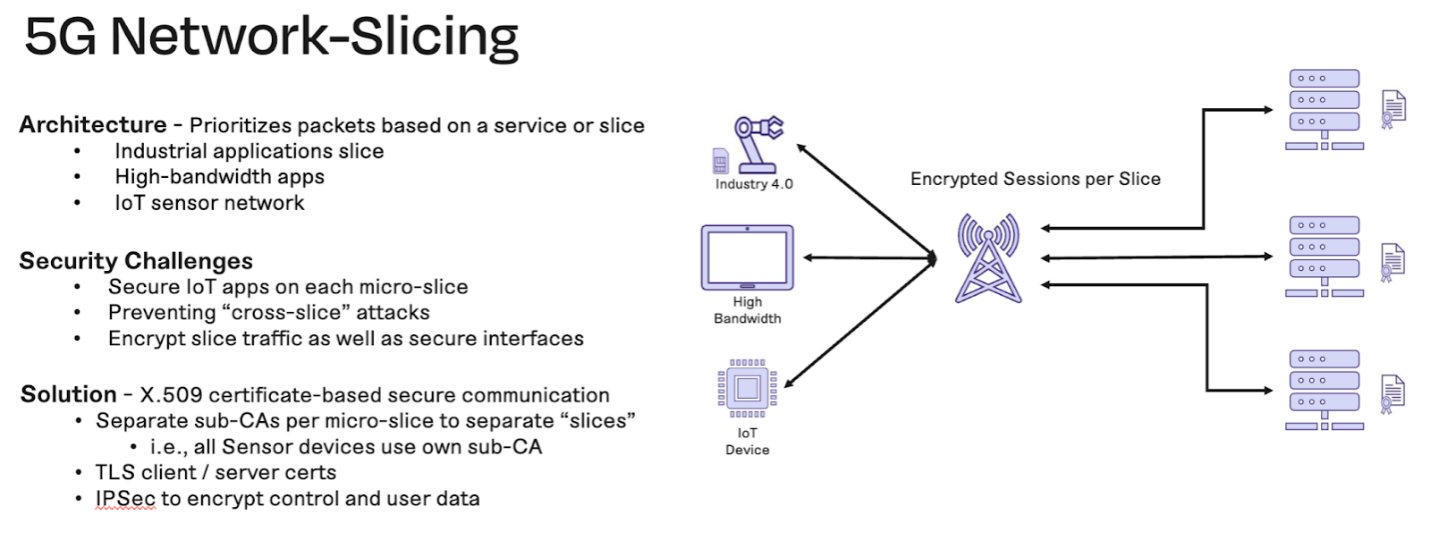
Cross-Slice Security Risks: The Illusion of Perfect Isolation
The fundamental security promise of network slicing is isolation. In theory, an event in one slice—be it a configuration error, a resource spike, or a security breach—should not affect any other slice. However, because all slices ultimately share some underlying resources, this isolation can be difficult to achieve perfectly. This gap between theoretical isolation and practical implementation is where cross-slice security risks emerge.
The following clip introduces two primary cross-slice attack vectors in a very direct way.
MAJOR 5G Vulnerabilities Discovered...
Let's return to the Seytonic video, which now pivots from explaining the concept to highlighting the vulnerabilities.
Watch from 02:23 to 03:35. The video discusses the possibility of 'slice hopping' by guessing slice IDs and performing denial-of-service attacks against one slice by exploiting another.
These attacks are possible because of the shared nature of the 5G architecture. The CISA, a U.S. government cybersecurity agency, published a document that clearly lists the security concerns introduced by network slicing.
5G Network Slicing-Security Considerations
This document from CISA provides an authoritative list of security issues related to network slicing. It directly addresses the theme of cross-slice risks.
Read the section titled 'Scope'. Find the bulleted list that begins with 'Network slicing introduces additional security concerns...'. This list is a concise summary of the key cross-slice risk areas.
As you can see from that list, the risks are varied, ranging from denial of service and resource exhaustion to side-channel attacks and failures in authentication between slices.
A Structured View of Slicing Attacks
To better understand these risks, it's helpful to categorize them based on the part of the architecture they target. The following academic paper provides an excellent framework for thinking about security challenges and attack vectors in network slicing.
5G Network Slicing: Security Challenges, Attack Vectors, and Mitigation Strategies
The paper '5G Network Slicing: Security Challenges, Attack Vectors, and ...' offers a structured analysis of security issues. We'll start with the high-level challenges.
Read Section 3.1, 'Technical Challenges,' and review Table 3. This section details problems like 'Slice Isolation Issues' and risks from 'Virtualization and Shared Resources,' which are the root causes of cross-slice vulnerabilities.
The paper then breaks down these general challenges into a specific, layered attack taxonomy. This is where your web security background will be particularly useful, as many of these attack vectors target the management and orchestration systems that, as we learned in the last lesson, are often built on web technologies.
This diagram shows the high-level management architecture that orchestrates these slices. A vulnerability in any of these management components could potentially impact all slices under its control.

Now, let's examine the specific attack vectors within this architecture.
5G Network Slicing: Security Challenges, Attack Vectors, and Mitigation Strategies
Let's continue with the same paper, now looking at its detailed attack classification.
Review Table 6 in Section 4, which lists threats across different architectural layers. Then, read Section 5 ('Discussion') and review Table 7. Focus on the threats related to 'Inter-Slice Communication' and 'Slice Isolation,' as these are the most direct examples of cross-slice attacks. Note how 'Resource Management' attacks can also create a cross-slice DoS condition.
Key Cross-Slice Attack Vectors
Synthesizing from these resources, we can identify three primary categories of cross-slice attacks:
-
Unauthorized Access and Lateral Movement ("Slice Hopping")
This occurs when an attacker in one slice gains access to the resources or data of another. This is the telecommunications equivalent of a compromised web application on a shared host being used to attack other applications on the same server.- Mechanism: An attacker could exploit weak authentication in the management APIs, guess a predictable Slice ID (known as an S-NSSAI), or find a vulnerability in a shared Network Function (e.g., a common AMF) to pivot from a low-security slice (e.g., for IoT sensors) to a high-security one (e.g., for government communications).
- Impact: Confidentiality and integrity breach, privilege escalation.
-
Resource Exhaustion (Cross-Slice Denial of Service)
This happens when one slice consumes a disproportionate amount of shared physical resources (like CPU, memory, or radio spectrum), degrading the performance of or denying service to other slices.- Mechanism: A compromised device or malicious slice tenant could intentionally generate massive amounts of traffic or processing load. Without proper resource quilting and rate limiting by the orchestration layer, this load can "leak" out and starve other slices.
- Impact: Availability failure for critical services. A DoS attack on a "smart toaster" slice could potentially impact an emergency services slice if isolation is not properly enforced.
-
Side-Channel and Information Leakage
This involves inferring information about one slice by observing the behavior of the shared infrastructure from another slice.- Mechanism: By monitoring subtle changes in CPU cache, memory access patterns, or network timing on the shared hypervisor or hardware, an attacker in one slice might be able to glean sensitive information about the data or operations in another, even without direct access.
- Impact: Confidentiality breach.
Conclusion
In this lesson, we demystified the concept of network slicing and explored the critical security challenges it presents. While slicing offers unprecedented flexibility for mobile operators, it hinges on the strength of the isolation between virtual networks.
Key Takeaways:
- Network Slicing is the creation of multiple virtual, end-to-end logical networks on top of a single physical 5G infrastructure, each tailored for a specific use case.
- Isolation is the Core Security Principle: The main goal is to ensure that slices are independent and that events in one do not affect others.
- Cross-Slice Risks are Real: Because slices share resources (hardware, hypervisors, network functions, management systems), perfect isolation is challenging, creating opportunities for attackers.
- Key Attack Vectors: The primary cross-slice threats include unauthorized access (slice hopping), resource exhaustion (cross-slice DoS), and information leakage through side channels.
- The Attack Surface is at the Seams: Vulnerabilities are most likely to be found in the components responsible for managing, orchestrating, and separating the slices.
Preview of the Next Lesson:
We have now covered several key architectural and security concepts in 4G and 5G. It's time to move from theory to practice. In our next lesson, we will begin the exciting process of building our own 5G security test lab. You will learn how to configure Open5GS and srsRAN for a basic 5G Standalone (SA) network. This will be the foundation for the hands-on attacks we will perform in later modules.