Hello and welcome back.
In our previous lesson, we explored how tools like SnoopSnitch and Ray Hunter can detect fake base stations from a user's perspective. We saw that detection relies on spotting anomalies in the radio signals a device receives.
Today, we shift our perspective from the individual user to the network operator. We'll explore the "blue team" strategies that a Mobile Network Operator (MNO) can employ at a massive scale to protect its subscribers. This lesson focuses on the defensive side of the cellular security arms race.
By the end of this lesson, you will be able to describe common operator-side countermeasures against rogue base stations and downgrade attacks.
The Operator's Challenge: Finding a Needle in a Haystack
Detecting malicious activity across a network serving millions of subscribers is a formidable challenge. Unlike a single user's phone, which has a limited view, an operator has access to a vast amount of signaling data. However, cellular networks were designed to be decentralized, making a single, global view of all activity difficult to obtain by default.
To understand the unique challenges and opportunities operators face, let's start with a paper co-authored by researchers and an engineer from T-Mobile Austria.
[PDF] Network Operator Based IMSI Catcher Detection
This paper, "Network Operator Based IMSI Catcher Detection," provides an excellent overview of the problem from an MNO's point of view.
Read the 'Abstract' and 'Introduction' sections. Focus on the distinction between user-side and operator-side detection, and the core challenge mentioned: operators by default do not have a global view of their network.
As the paper highlights, operators must develop clever ways to find the subtle "footprints" left by attackers within their vast signaling logs. Let's examine some of the most effective techniques they use.
Countermeasure 1: Detection via Network-Wide Anomaly Monitoring
This approach is analogous to threat hunting in enterprise IT security, where analysts sift through logs to find patterns that indicate a compromise. For an MNO, this means analyzing signaling data from the core network.
Detecting Implausible Location Updates
One of the most revealing footprints is left when a phone is "released" from a fake base station and reconnects to the legitimate network.
When a phone moves from one Location Area to another, it sends a Location Update Request message to the network, which includes the Location Area Identity (LAI) of the previous cell it was connected to. An attacker running a fake base station often uses a custom, non-existent LAI. When the victim's phone leaves the fake cell and reconnects to the real network, it reports this fake LAI.
This creates two detectable scenarios for the operator:
- Unknown LAI: The reported previous LAI doesn't exist anywhere in the operator's network. This is a trivial catch.
- Impossible Travel: The attacker might use a real LAI from a different part of the country. An operator can detect a geographically impossible "jump"—for instance, a subscriber appearing to move from a cell in San Francisco to one in New York in a matter of minutes.
The paper you just read details this technique and its real-world complications.
[PDF] Network Operator Based IMSI Catcher Detection
Let's dive deeper into how LAI analysis works and what can cause false positives.
Read the subsection titled 'Detection of unknown, unusual or implausible origin-LAI/TAI in Location Update Requests'. Pay attention to the 'Power on at a new location' scenario (the airport example), which illustrates why this detection method requires careful correlation to avoid false positives.
Detecting Cipher Downgrades
A much stronger and more reliable indicator is the detection of cipher downgrades. As we've discussed, a common tactic for IMSI catchers is to force a device to use weak or no encryption (e.g., A5/1 or even A5/0 on 2G). A modern phone that supports strong encryption has no legitimate reason to suddenly use a weaker algorithm.
Operators can detect this by maintaining a simple database that maps a device's unique identity (its IMEI) to the strongest encryption algorithm it has ever been observed using.
- When a device first connects, its capabilities are noted.
- If that same device later connects using a weaker cipher than its recorded best, an alert is triggered.
This is a powerful technique because, barring a major software bug, a phone's hardware capabilities don't degrade over time.
[PDF] Network Operator Based IMSI Catcher Detection
The following section explains this straightforward but highly effective countermeasure.
Read the subsection 'Detection of cipher downgrades'. This method is a prime example of turning device-specific information into a high-fidelity security signal.
Physical Localization
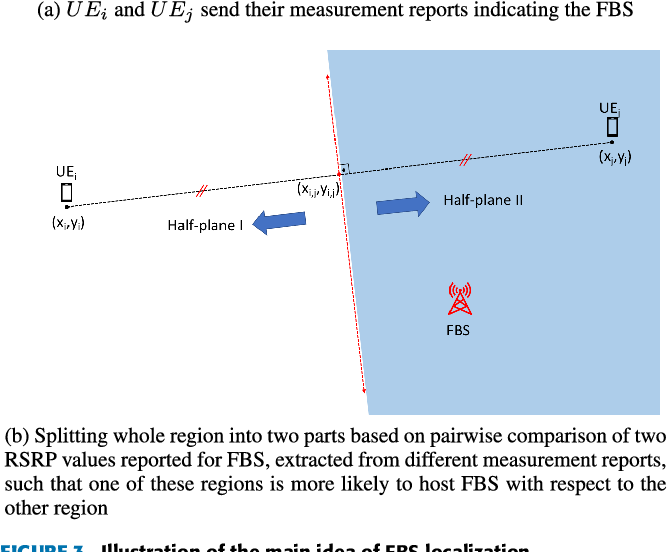
Once an operator suspects a rogue base station is active, they can move from passive detection to active localization. By collecting signal strength measurements (RSRP - Received Signal Reference Power) from multiple subscribers in the area, the operator can perform trilateration to pinpoint the physical source of the rogue signal.
Countermeasure 2: Architectural and Protocol-Level Hardening
While detection is crucial, the ideal solution is to prevent attacks from succeeding in the first place. This involves building more robust architectures and fixing protocol weaknesses.
Deploying Signaling Firewalls
In earlier modules, we touched on the vulnerabilities in core network protocols like SS7 and its 4G successor, Diameter. These protocols are used for roaming and interconnecting between different MNOs. Attackers have exploited the "trusted partner" model, where operators blindly trust signaling messages from other networks.
A key countermeasure is the deployment of Signaling Firewalls at the network edge. These are analogous to the Web Application Firewalls (WAFs) you might be familiar with. They inspect incoming Diameter and GTP (GPRS Tunneling Protocol) messages, filtering out malformed or malicious requests that could be used to track subscribers or commit fraud.
An Evolutionary Analysis of Cellular Network Security
This article discusses the evolutionary nature of cellular security and provides strategic recommendations, including the use of firewalls.
Read sections '3.2 The Diameter Protocol' and '3.3 The Tunneling Threat: GPRS Tunneling Protocol (GTP) Attacks' to understand the vulnerabilities. Then, read recommendation #2 under 'For Network Operators' in section '5.3 Recommendations for the Ecosystem', which explicitly advises implementing robust signaling firewalls.
Fixing Weaknesses in the Standard
Sometimes, vulnerabilities are discovered not in an operator's configuration but in the 3GPP standard itself. A prime example is the "bidding down" attack we've mentioned previously, which exploits the fact that device capabilities are exchanged before security is activated.
When such a flaw is responsibly disclosed, 3GPP can issue a fix in a new release of the standard. It is then up to equipment vendors and network operators to implement this fix.
New Vulnerabilities in 5G Networks
This video provides a fantastic case study of a vulnerability, its disclosure, and the resulting fix in the standard. It shows the cat-and-mouse game between researchers and standards bodies.
Watch from 29:16 to 36:28 to understand the bidding-down attack. Then, watch from 39:43 to 43:25 to learn how the vulnerability was reported and fixed in 3GPP Release 14, which mandates that capability exchange must happen after security is established.
This example shows a mature security ecosystem at work: a vulnerability is found, reported, and an architectural fix is standardized. The operator's role is to ensure their network equipment is updated to comply with the more secure standard.
Countermeasure 3: The Strategic Solutions
While the above countermeasures are tactical, there are two overarching strategic solutions that fundamentally change the security landscape.
The 5G Architectural Fix
5G was designed from the ground up to architecturally solve many of the legacy problems of 2G, 3G, and 4G.
- SUPI Concealment: To defeat IMSI Catchers, 5G mandates the encryption of the subscriber's permanent identity (SUPI) before it is ever sent over the air. The encrypted identifier is called the SUCI. This robs IMSI catchers of their primary function.
- Security Edge Protection Proxy (SEPP): To fix the insecure roaming interconnect problem, 5G introduces the SEPP. This is a mandatory security gateway at the network edge that enforces a zero-trust model, authenticating and encrypting all signaling traffic between operators. It's the architectural evolution of the signaling firewall.
An Evolutionary Analysis of Cellular Network Security
The following sections from the "Evolutionary Analysis" article explain these two foundational 5G security enhancements.
Read section '4.1 Defeating the IMSI Catcher: Subscriber Privacy with SUPI Concealment' and section '4.2 Securing a Virtualized Core: The Service-Based Architecture, SEPP...'. This will give you a clear idea of how 5G addresses these long-standing threats and provides a preview of our upcoming 5G modules.
Decommissioning Legacy Networks
The ultimate countermeasure against downgrade attacks is simple: eliminate the less secure networks. As long as 2G and 3G networks remain operational for backward compatibility, an attacker can always try to force a device down to that weakest link. The gradual shutdown of these legacy networks by operators around the world is one of the most effective security measures underway, though it is a slow and costly process driven by business and regulatory factors as much as by security.
Conclusion
Today we've seen that defending a cellular network is a multi-layered effort. Operators are not helpless against threats like rogue base stations and downgrade attacks. They can actively hunt for attackers in their networks and build stronger walls to keep them out.
Key Takeaways:
- Detection: Operators can perform network-wide monitoring to find anomalies like implausible location updates and cipher downgrades, which are strong indicators of an attack.
- Prevention: Deploying signaling firewalls for Diameter and GTP helps protect the core network from malicious requests, especially across roaming interconnects.
- Standardization: The security ecosystem evolves by identifying flaws in the 3GPP standards and issuing fixes, which operators must then implement.
- Architectural Solutions: 5G introduces fundamental solutions like SUPI concealment (to stop IMSI catching) and the SEPP (to secure interconnects), moving from tactical fixes to built-in security.
- Strategic Decommissioning: The most effective, long-term solution to downgrade attacks is the shutdown of legacy 2G and 3G networks.
Preview of the Next Lesson:
This was our final lesson on specific attack and defense techniques. In the very last lesson of this course, we will step back to discuss the broader context of this field: the legal and ethical framework that governs cellular security research and the process of responsible vulnerability disclosure.