Introduction
In our last lesson, we focused on liquidity, assessing a company's ability to meet its short-term obligations. This provided a snapshot of immediate financial health. Now, we will extend our analysis to the company's long-term financial structure and stability. This lesson addresses two critical questions: How much does the company rely on borrowed money to finance its assets? And can it comfortably afford the costs of that debt?
We will explore gearing and coverage ratios. Gearing, also known as leverage, measures the proportion of a company's financing that comes from debt compared to equity. Coverage ratios measure a company's ability to service its debt obligations, such as interest payments, from its profits. For the CB1 exam, mastering these calculations and their interpretation is essential for evaluating a company's long-term risk profile. Given your background in statistics, you'll find that these ratios provide a powerful way to quantify and interpret financial risk.
Gearing Ratios: Measuring Financial Leverage
Gearing reveals the fundamental financing decision every company makes: how to balance funding from owners (equity) against funding from lenders (debt). A company that uses a high proportion of debt is said to be "highly geared" or "highly leveraged."
Why would a company take on debt? Debt can be a powerful tool to amplify returns for shareholders. If a company can borrow money at 5% and invest it in a project that earns 10%, the excess return belongs to the shareholders. However, this leverage is a double-edged sword. Debt also introduces fixed costs (interest and principal repayments) that must be met regardless of the company's profitability, increasing financial risk.
To understand this concept and see how the main gearing ratios are calculated, let's watch a video that breaks it down with clear examples.
Gearing Ratio | A-Level, IB & BTEC Business
This video from tutor2u, "Gearing Ratio," provides an excellent introduction to the concept of gearing and the capital structure of a business. It then demonstrates how to calculate two key gearing ratios.
Please watch the following segments: What is Gearing? This section introduces the core concept of financing through equity versus debt. Debt-to-Equity Ratio: This part explains the capital structure in more detail and uses a clear example to calculate the debt-to-equity ratio, comparing two businesses with different financing structures. Gearing Ratio Percentage: This explains the most common gearing formula used in exams, which expresses debt as a proportion of total capital. Pay close attention to the formula and the benchmark figures for high and low gearing.
As the video explained, there are two primary ways to measure gearing:
-
Debt-to-Equity Ratio: This ratio directly compares the amount of total debt to the amount of shareholders' equity.
A ratio of 1.0 (or 100%) means the company has one dollar of debt for every dollar of equity. A higher ratio signifies greater reliance on debt.
-
Gearing Ratio (Debt-to-Capital): This is a very common formula that measures debt as a percentage of the total long-term capital employed.
- Non-current liabilities represent long-term debt.
- The denominator (Shareholders' Equity + Non-current Liabilities) represents the total long-term capital invested in the business.
- As a general rule of thumb, a gearing ratio above 50% is considered high, while below 25% is considered low.
The choice between high and low gearing depends on the company's context. A stable, profitable company with predictable cash flows can safely handle high gearing. A start-up or a company in a volatile industry might prefer low gearing to minimize risk.
Coverage Ratios: Can the Company Pay Its Dues?
Knowing a company is highly geared is only half the story. The next logical question is: can it afford the interest payments on its debt? This is where coverage ratios come in. They compare a company's profits to its interest and other debt-related expenses.
The most important coverage ratio is the Interest Coverage Ratio.
FINANCIAL RATIOS: How to Analyze Financial Statements
Let's turn to another video from Accounting Stuff, which clearly explains the key coverage ratios. We'll focus on the part that discusses leverage ratios from the income statement perspective.
Please watch the segment on Interest Ratios. This will explain how to calculate and interpret the Interest Coverage Ratio and the Debt Service Coverage Ratio (DSCR), which also accounts for principal repayments.
Let's summarise the key formulas.
-
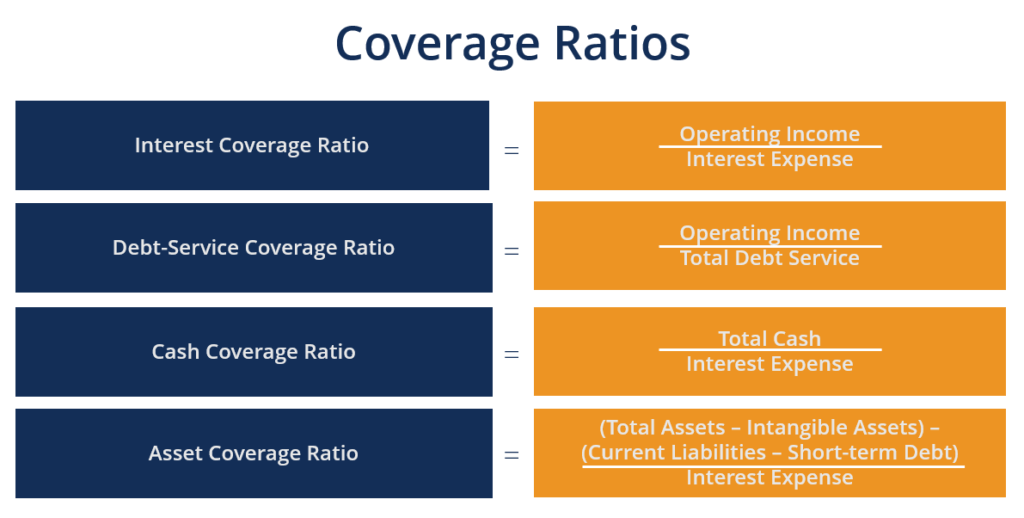
Interest Coverage Ratio (ICR): Also known as Times Interest Earned (TIE), this measures how many times a company's operating profit can cover its interest expenses.
Operating Profit is also known as Earnings Before Interest and Tax (EBIT). A higher ratio is better, indicating a stronger ability to meet interest payments. A ratio below 1.5 might be a cause for concern for lenders.
-
Debt-Service Coverage Ratio (DSCR): This is a more comprehensive measure used by lenders, especially in project finance. It includes not just interest but also principal repayments.
Where Total Debt Service = Interest Expense + Principal Repayments. A DSCR below 1.0 means the company doesn't generate enough cash to cover its debt payments.
The image below provides a useful summary of these and other related coverage ratios.
Application: A CB1 Exam-Style Problem
Let's apply these concepts to some questions straight from the CB1 specimen paper. This will give you a feel for how these topics are tested.
[PDF] Objective Based Assessment - CB1 Specimen Examination
This document contains sample questions for the CB1 exam. We will focus on a direct calculation question for interest cover.
Please locate Question 49. Read the information provided for Company Q and try to calculate the interest cover yourself before reading my explanation below. You'll need to find the relevant data in the table.
Worked Solution for Q.49 (Interest Cover):
The question provides the following data for Company Q:
- Profit before interest and tax (EBIT): 220,000
- Interest on loan capital: (22,000)
Using the formula for the Interest Coverage Ratio:
The interest cover is 10 times. This means that Company Q's operating profit is 10 times greater than its interest expense for the period. This is a very healthy ratio, suggesting a low risk of the company defaulting on its interest payments.
Now let's try another related ratio from the same paper, the Asset Coverage Ratio.
[PDF] Objective Based Assessment - CB1 Specimen Examination
Now, let's look at Question 48. This question asks you to calculate the asset cover on loan capital.
Find Question 48 and review the provided balance sheet data. The formula for Asset Cover is: (Total Assets - Intangible Assets - Current Liabilities) / Loan Capital. Try to calculate it.
Worked Solution for Q.48 (Asset Cover):
The question provides:
- Intangible assets: 200
- Property, Plant and Equipment: 700
- Current assets: 150
- Total assets: 1,050
- Loan capital: 550
- Current liabilities: 100
Using the formula for Asset Cover:
The asset cover is approximately 1.4 times (matching option B). This ratio indicates how many times the company's net tangible assets cover its long-term debt in a liquidation scenario. It gives lenders an idea of the protection they have if the company fails.
Conclusion
In this lesson, we have dissected a company's long-term financial risk using gearing and coverage ratios. You learned how to measure a company's reliance on debt and its capacity to service that debt from its earnings.
Key Takeaways:
- Gearing ratios (like Debt-to-Equity and the Gearing Ratio) measure a company's financial leverage, indicating the balance between debt and equity financing. High gearing amplifies both risk and potential returns.
- Coverage ratios (like the Interest Coverage Ratio) measure a company's ability to meet its debt-related obligations from its profits. A high coverage ratio indicates a strong capacity to service debt.
- The formulas you must know for the exam include:
- Debt-to-Equity:
- Gearing Ratio:
- Interest Coverage:
- These ratios are of primary interest to lenders and long-term investors, as they provide insight into a company's long-term solvency and financial risk.
So far, we have covered profitability, short-term liquidity, and long-term solvency. In our next lesson, we will complete our toolkit for interpreting accounts by examining efficiency ratios. These ratios reveal how effectively a company is using its assets and managing its working capital to generate sales.