In our previous lesson, we delved into the mechanics of insurance accounting, calculating the crucial liabilities known as technical provisions. You saw how insurers estimate their future obligations to policyholders through the Unearned Premium Reserve and the Loss Reserve. The sheer size of these estimated liabilities on an insurer's balance sheet raises a critical question: how can policyholders be confident that the insurer will be able to pay their claims, sometimes many years in the future?
This lesson addresses that question by exploring the regulatory principles that govern insurance company accounts. We will focus on the most important framework in Europe, Solvency II, which is designed to ensure insurers remain financially sound and can meet their promises. Your background in statistics will be valuable as we explore this risk-based system, which uses probabilistic concepts to set capital requirements. By the end of this lesson, you will be able to describe the key principles of this regulatory regime and understand how they translate into the figures on an insurer's financial statements.
The Need for a Risk-Based Rulebook: Solvency II
The fundamental business of insurance is taking on risk. To ensure this risk is managed responsibly and that policyholders are protected, a robust regulatory framework is essential. The 2008 financial crisis further underscored the need for a sophisticated, harmonised approach to financial supervision across Europe. The result for the insurance industry was Solvency II, a regime that came into force in 2016.
For a concise overview of what Solvency II is and what it aims to achieve, let's start with a short video.
Solvency II - Simply Explained in 3 Minutes
This video, "Solvency II - Simply Explained in 3 Minutes," provides a high-level introduction to the framework and its core structure.
Please watch the full video. As you watch, pay attention to the three-pillar structure, which is the foundational concept of Solvency II. Pillar 1: The quantitative, or "numbers-driven," part (this section). Pillar 2: The qualitative, governance-focused part (this section). Pillar 3: The reporting and disclosure part (this section).
As the video explained, Solvency II is a significant step up from previous, simpler regulations. It is built on a few key principles that are worth highlighting.
Solvency II - EIOPA's - European Union
This official page from the European Insurance and Occupational Pensions Authority (EIOPA) outlines the purpose and key features of Solvency II.
Please read the sections titled What is Solvency II? and What are its main features?. Focus on understanding these four characteristics: Market consistent: Assets and liabilities are valued at fair market values. Risk-based: Higher risks demand higher capital. This is a central theme. Proportionate: The rules are applied according to the size and complexity of the insurer. Group supervision: It looks at the risk of entire insurance groups, not just individual companies.
The Three Pillars in Detail
The three-pillar structure provides a comprehensive framework for supervision. While all are important, Pillar 1 is the most numerically intensive and is therefore most relevant to our focus on financial accounts.
Pillar 1: Quantitative Requirements
This pillar dictates how an insurer must value its assets and liabilities and, crucially, how much capital it must hold. The total liability to policyholders, which we called "technical provisions" in the last lesson, is broken down into two components under Solvency II:
-
Best Estimate Liabilities (BEL): This is the probability-weighted average of all future cash flows required to settle the insurance obligations. As a statistician, you can think of this as the expected value of the future claims payments, discounted to a present value using a risk-free interest rate. It is the insurer's most neutral, unbiased estimate of its liabilities.
-
Risk Margin (RM): The BEL is just an average; reality can be worse. The Risk Margin is an additional amount on top of the BEL. It is calculated to be the amount another insurer would theoretically charge to take over the portfolio of liabilities. It serves as a buffer against the uncertainty inherent in the BEL estimate.
Together, these form the technical provisions:
On top of holding assets to cover these technical provisions, an insurer must hold additional capital as a final buffer against extreme events. This is the Solvency Capital Requirement (SCR).
- Solvency Capital Requirement (SCR): This is the amount of capital an insurer needs to hold to be 99.5% confident that it can withstand the worst expected losses over a one-year period. This corresponds to a 1-in-200-year shock event, a concept straight from probability theory. If capital falls below the SCR, regulators intervene.
- Minimum Capital Requirement (MCR): This is an even lower, absolute minimum level of capital. A breach of the MCR is a much more serious event and could lead to the insurer's license being revoked.
Pillar 2: Governance & Risk Management
This pillar is qualitative. It requires insurers to have robust internal governance and risk management systems. The centerpiece is the Own Risk and Solvency Assessment (ORSA). In the ORSA, the insurer must perform its own analysis of its risk profile and determine whether the regulatory capital (SCR) is adequate. It's a formal process of self-assessment that forces the company to understand and manage its own unique risks.
Pillar 3: Reporting & Disclosure
This pillar is all about transparency. Insurers must regularly report detailed information to their supervisors and also make public disclosures about their financial health and risk profile. This includes:
- Solvency and Financial Condition Report (SFCR): A public, annual report that provides a detailed picture of the business, its performance, risk profile, and capital position.
- Regulatory Supervisory Report (RSR): A more detailed, private report submitted only to the regulator.
A Practical Calculation: The Risk Margin
To bridge the gap between regulatory principle and practical calculation, let's look at how the Risk Margin is determined. It isn't just a thumb-suck figure; it's calculated using a "Cost-of-Capital" approach.
The logic is as follows: to support the insurance liabilities, a company must hold the Solvency Capital Requirement (SCR). Holding this capital has a cost (it could have been invested elsewhere). The Risk Margin is the present value of the cost of holding the SCR over the entire lifetime of the insurance obligations as they "run-off" (i.e., as claims are paid out).
The following resource provides a detailed look at this calculation.
[PDF] H E i Ri k M i How to Estimate Risk Margins Under Solvency II
This presentation from PwC breaks down the calculation of the Risk Margin, including a worked example.
Please review the following sections: Definition and Overview: Read the definitions on slides 3-4 (see definitions) and the calculation overview on slides 11-13 (see overview). Note the fixed Cost-of-Capital (CoC) rate of 6%, which is prescribed by the regulation. Calculation Method: Skim slide 37 (Proportional Approach). This is the most common simplification, where future SCR is assumed to run off in proportion to the Best Estimate Liabilities. Worked Example: Study the example on slides 38 and 39 (the example). Follow the steps: First, the future values of the BEL and SCR are projected. Then, the Risk Margin is calculated by applying the 6% CoC rate to each future year's SCR, discounting it back to the present, and summing the results. This demonstrates how a key regulatory principle is quantified.
A Brief Comparison: Solvency II vs. IFRS 17
It's important to distinguish between regulatory reporting (Solvency II) and financial accounting (IFRS). While Solvency II's primary audience is the regulator, ensuring solvency, IFRS financial statements are for investors and other stakeholders.
The new accounting standard for insurance, IFRS 17, has a similar structure to Solvency II but with some key differences. The image below compares the liability side of the balance sheet under both frameworks.

Under IFRS 17, the liability for future policy benefits is made up of:
- Present Value of Future Cash Flows (PVFCF): Conceptually similar to the BEL.
- Risk Adjustment (RA): A buffer for uncertainty, conceptually similar to the Risk Margin.
- Contractual Service Margin (CSM): This is the key difference. The CSM represents the unearned profit in the insurance contracts. It is recognised as profit in the income statement over the life of the policies as services are provided. Its purpose is to prevent an insurer from booking a large "day one profit" when it signs a new, profitable contract.
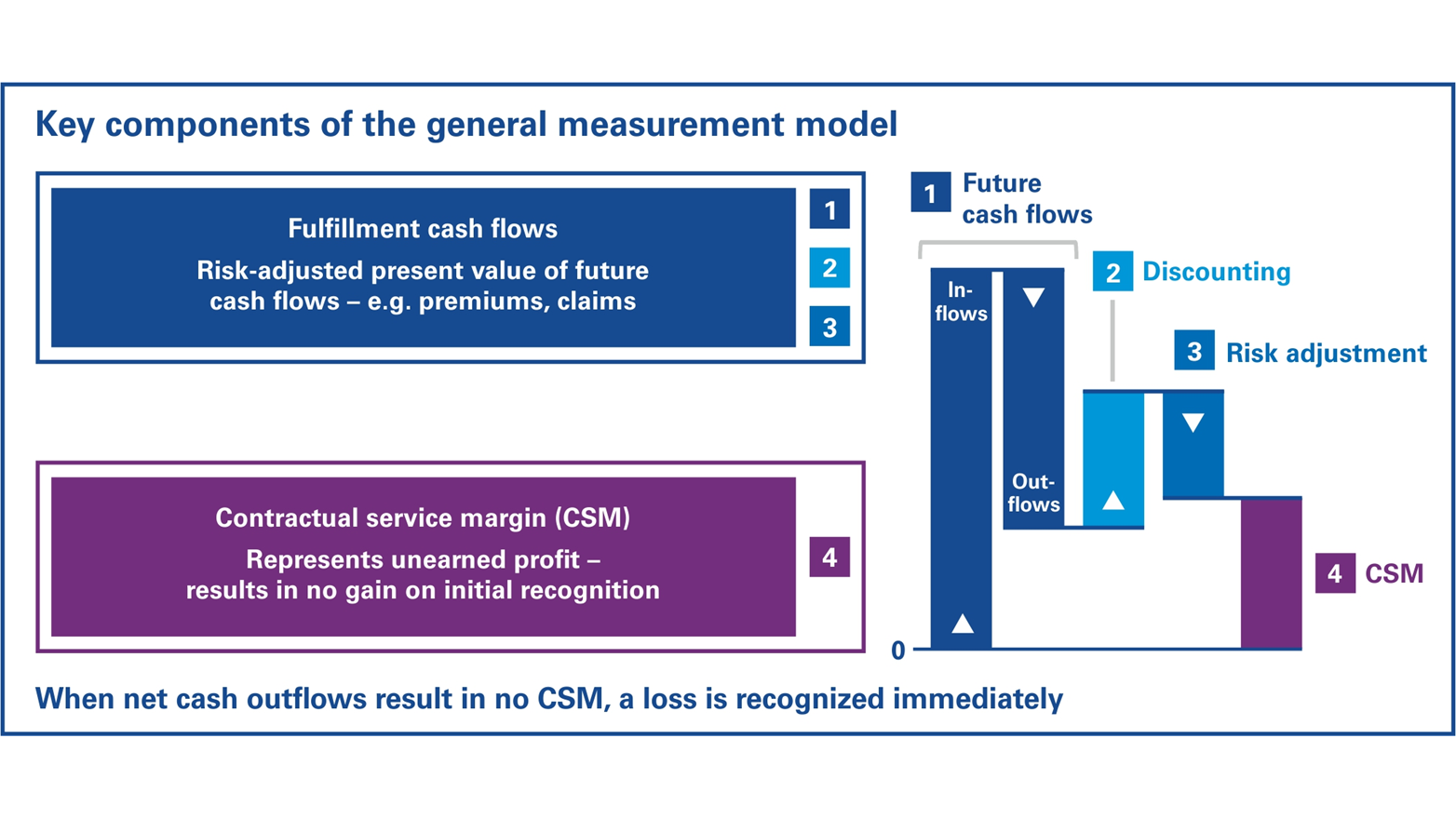
You are not required to know the details of IFRS 17 for the CB1 exam, but seeing this comparison helps solidify your understanding of Solvency II by placing it in the broader context of insurance reporting.
Conclusion
In this lesson, we have unpacked the principles that ensure insurance companies can withstand financial shocks and meet their obligations. We saw that the Solvency II framework, built on its three pillars, provides a comprehensive, risk-based approach to regulation.
Key Takeaways:
- The primary goal of insurance regulation is to protect policyholders.
- Solvency II is the key EU framework, characterised as being risk-based and market-consistent.
- Pillar 1 sets quantitative requirements. Technical provisions are split into the Best Estimate Liabilities (BEL) and the Risk Margin (RM). Insurers must also hold capital to meet the Solvency Capital Requirement (SCR), calibrated to a 99.5% confidence level over one year.
- Pillar 2 focuses on internal governance and risk management, centered on the ORSA.
- Pillar 3 mandates public and private reporting to ensure transparency.
- Regulatory components like the Risk Margin are not arbitrary but are derived from specific calculations, such as the Cost-of-Capital method.
We have now examined the specific accounting practices for both group companies and insurance companies. In the next lesson, we will complete this module by turning our attention to the third and final specialised industry: banking. We will explore their unique financial statements and the key regulatory principles, like capital adequacy, that govern their operations.