Welcome back. In our previous lesson, we established the fundamental principles of group accounting, answering why and when consolidated financial statements are necessary. We learned that the trigger for consolidation is 'control' and that the goal is to present a parent and its subsidiaries as a single economic entity.
This lesson marks our shift from the 'why' to the 'how'. When one company acquires another, the first crucial calculation we must perform for the consolidated accounts is for goodwill. Goodwill is a unique asset that arises only in a business combination. By the end of this lesson, you will be able to apply the standard formula under IFRS 3 to calculate the goodwill arising on the acquisition of a subsidiary, a core skill for preparing consolidated financial statements.
1. The Nature of Goodwill
When a parent company acquires a subsidiary, it often pays a price that is higher than the fair value of the subsidiary's identifiable net assets (i.e., its assets minus its liabilities). Why would a company willingly pay this premium? The premium pays for valuable economic benefits that are not recorded as separate assets on the subsidiary’s own balance sheet. These can include:
- A strong brand reputation
- A loyal customer base
- Proprietary technology
- Synergies expected from combining the businesses
This premium is called goodwill. It is recognised as an intangible non-current asset in the consolidated statement of financial position.
Group SFP - Goodwill - ACCA Financial Reporting (FR)
To build an intuition for this concept, watch the first part of the video "Group SFP - Goodwill" from OpenTuition.
Watch from the introduction. The presenter clearly explains the commercial reasons why goodwill arises and why it's recognised as an asset upon consolidation.
2. The Formula for Calculating Goodwill
The calculation of goodwill at the date of acquisition is governed by IFRS 3, Business Combinations. The formula is a cornerstone of consolidation accounting and one you should commit to memory.
The general structure is:
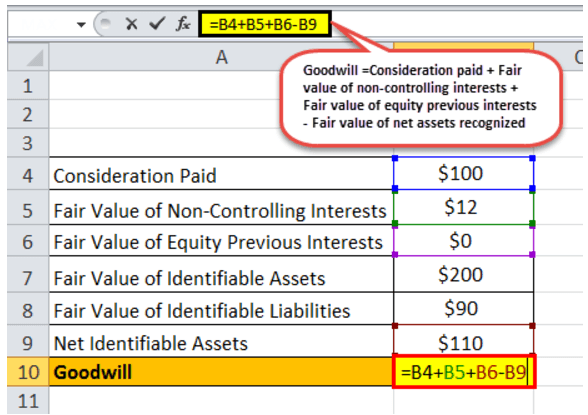
Let's break down each component.
Consideration Transferred
This is what the parent gives to the former owners of the subsidiary to gain control. It's often more complex than a simple cash payment.
Accounting for goodwill | ACCA Global
The article "Accounting for goodwill" from ACCA Global provides an excellent breakdown of the different forms consideration can take. This level of detail is crucial for exam questions.
Please read the section titled "1. Consideration paid". As you read, note the specific accounting treatment for: Deferred consideration: cash payable in the future, which must be discounted to its present value. Contingent consideration: future payments dependent on certain events, recognised at fair value. Share consideration: the parent issuing its own shares, valued at the parent's share price at the acquisition date. Acquisition costs: these are expensed and are not included in the goodwill calculation.
Fair Value of Net Assets Acquired
This is the value of the subsidiary’s assets less its liabilities at the acquisition date. It's important to use the fair values of these items, which may differ from the carrying amounts in the subsidiary's own books (their 'book value').
Non-Controlling Interest (NCI)
When a parent acquires a subsidiary but does not purchase 100% of its shares (e.g., it buys 80%), the remaining portion (20%) is owned by outside shareholders. This is the Non-Controlling Interest. For the goodwill calculation, we need to place a value on the NCI's stake at the acquisition date. IFRS 3 provides two methods for this, and the choice has a direct impact on the value of goodwill.
3. The Two Methods for Valuing NCI and their Impact on Goodwill
The two methods for valuing NCI at acquisition are:
-
The Fair Value Method: The NCI is valued at its fair value at the acquisition date. This is often determined by the market price of the subsidiary's shares. This method leads to what is called full goodwill, as it includes goodwill attributable to both the parent and the NCI.
-
The Proportionate Share of Net Assets Method: The NCI is valued as its percentage share of the subsidiary's identifiable net assets. For an NCI of 20%, you would take 20% of the fair value of the subsidiary's net assets. This method leads to partial goodwill, as it only recognises the goodwill attributable to the parent.
The following video walks through a numerical example applying both methods, which is the best way to understand the difference.
Group SFP - Goodwill - ACCA Financial Reporting (FR)
Let's return to the OpenTuition video on goodwill. The presenter will now introduce the formula and apply it using both NCI valuation methods.
First, watch the overview of the goodwill calculation. Then, carefully follow the two worked examples: The calculation using the proportionate share method. The calculation using the fair value method. Notice how the Consideration Paid and Net Assets figures remain the same in both calculations; only the NCI value changes, which in turn changes the final goodwill figure.
To solidify this, let's review a concise textual example that mirrors the video's calculations.
IFRS 3, Business Combinations - ACCA Global
This article from ACCA Global provides another clear illustration of the two methods.
Please read the section under the heading "Goodwill and non-controlling interests". Focus on Example 1, comparing Method (i) (fair value) with Method (ii) (proportionate share).
4. Full vs. Partial Goodwill: The Conceptual Difference
You might wonder why two different goodwill figures are possible. The choice of NCI valuation reflects two different perspectives on what "goodwill" represents on the consolidated statement.
-
Full Goodwill (from the Fair Value method): The consolidated statement of financial position includes 100% of the subsidiary's assets and liabilities. The full goodwill method argues that if we are consolidating 100% of the assets, we should also recognise 100% of the goodwill, including the portion attributable to the non-controlling shareholders.
-
Partial Goodwill (from the Proportionate Share method): This method takes the view that the consolidated accounts should only reflect the assets that the parent has effectively "purchased." Therefore, it only includes the goodwill that the parent has paid for through its consideration.
Group SFP - Goodwill - ACCA Financial Reporting (FR)
The final section of the OpenTuition video provides a brilliant breakdown of how the 'full goodwill' figure contains components belonging to both the parent and the NCI.
Watch the explanation from the discussion on full vs. partial goodwill. The key insight here is seeing how the higher goodwill from the fair value method is the sum of the parent's share of goodwill and the NCI's share.
Under IFRS 3, a company has the choice of which method to use for each individual acquisition.
5. A Comprehensive Example
Let's apply these principles to a more exam-style question that involves a share exchange as part of the consideration.
IFRS 3, Business Combinations - ACCA Global
Let's return to the ACCA Global article on IFRS 3 and examine a more complex calculation.
Find the section with the heading "Workings" and study the sub-section "(ii) Goodwill in Savannah". Trace how each number in the calculation is derived from the problem description (which you can find just above the workings if you need context): Controlling interest (Consideration) is a mix of shares and cash. Non-controlling interest is calculated using the fair value method (1 million shares held by NCI × $3.25 share price). The fair value of net assets is deducted to arrive at the consolidated goodwill.
Conclusion
In this lesson, we transitioned from the theory of consolidation to the practical mechanics of the process. We have focused on the calculation of goodwill, a unique and important asset that arises when a parent acquires a subsidiary.
Key Takeaways:
- Goodwill represents the premium paid for a subsidiary's future economic benefits that are not separately identifiable, such as reputation and customer loyalty.
- The standard formula for goodwill is: Consideration Transferred + Non-Controlling Interest - Fair Value of Net Assets.
- Consideration can be complex, including deferred cash, contingent payments, and share exchanges, each with specific valuation rules.
- The value of goodwill critically depends on the method used to value the Non-Controlling Interest (NCI):
- Fair Value Method leads to Full Goodwill.
- Proportionate Share of Net Assets Method leads to Partial Goodwill.
We have established how to calculate the NCI value at the date of acquisition for the goodwill calculation. However, the NCI is also a component of group equity that must be updated at the end of each reporting period. In our next lesson, we will delve into the calculation of NCI at both the acquisition and reporting dates, a crucial step in preparing a complete consolidated statement of financial position.