In our previous lesson, we focused on calculating goodwill, where we saw that the Non-Controlling Interest (NCI) is a key component of the formula. We established how to determine its value at the date of acquisition. Now, we will give NCI our full attention.
This lesson delves into the calculation of non-controlling interest, not just at the point of acquisition but also at subsequent reporting dates. Mastering this is essential, as NCI is a mandatory line item in the equity section of any consolidated statement of financial position where the parent does not own 100% of the subsidiary. By the end of this lesson, you will be able to confidently calculate NCI for any reporting period.
1. Understanding Non-Controlling Interest
Before we dive into the calculations, let's solidify our understanding of what NCI represents. When a parent company has control over a subsidiary (typically by owning more than 50% of its shares) but doesn't own it entirely, the portion of the subsidiary's equity owned by the other shareholders is the non-controlling interest.
Accounting standards require that the consolidated financial statements show 100% of the subsidiary’s assets and liabilities, because the parent controls all of them. To balance this, we must also show the claim that these external, non-controlling shareholders have on the subsidiary's net assets. This is the NCI. It is presented within the equity section of the consolidated statement of financial position.
Non Controlling Interest in Consolidated Financial Statements
This article from DataSights provides a clear and concise explanation of the concept of NCI.
Read the introduction and the section titled "Understanding NCI". Focus on the core principle: consolidation is based on control, not just ownership percentage, and NCI is the mechanism used to account for the portion of the subsidiary not owned by the parent.
2. NCI at the Date of Acquisition: A Quick Review
As we saw in the last lesson, the value assigned to NCI at the acquisition date is the first step and is crucial for calculating goodwill. IFRS 3 permits two methods for this initial measurement:
- The Fair Value Method: The NCI is measured at its fair value on the acquisition date. This is often based on the market price of the subsidiary's shares held by the NCI. This approach leads to the recognition of 'full goodwill' (goodwill attributable to both the parent and the NCI).
- The Proportionate Share of Net Assets Method: The NCI is measured as its percentage stake in the fair value of the subsidiary's identifiable net assets. For example, a 20% NCI would be valued at 20% of the subsidiary's net assets. This leads to 'partial goodwill' (only the parent's share of goodwill is recognised).
Let's review a quick numerical comparison of these two methods.
IFRS 3, Business Combinations - ACCA Global
This technical article from ACCA Global provides a perfect side-by-side comparison of the two NCI valuation methods at acquisition.
Please read the section under the heading Goodwill and NCI. Pay close attention to Example 1. Note how in Method (i), the NCI is given as a fair value ($25m), while in Method (ii), it is calculated as a proportion of the net assets ($75m x 20% = $15m). This difference directly impacts the final goodwill figure.
3. NCI at the Reporting Date: Tracking the Movement
The NCI's value is not static; it changes after the acquisition date. The value of the NCI on the consolidated statement of financial position must be updated at each year-end to reflect its share of the subsidiary's performance during the post-acquisition period.
The calculation follows a straightforward "roll-forward" logic. We start with the NCI value at the beginning of the period, and then adjust it for its share of the subsidiary's profits and any dividends it has received. This can be remembered with the BASE mnemonic.
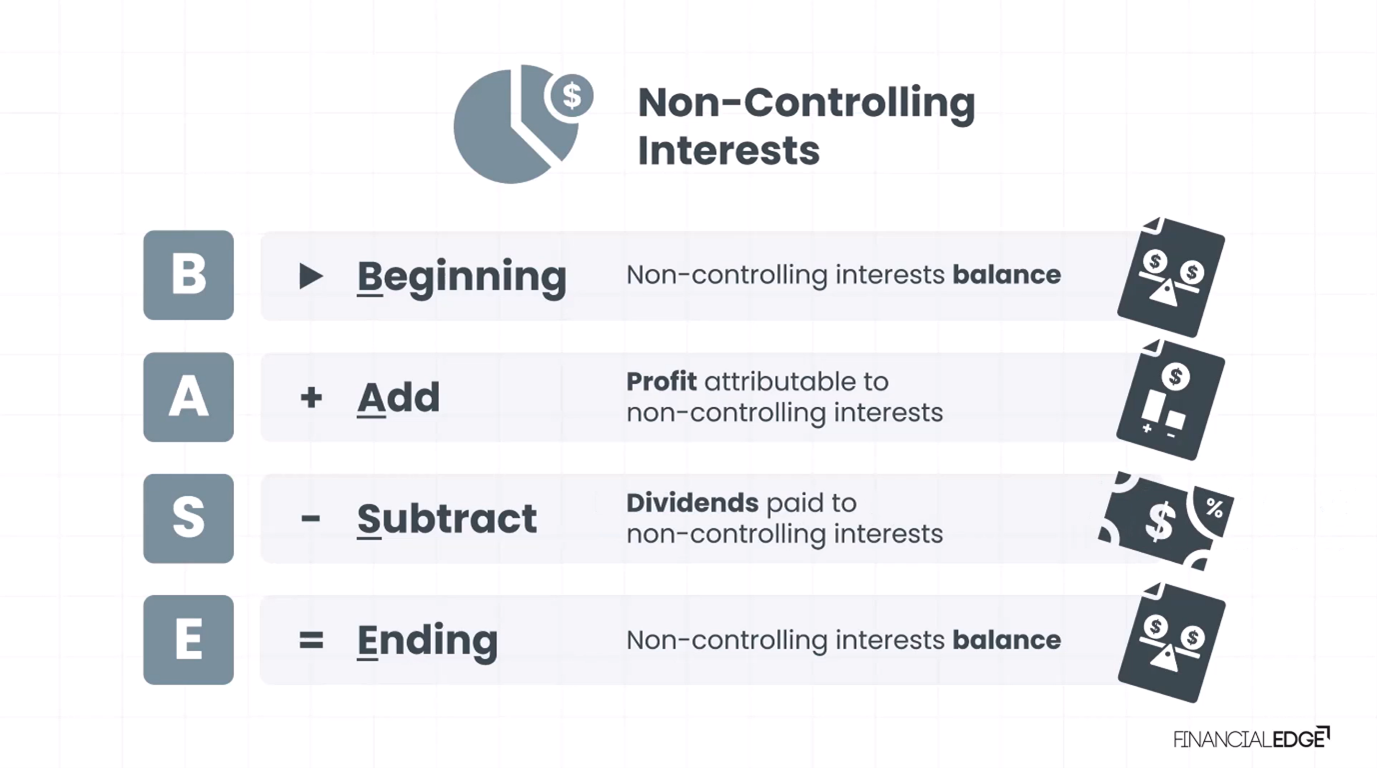
The formula is as follows:
Ending NCI = Beginning NCI + (NCI % × Subsidiary's Post-Acquisition Profit) – (NCI % × Dividends paid by Subsidiary)
Let's break this down:
- Beginning NCI: This is the NCI value at the start of the reporting period. For the first year after acquisition, this will be the NCI value calculated at the acquisition date using either the fair value or proportionate share method.
- Add Profit: The NCI is entitled to its share of the subsidiary's profits earned since the acquisition. We calculate the post-acquisition profit (usually the movement in the subsidiary's retained earnings) and multiply it by the NCI's ownership percentage.
- Subtract Dividends: If the subsidiary pays dividends, the NCI shareholders receive their portion in cash. This payment reduces their claim on the subsidiary's net assets, so we subtract the NCI's share of dividends paid.
The following video provides a comprehensive, step-by-step example of calculating NCI at both the acquisition and reporting dates. It’s an excellent demonstration of putting the theory into practice.
CIMA F1 Non-controlling interest
The video "CIMA F1 Non-controlling interest" from OpenTuition will walk us through a complete example, from setting up the consolidated statement to proving the final NCI figure.
Please watch the main example from the worked example. This is a detailed walkthrough, so feel free to pause and re-watch sections. Focus on these key stages of the calculation: Calculating NCI at Acquisition (13:00 - 14:36): The presenter calculates the subsidiary's net assets at acquisition and takes the NCI's 20% share. This is the Beginning NCI. Calculating NCI's Share of Post-Acquisition Profit (14:53 - 16:31): The presenter identifies the subsidiary's profit for the year and allocates 20% of it to the NCI. This is the Add step. (Note: this example doesn't include dividends, so there is no Subtract step). Calculating Ending NCI (16:31 - 16:37): The presenter adds the two components together to arrive at the final NCI figure for the reporting date. This example uses the proportionate share method for the initial NCI value. However, the logic for the post-acquisition movement is identical regardless of the starting point.
To confirm this, let's look at an example where the NCI was initially measured at fair value.
IFRS 3, Business Combinations - ACCA Global
Let's return to the ACCA article. It confirms the post-acquisition treatment and provides an example starting from a fair value NCI.
First, read the single, crucial paragraph that begins Subsequent to acquisition. It explicitly states that the NCI carrying amount changes by its share of post-acquisition profits. Next, look at Example 3. You don't need to study the full question, just the working for NCI. Scroll down to the Workings and find working (vii). Notice the calculation is the same as in the video: It starts with the Fair value at acquisition ($3,250k). It then adds the Post-acquisition profit attributable to the NCI (25% of the subsidiary's adjusted profit). This confirms that the roll-forward method applies universally.
4. NCI in the Broader Context
It's helpful to visualize how NCI fits into the overall valuation of the subsidiary at acquisition. When a parent buys a subsidiary, the total value of that subsidiary is allocated between the different parties and components.
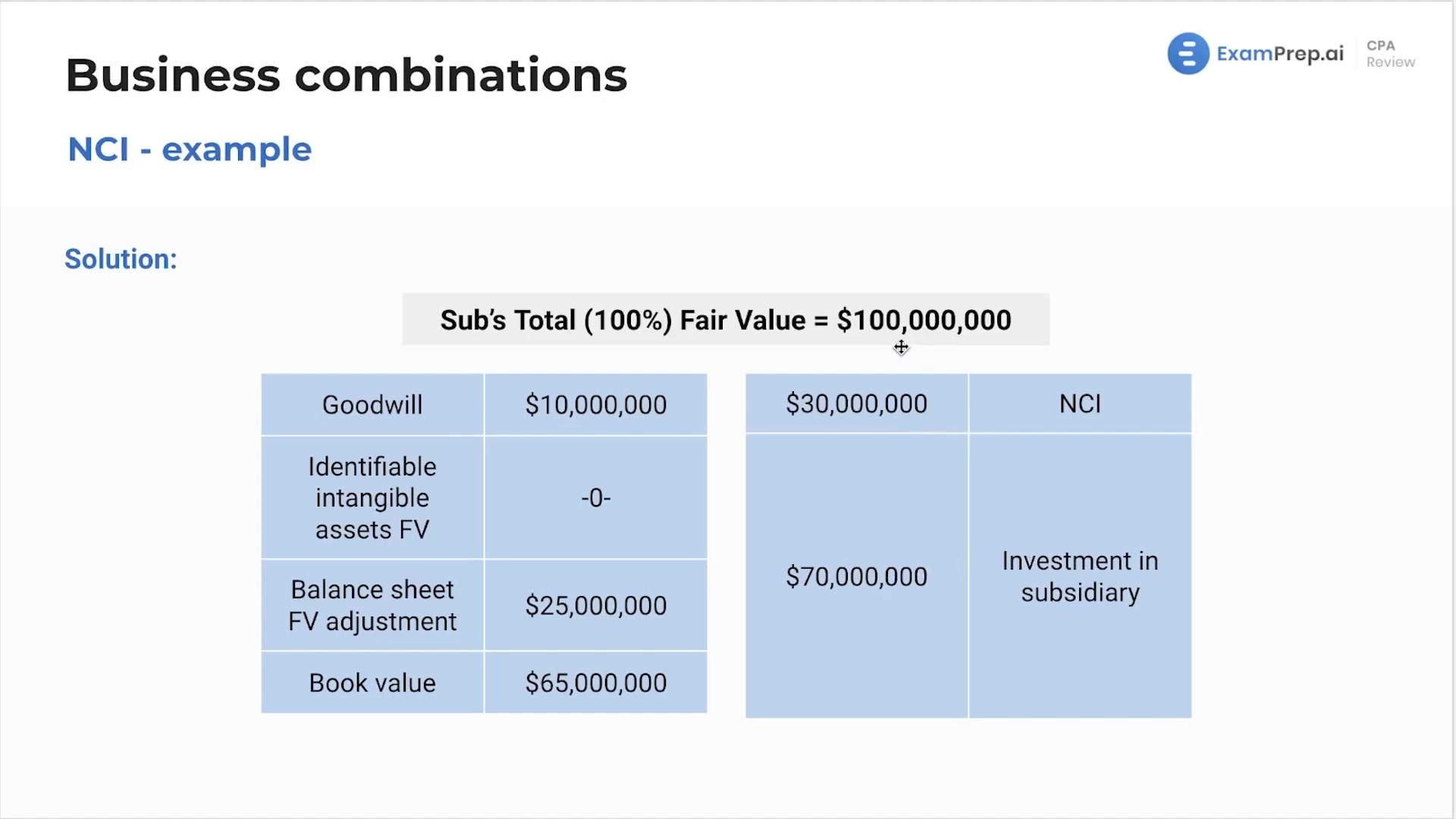
As the diagram shows, the parent's "Investment in subsidiary" and the "NCI" together represent the total claim on the subsidiary's value (its net assets plus any goodwill). After the acquisition, the parent's investment is eliminated during consolidation, and the NCI is shown as a separate component of equity.
Conclusion
In this lesson, we have focused entirely on the non-controlling interest, a key element in group accounting. You now have the tools to calculate its value at two critical points in time: at the date of acquisition and at a subsequent reporting date.
Key Takeaways:
- Non-Controlling Interest (NCI) represents the portion of a subsidiary's equity not attributable to the parent company.
- At the acquisition date, NCI can be measured at either fair value or its proportionate share of the subsidiary's net assets. This choice impacts the amount of goodwill recognised.
- At the reporting date, the NCI value is calculated by taking the beginning NCI balance, adding the NCI's share of the subsidiary's post-acquisition profits, and subtracting the NCI's share of any dividends paid by the subsidiary.
We have now examined the calculation of goodwill and NCI in detail. With these two major components understood, we are ready to assemble a complete picture. In our next lesson, we will integrate these elements and prepare a consolidated statement of financial position from start to finish.