Welcome to our next lesson. In our previous session, we examined rights issues, a method for public companies to raise additional equity capital from existing shareholders. Today, we shift our focus from pure equity to a fascinating hybrid instrument that blends the characteristics of both debt and equity: the convertible bond.
This lesson will address the learning outcome: describe the features of convertible bonds and calculate their conversion value. As you prefer a practical, calculation-based approach, we will concentrate on the mechanics and numerical valuation of these securities. Understanding convertibles is crucial as they represent a flexible financing tool for companies and a unique investment opportunity for portfolio managers.
The Anatomy of a Convertible Bond
A convertible bond is a corporate bond that gives the holder the right, but not the obligation, to exchange the bond for a predetermined number of the issuing company's common stock shares. This dual nature is its defining characteristic:
- Debt Component: Like a standard bond, it pays periodic interest (coupons) and has a principal amount (par value) that is repaid at maturity if the bond is not converted. This provides a relatively stable income stream and a "floor" value.
- Equity Component: The embedded option to convert into stock offers the potential for significant capital appreciation if the company's share price rises.
Because of this valuable equity option, issuers can offer convertible bonds with lower coupon rates than they would on comparable non-convertible (straight) debt. For the issuer, this means cheaper debt financing; for the investor, it means accepting a lower fixed income in exchange for potential equity upside.
To begin, let's establish the fundamental terminology.
CFA® Level II Fixed Income - Convertible Bonds: Features, valuation, and risk characteristics
This video from PrepNuggets provides a concise introduction to the key terms associated with convertible bonds.
Please watch the first minute, from the beginning, to familiarise yourself with the definitions of conversion period, conversion price, and conversion ratio.
As the video explained, the conversion terms are defined in the bond's indenture (the formal agreement) at issuance. The two most important terms, which are mathematically linked, are the conversion price and the conversion ratio.
- Conversion Ratio (CR): The number of common shares you receive for converting one bond.
- Conversion Price (CP): The effective price per share you are "paying" when you convert the bond.
These are linked by the bond's par value (which we typically assume to be $1,000 unless stated otherwise).
Let's solidify this with a few practical examples.
Convertible corporate bonds | Debt | Investment vehicle characteristics
The article "Convertible corporate bonds" from Achievable provides clear, step-by-step calculations for finding the conversion ratio and price.
Please read the section under the heading "Conversion logistics". Work through the two examples to see how you can calculate one of these terms if you are given the other.
Calculating Conversion Value
Now we arrive at the central calculation for this topic. The conversion value of a bond is simply the total market value of the shares that the bond can be converted into at any given time. It represents the value an investor would receive if they were to exercise their conversion option immediately.
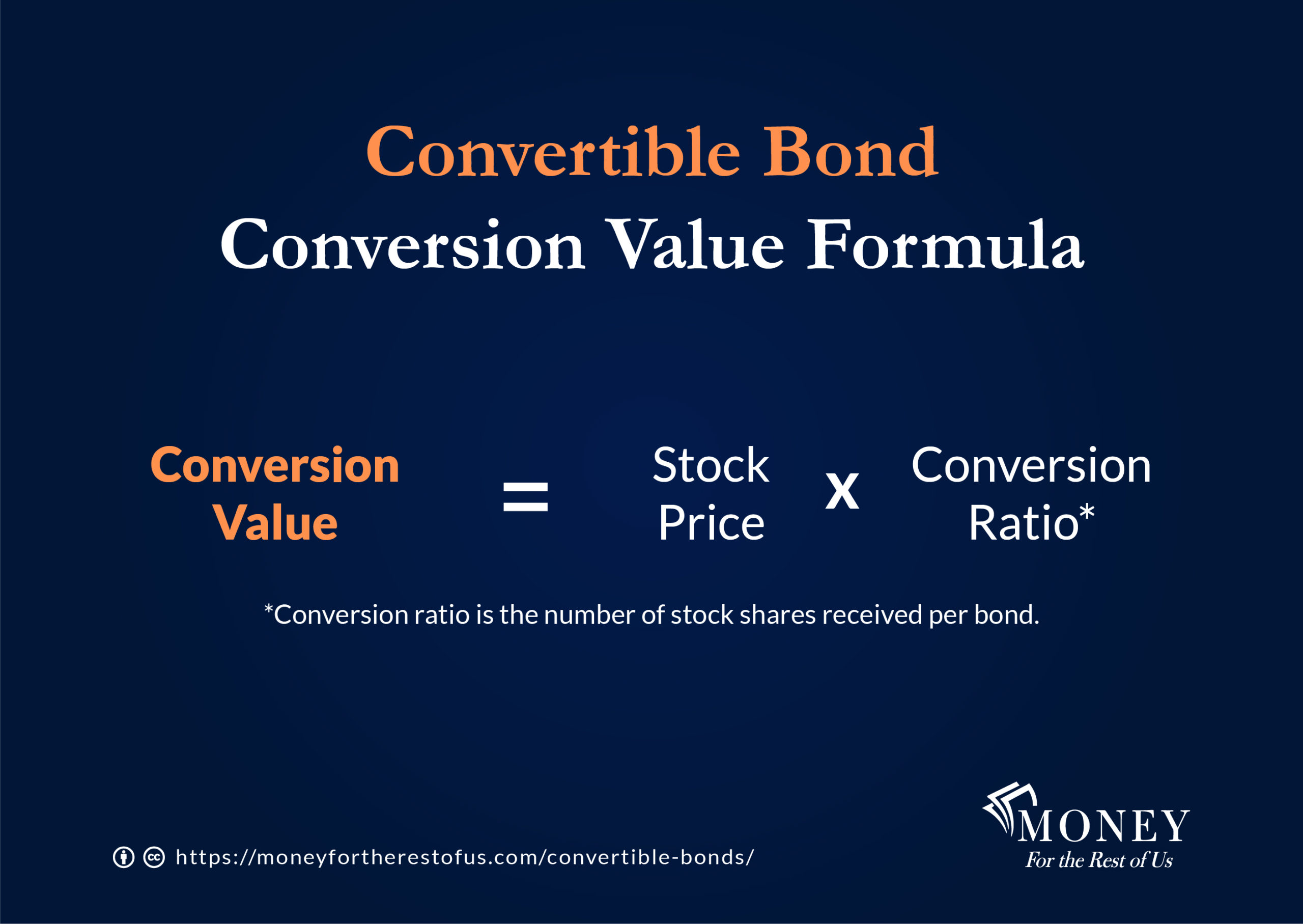
The formula is:
This value is crucial because it allows an investor to compare the value of holding the bond versus converting it into stock. A rational investor would generally not convert the bond unless the conversion value is greater than the market price of the bond itself.
Let's watch two short worked examples to see this calculation in action.
CFA® Level II Fixed Income - Convertible Bonds: Features, valuation, and risk characteristics
The PrepNuggets video we saw earlier also has a clear example of calculating the conversion value.
Watch the short segment from this timestamp for a quick demonstration.
And for a second perspective:
The video "Convertible Bonds" by Jeff Davis provides another excellent, self-contained example.
Watch from the beginning to see how the bond's features are presented and then used to calculate the conversion value. Pay attention to how the bond's market price ($1,130) is compared to its calculated conversion value ($1,040).
The difference between the bond's market price and its higher conversion value is known as the conversion premium. In the Jeff Davis example, the premium is $1,130 - $1,040 = $90. Investors are willing to pay this premium for the benefits of the bond, such as its regular coupon payments (which are often higher than stock dividends) and the downside protection offered by the bond's value as a debt instrument.
The Value Profile of a Convertible Bond
To tie these concepts together, it's incredibly useful to visualize the value of a convertible bond in relation to the underlying stock price.
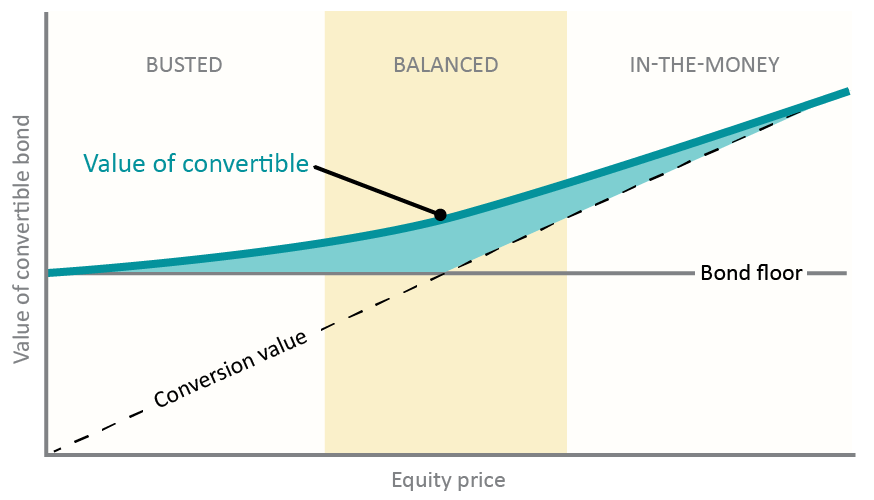
Let's break down this important graph:
- Bond Floor: This horizontal line represents the value of the convertible bond if it were stripped of its conversion feature. It's the minimum value the bond would have, based on the present value of its future coupon payments and principal repayment. This floor provides downside protection for the investor; even if the stock performs poorly, the bond's value won't fall below this level.
- Conversion Value: This dashed line represents the value we just learned to calculate (
Stock Price × Conversion Ratio). It rises linearly with the stock price. - Value of Convertible (Market Price): The solid teal curve shows the actual market price of the convertible bond. Crucially, its value is always greater than both the bond floor and the conversion value. This extra value comes from the flexibility of the embedded option—the holder has the choice to hold it as a bond or convert it to equity.
The graph highlights three distinct zones for a convertible bond's behavior:
- Busted (low stock price): Here, the stock price is so low that the conversion option is far "out-of-the-money." The conversion value is well below the bond floor. The instrument trades like a regular bond, with its value dictated by interest rates and the issuer's credit quality.
- In-the-Money (high stock price): Here, the stock price is high, making the conversion option valuable. The bond's value is primarily driven by its conversion value, and it behaves much like the underlying stock. It's effectively an equity equivalent.
- Balanced (hybrid zone): In this middle range, the bond exhibits its true hybrid nature. Both the bond floor and the conversion value influence its price. The option value is at its greatest, and the bond offers a combination of equity upside and debt-like downside protection.
Conclusion
In this lesson, we have moved from pure financing instruments to the hybrid world of convertible bonds. We've seen how they combine features of both debt and equity, offering a unique risk-return profile for investors and a flexible financing option for companies.
Key Takeaways:
- A convertible bond is a debt instrument that can be exchanged for a fixed number of common stock shares.
- Key features include the conversion ratio (shares per bond) and conversion price (effective price per share at conversion), which are inversely related.
- The conversion value is the current worth of the shares for which the bond can be exchanged. It is calculated as:
- The value of a convertible bond is supported by its bond floor (its value as straight debt) and its conversion value. Its market price is typically higher than both due to the value of the embedded conversion option.
In our next lesson, we will continue our exploration of hybrid securities by looking at warrants. While similar to the conversion feature of a convertible bond, warrants have a key structural difference: when a warrant is exercised, the holder pays new cash to receive shares, and the original bond (if any) remains outstanding. We will explore how to value these instruments.