Welcome back. In our previous lesson, we assembled the Statement of Financial Position, which gives a static snapshot of a company's assets, liabilities, and equity at a specific moment. One of the key figures in that statement is the cash balance. But how did that cash balance change from the start of the year to the end? Was it through selling products, buying equipment, or taking out loans?
This lesson answers that very question by introducing the fourth and final major financial statement: the Statement of Cash Flows (SCF). It explains the sources and uses of cash over an entire accounting period, bridging the gap between the opening and closing cash balances. By the end of this lesson, you will be able to prepare a complete Statement of Cash Flows using the common 'indirect method', classifying all cash movements into their respective categories.
1. Why Net Profit is Not Net Cash
A common misconception is that a company's net profit for the year should equal the increase in its cash balance. This is incorrect because the Income Statement is prepared using the accrual basis of accounting, not the cash basis.
Under the accrual basis:
- Revenue is recognized when it is earned, not necessarily when cash is received (e.g., a sale on credit increases revenue and accounts receivable, but not cash).
- Expenses are recognized when they are incurred, not necessarily when cash is paid (e.g., depreciation expense reduces profit but involves no cash outflow).
The Statement of Cash Flows is essential because it reconciles the accrual-based net income figure with the actual change in cash. It provides a clearer picture of a company's ability to generate cash to sustain operations, pay dividends, and make investments.
To begin, let's watch a video that introduces the Statement of Cash Flows and explains its fundamental purpose and structure.
The CASH FLOW STATEMENT for BEGINNERS
The video "The CASH FLOW STATEMENT for BEGINNERS" by Accounting Stuff provides a clear overview of why this statement is necessary and how it's structured.
Please watch the first part of the video, from the introduction. Pay close attention to the explanation of cash vs. accrual accounting and the introduction of the three main activity sections.
2. The Three Categories of Cash Flow
As the video explained, the SCF organizes all cash transactions into three distinct activities. This classification is crucial for understanding how a company is generating and using its cash.
Here are the formal definitions for each category.
[PDF] Cash Flow Construction Indirect Method Statement of Cash Flows ...
This document by Charles Mulford provides clear, concise definitions for the three types of cash flow activities.
Please read the section titled "A Closer Look at Cash Flow Classification" on page 15. As you read, think about where transactions like buying new machinery, paying a dividend, or selling goods would fit.
To summarize:
- Operating Activities: These are the principal revenue-producing activities of the business. They relate to the day-to-day operations of providing goods and services. Think of them as the cash effects of the transactions that determine net income.
- Investing Activities: These involve the purchase and sale of long-term assets and other investments not included in cash equivalents. This includes buying or selling property, plant, and equipment (PP&E) or shares in other companies.
- Financing Activities: These involve transactions with the owners and creditors of the company. This includes issuing or repurchasing shares, taking out or repaying loans, and paying dividends.
Here is an example of a completed Statement of Cash Flows, showing the three sections clearly.
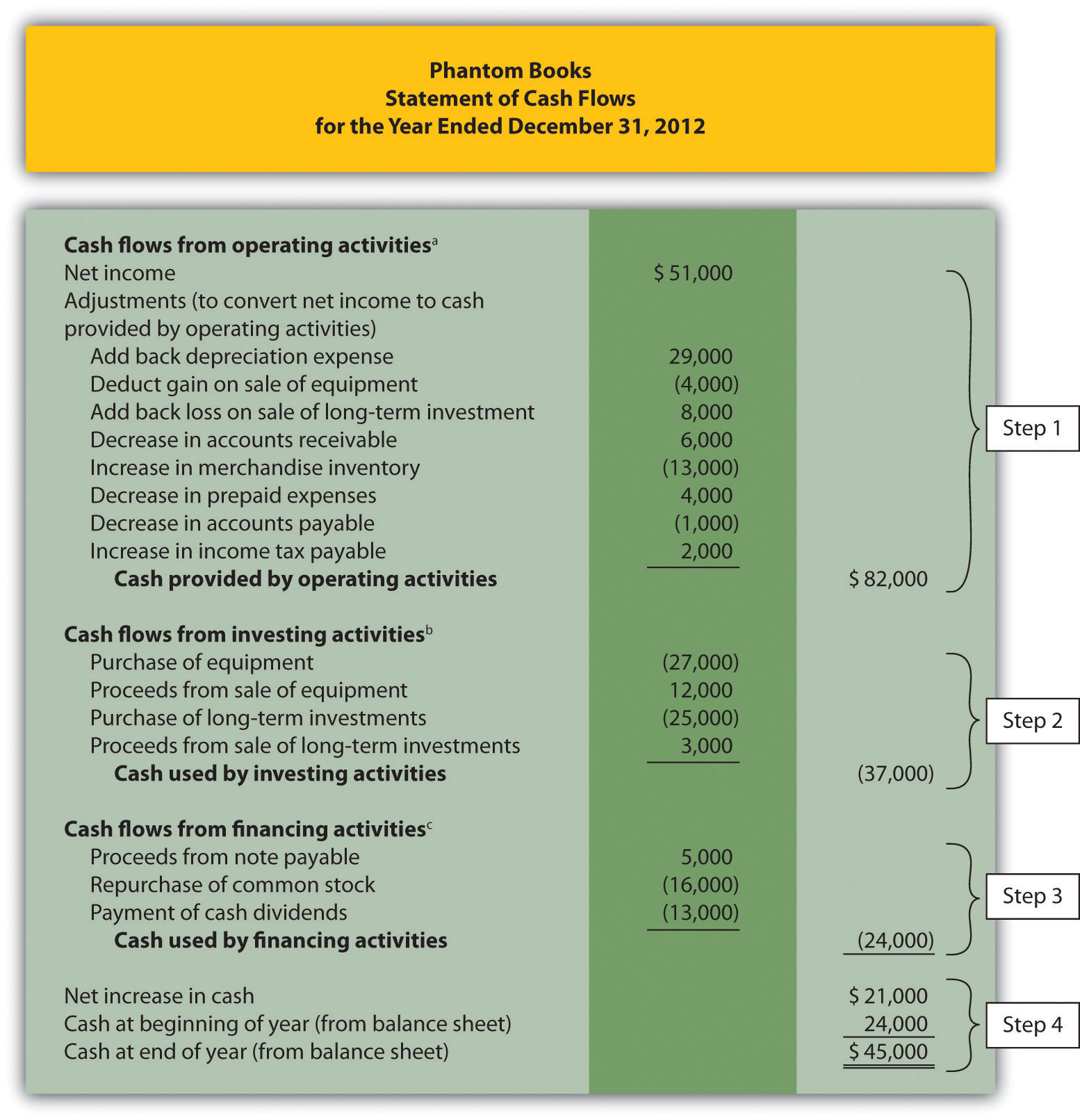
3. Preparing the Statement: The Indirect Method
There are two ways to prepare the operating activities section: the direct method and the indirect method. The vast majority of companies use the indirect method, which is what we will focus on. The investing and financing sections are prepared the same way regardless of the method used for operations.
The indirect method is essentially a reconciliation exercise. It starts with the Net Income from the Income Statement and adjusts it for two types of items to arrive at the net cash flow from operating activities:
- Non-cash items: Expenses and revenues that are included in net income but do not affect cash (e.g., depreciation, amortization, gains/losses on asset sales).
- Changes in operating working capital: Changes in current asset and current liability accounts (e.g., Accounts Receivable, Inventory, Accounts Payable).
A simple rule of thumb when adjusting for working capital changes is to ask: "Is this change good or bad for cash?"
Prepare Cashflow Statement in 10 Minutes: Indirect Method
The video "Prepare Cashflow Statement in 10 Minutes" by The Financial Controller offers a great heuristic for this process.
First, watch the brief introduction from the guiding principle where the presenter explains this rule. Then, watch the segment from calculating cash from operations, where he applies this "good or bad for cash" logic to changes in Accounts Receivable, Current Liabilities, and Inventory.
4. A Comprehensive Worked Example
Now, let's construct a full Statement of Cash Flows from scratch. This process requires three documents:
- The Income Statement for the period.
- The Balance Sheet from the beginning of the period.
- The Balance Sheet from the end of the period.
We will use a detailed, step-by-step guide to walk through the process. Your numerical background will be very helpful here, as each step is a logical calculation based on the provided data.
20.2 Statement of Cash Flows: Indirect Method Review
This guide from eCampusOntario provides the financial statements for a company, "Watson Ltd.", and walks through the entire preparation of its Statement of Cash Flows. This is the core numerical task of our lesson.
Please follow the steps in the guide carefully: Review the Data: First, familiarize yourself with the financial statements and additional information for Watson Ltd. Operating Activities: Follow the calculations for this section. Start with Step 2 & 3, where Net Income is recorded and adjusted for non-cash items like depreciation and gains. Continue with Step 4, which shows how to calculate the adjustments for changes in working capital accounts (like Accounts Receivable and Accounts Payable). The explanation of the accounting equation here provides a formal basis for the "good or bad for cash" rule. Investing Activities: Read Step 5. This is a crucial step. Notice how T-accounts are used to analyze the changes in long-term assets (Investments, Buildings) to figure out the cash paid for purchases or cash received from sales. Financing Activities: Read Step 6. This step analyzes changes in long-term debt and equity accounts (Notes Payable, Common Shares, Retained Earnings) to determine cash flows from financing. Pay special attention to how dividends paid are calculated from the change in Retained Earnings. Final Reconciliation: Finally, review Step 7 and 8, which show how the sections are summed up to reconcile the overall change in cash and list the required disclosures.
5. Your Turn: Practice Exercise
Now that you have seen a complete example, it's time to apply your knowledge. The best way to master this topic is by doing it yourself.
Below are the financial statements for a company called "Jewel's Jewelers, Inc." Your task is to prepare a Statement of Cash Flows using the indirect method. Use the same systematic approach we followed with Watson Ltd.
[PDF] Cash Flow Construction Indirect Method Statement of Cash Flows ...
This document contains a practice problem and its solution.
First, find the section titled "Preparing an Indirect-Method Format Cash Flow Statement" on pages 39-40. Using the Income Statement and comparative Balance Sheets for Jewel's Jewelers, try to construct the Statement of Cash Flows on a piece of paper. After you have made your best attempt, compare your work with the provided solution on page 59. Check your figures for each of the three activity sections.
Conclusion
In this lesson, we have demystified the Statement of Cash Flows. We learned that it is a crucial report that translates accrual-based profit into the tangible movement of cash, providing insights that the other statements cannot.
Key Takeaways:
- The Statement of Cash Flows explains the change in a company's cash balance over a period by classifying cash flows into Operating, Investing, and Financing activities.
- The indirect method for preparing the operating section starts with Net Income and adjusts for non-cash items and changes in working capital.
- Analyzing changes in non-current assets reveals cash flows from investing activities.
- Analyzing changes in non-current liabilities and equity reveals cash flows from financing activities.
- The final statement must reconcile the total net change in cash with the change seen on the company's Balance Sheets.
This concludes our module on constructing the core financial statements. You can now prepare a Statement of Profit or Loss, a Statement of Changes in Equity, a Statement of Financial Position, and a Statement of Cash Flows.
In our next lesson, we will begin a new module, "Specialised and Group Accounts," where we'll explore more complex accounting scenarios, starting with the purpose and preparation of consolidated accounts for corporate groups.