Hello! Welcome back to our course on the internals of database systems.
In our last lesson, we established that materialized views are a powerful optimization technique for speeding up complex, repetitive queries by pre-computing their results. However, we also highlighted their main drawback: the data they hold can become stale as the underlying base tables change.
This lesson directly addresses that challenge. We'll explore the various strategies databases use to keep materialized views up-to-date. Our goal is to satisfy the learning outcome: Describe strategies for materialized view maintenance (e.g., immediate vs. deferred refresh). We will examine the two primary families of strategies—deferred and immediate—and analyze their respective trade-offs in terms of data freshness, performance, and complexity.
The Central Problem: To Recompute or To Increment?
When the data in a base table changes due to INSERT, UPDATE, or DELETE operations, any materialized view built upon it becomes out of sync. A database must have a strategy to "refresh" the view. At a high level, there are two ways to do this:
-
Full Recomputation (or Complete Refresh): This is the simplest approach. The system completely discards the existing data in the materialized view and re-runs the original query from scratch to repopulate it. While straightforward, this can be extremely slow and resource-intensive, especially for the complex analytical queries that materialized views are meant to optimize.
-
Incremental Maintenance: A much more efficient approach. Instead of recomputing everything, the system calculates only the changes (the "delta") to the view based on the changes in the base tables and applies just those updates. For example, if one new order comes in, an incremental approach would update the total sales figure in the view rather than recalculating the sum over all historical orders.
Most practical maintenance strategies use some form of incremental update. These strategies generally fall into two categories based on when the update happens: deferred or immediate.
Deferred Maintenance: Updating on a Schedule
Deferred maintenance is an asynchronous approach where the materialized view is updated after the transaction that changed the base table has already committed. This means there will be a period of time when the view is stale.
The refresh can be triggered in several ways:
- On-demand: A user or application explicitly runs a command like
REFRESH MATERIALIZED VIEW. - On a schedule: A background process (like a cron job or an internal database scheduler) automatically refreshes the view at a defined interval (e.g., every hour, or once a night).
The following diagram illustrates the lifecycle of a materialized view's freshness under a scheduled refresh policy.

Fast Refresh vs. Complete Refresh
A crucial distinction within deferred maintenance is how the refresh is performed. It can be a full recomputation, or it can be a "fast refresh"—an incremental update.
To enable fast refreshes, the database needs to track changes to the base tables. This is typically done using a materialized view log (or sometimes called a snapshot log). This log is a special table associated with a base table that records information about every row that has been inserted, updated, or deleted since the last refresh.
When a fast refresh is triggered, the database doesn't query the entire base table. Instead, it reads the compact materialized view log, computes the net effect of those changes, and applies the resulting delta to the materialized view. This is vastly more efficient.
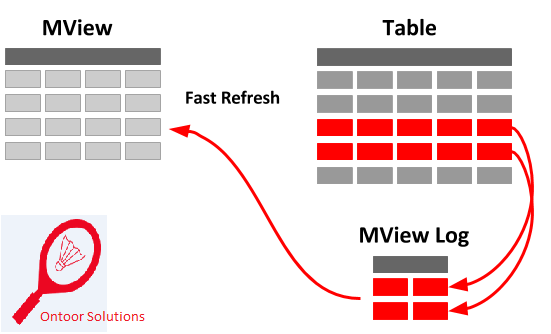
This next video provides a fantastic explanation of the difference between a full refresh and a fast refresh, and it also discusses the practical implications of scheduled refreshes.
Count Millions of Rows Fast with Materialized Views: Databases for Developers: Performance #6
The video 'Count Millions of Rows Fast with Materialized Views' from The Magic of SQL channel explains the practical mechanics of refreshing materialized views.
Please watch from 3:27 to 6:11 and then from 7:40 to 10:52. The first segment (3:27-6:11) introduces the concept of refreshing and then details how a 'fast refresh' works using materialized view logs. The second segment (7:40-10:52) discusses the trade-offs of scheduled refreshes, data staleness, and the 'stale tolerated' option for query rewriting.
As the video highlights, the main trade-off with deferred maintenance is data freshness vs. write performance. Because the refresh happens outside the write transaction, write operations on the base tables remain fast. However, applications reading from the materialized view must be able to tolerate potentially stale data.
Immediate Maintenance: Always Fresh Data
Immediate maintenance is a synchronous approach where the materialized view is updated within the same transaction that modifies the base table.
- Benefit: The materialized view is always perfectly consistent with the base tables. There is no data staleness.
- Drawback: This adds overhead to the write transaction. Every
INSERT,UPDATE, orDELETEon a base table now has the additional work of updating any dependent materialized views before it can commit. This can significantly increase write latency.
A common way to implement immediate maintenance in a traditional DBMS is with triggers. An AFTER trigger on a base table can execute the logic needed to incrementally update the materialized view.
Let's explore the theory and implementation of these two maintenance strategies in more detail.
The PostgreSQL Wiki page on 'Incremental View Maintenance' provides an excellent technical summary of the two main strategies.
Please read the following sections from the wiki page: Start with the section 'When to maintain materialized views'. This directly compares 'Immediate View Maintenance' and 'Deferred View Maintenance'. Then, read 'Basic Theory of IVM' to understand the relational algebra behind calculating deltas. Finally, review 'How to extract changes on base tables' to see how mechanisms like triggers and transition tables are used to capture deltas for immediate maintenance.
The approach of using AFTER triggers with transition tables (which capture the sets of inserted and deleted rows) is a powerful, low-level mechanism for building immediate, incremental maintenance inside the database.
From a broader software architecture perspective, this synchronous update pattern has parallels in event-driven systems and CQRS (Command Query Responsibility Segregation). This next clip frames the problem in that context.
Speeding up Queries by Pre-computation & Transformation
In 'Speeding up Queries by Pre-computation & Transformation', developer Derek Martin discusses synchronous and asynchronous updates of read models, which are conceptually identical to materialized views.
Please watch from 4:16 to 5:31. Notice how he describes the trade-offs: synchronous updates provide consistency but add latency and can cause write failures, which directly maps to immediate maintenance.
Test your understanding!
You are designing the database for a social media platform. A user's profile page displays their total number of followers. This number is used very frequently for reads but updated relatively infrequently. The business requirement is that the follower count must always be accurate. Which maintenance strategy would you choose for a materialized view that stores this count, and why? What is the performance cost?
Show answer
The best choice here is immediate maintenance. The requirement that the follower count is always accurate rules out any deferred strategy, which would introduce data staleness.
You would likely implement this with a trigger. An AFTER INSERT on the followers table would increment the count in the materialized view for the followed user, and an AFTER DELETE would decrement it.
The performance cost is increased write latency. The action of following or unfollowing someone will now take slightly longer because the transaction must also update the materialized count before it can commit. Given that following is an interactive user operation, this small latency is usually an acceptable trade-off for ensuring data consistency.
The Ultimate Immediate Maintenance: Streaming Databases
The concept of immediate, incremental view maintenance has been taken to its logical conclusion in a modern class of systems called streaming databases. Systems like Materialize are architected from the ground up for this specific task.
Instead of thinking in terms of static tables that are occasionally updated, these systems operate on continuous streams of change data (e.g., from a CDC source like Debezium connected to an OLTP database). The core purpose of the database is to maintain materialized views over these constantly changing streams. The view maintenance isn't a bolt-on feature; it is the feature.
This is achieved using dataflow engines (like Timely Dataflow and Differential Dataflow) that are designed to perform complex computations, like joins and aggregations, incrementally and efficiently as new data flows through.
CMU DB Talk: Building Materialize
This technical blog post, 'Building Materialize', written as a transcript of a talk at CMU, provides a superb high-level view of the philosophy and architecture behind a streaming database designed for view maintenance.
Please read the following parts of the article: The introduction (up to the heading 'What's different about online view maintenance?'). This sets the stage, contrasting with traditional OLTP/OLAP and explaining why a new architecture for view maintenance is needed. The section 'What's different about online view maintenance?'. This highlights the unique challenges of maintaining views over dynamic, streaming data. The section 'Materialize: Architecture'. This gives a high-level overview of how the system is layered using Timely and Differential Dataflow to achieve continuous, incremental computation.
This streaming approach represents the state-of-the-art for immediate view maintenance, providing fresh, consistent results for real-time analytical workloads.
Summary of Strategies
Let's summarize the maintenance strategies and their key characteristics in a table.
| Strategy | Data Freshness | Write Latency | Refresh Cost/Complexity | Typical Use Case |
|---|---|---|---|---|
| Deferred (Full Refresh) | Stale | Low | Very High (full recomputation) | Nightly data warehousing, non-urgent reports |
| Deferred (Fast Refresh) | Stale | Low | Low (reads from log), but requires a change log | Near real-time dashboards (e.g., minute-level) |
| Immediate (Triggers) | Always Fresh | High | Low per-update, but adds overhead to every write txn | Critical counts/stats that must be exact (e.g., inventory) |
| Immediate (Streaming) | Always Fresh | N/A (ingest) | Low (built for incremental), but a different architecture | Real-time analytics, monitoring, alerting |
Conclusion
We have seen that keeping materialized views up-to-date is a critical problem with a rich set of solutions. The choice of maintenance strategy hinges on a fundamental trade-off between data freshness and write performance.
Key Takeaways:
- Deferred Maintenance is asynchronous, allowing for low write latency on base tables at the cost of data staleness.
- A full refresh is simple but inefficient.
- A fast refresh uses materialized view logs for efficient, incremental updates.
- Immediate Maintenance is synchronous, ensuring the view is always up-to-date but at the cost of higher write latency.
- This is often implemented using database triggers.
- Streaming databases represent an architecture built entirely around continuous, immediate, and incremental view maintenance.
- The right strategy depends entirely on the application's requirements for data latency and write throughput.
Preview of the Next Lesson
So far in this course, we've largely been operating under the assumption of a traditional row-oriented storage layout, where all the fields for a given record are stored together. But for the large-scale analytical queries that often motivate the use of materialized views, is this the best layout?
In our next lesson, we will kick off a new module by challenging this assumption. We will explore column-oriented storage, an alternative physical layout that can provide massive performance gains for analytical workloads. We will begin by addressing the learning outcome: Explain the architectural differences between row-oriented and column-oriented storage layouts.