Hello! Welcome back to our study of database concurrency control.
In the last lesson, we designed and built the core machinery for controlling concurrent access: a lock manager. You now understand how to create a centralized service that can grant shared (read) and exclusive (write) locks, and how to use C++ primitives like std::mutex and std::condition_variable to manage waiting transactions.
However, having a lock manager is only half the story. It provides the mechanism for control, but we still need a policy—a set of rules that transactions must follow when acquiring and releasing locks to guarantee correctness. Today, we will explore and implement the most important of these policies: Strict Two-Phase Locking (S2PL). By the end of this lesson, you will be able to integrate your lock manager with transaction logic to enforce S2PL, creating a robust system that prevents concurrency anomalies.
Two-Phase Locking (2PL): The Foundational Protocol
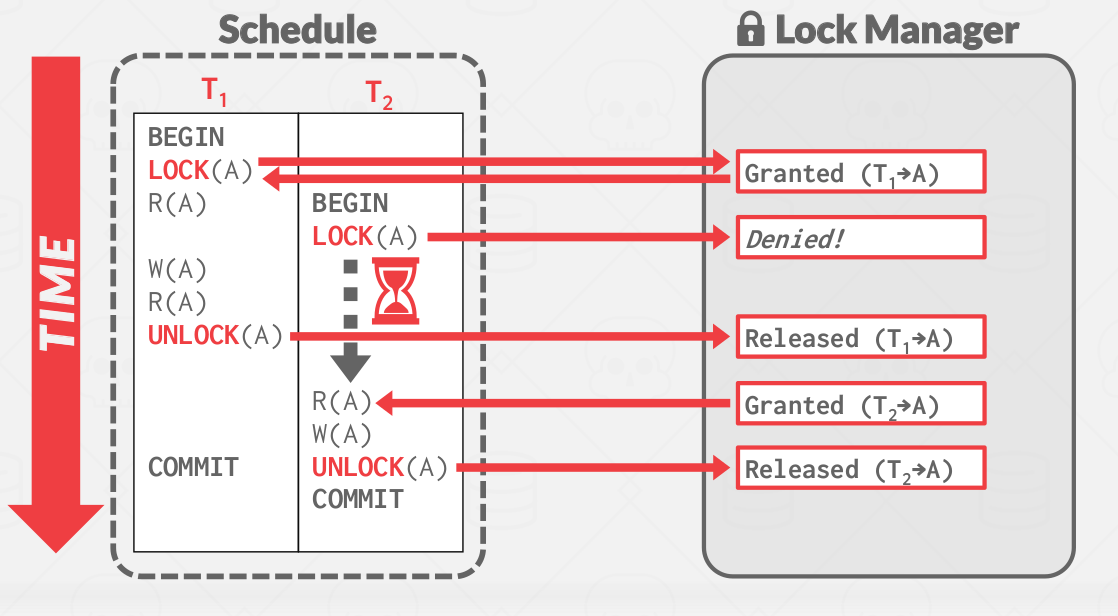
The first major protocol for using locks is called Two-Phase Locking (2PL). It's a simple but powerful idea that forces an ordering on conflicting transactions. The protocol divides a transaction's life into two distinct phases:
- Growing Phase: The transaction can acquire any locks it needs (shared or exclusive). It cannot release any locks during this phase.
- Shrinking Phase: After releasing its first lock, the transaction enters the shrinking phase. In this phase, it can only release locks; it is not allowed to acquire any new ones.
The point where the transaction acquires its final lock is called the "lock point." By ensuring that a transaction doesn't acquire new locks after it has started releasing old ones, 2PL guarantees that all schedules will be conflict-serializable.
The following video provides an excellent conceptual overview of these two phases.
16 - Two-Phase Locking in Databases (CMU Intro to Database Systems / Fall 2022)
This segment from CMU's database course introduces the Two-Phase Locking protocol, explaining the growing and shrinking phases and how they ensure serializability without needing to know a transaction's queries in advance.
Watch from 12:11 to 17:11. Focus on the core rule: once a transaction releases a lock (entering the shrinking phase), it cannot acquire any new locks. Note the visual representation of the number of locks held over time.
The Problem with Basic 2PL: Cascading Aborts
While 2PL guarantees serializability, it has a significant practical drawback: it is susceptible to cascading aborts. This occurs when one transaction reads data that was modified by another transaction that has not yet committed.
Consider this scenario:
- T1 acquires an exclusive lock on record
A, writes a new value, and then releases the lock (entering its shrinking phase). - T2 acquires an exclusive lock on
A, reads T1's uncommitted change, and continues its work. - Later, T1 decides to abort.
Because T2 read "dirty" data from T1, T2 must also be aborted to maintain consistency. If a third transaction, T3, had read data from T2, it would also need to abort, and so on. This chain reaction is a cascading abort, which wastes significant computational resources.
The next video clip explains this problem clearly.
16 - Two-Phase Locking in Databases (CMU Intro to Database Systems / Fall 2022)
This part of the lecture illustrates how basic 2PL can lead to cascading aborts. It shows a schedule where one transaction reads uncommitted data from another, creating a dependency that forces a rollback if the first transaction aborts.
Watch from 20:36 to 24:00. Pay close attention to the example schedule and understand why T2 is forced to abort when T1 aborts. This demonstrates the inefficiency that S2PL is designed to solve.
Strict Two-Phase Locking (S2PL): The Practical Solution
To solve the problem of cascading aborts, nearly all commercial database systems use a more restrictive version of 2PL called Strict Two-Phase Locking (S2PL). The rule is even simpler than basic 2PL:
A transaction must hold all its exclusive locks until it commits or aborts.
In practice, most systems implement Strong Strict 2PL, which extends this rule to all locks (both shared and exclusive). This completely prevents cascading aborts because a transaction can never read or write data that another active transaction has modified. The "shrinking phase" is effectively reduced to a single atomic step at the very end of the transaction's life.

The following video offers a concise summary of S2PL and its benefits.
#17 - Two-Phase Locking Concurrency Control (CMU Intro to Database Systems)
This clip directly explains Strict and Strong Strict Two-Phase Locking, highlighting how holding locks until the transaction completes simplifies recovery and prevents the cascading abort problem.
Watch from 22:29 to 25:19. This is the key concept for today. Understand that S2PL's main benefit is that when a transaction aborts, the system only needs to roll back that single transaction, because no others could have seen its changes.
To see S2PL in action, let's look at the banking example from the video, comparing execution without 2PL to execution with S2PL.
#17 - Two-Phase Locking Concurrency Control (CMU Intro to Database Systems)
This segment provides a concrete example of a bank transfer, showing how an incorrect result occurs without locking, and how S2PL enforces the correct, serializable outcome.
Watch the examples from 25:36 to 28:36. Observe how under S2PL, transaction T2 is blocked until T1 fully commits and releases its locks, preventing the inconsistent read that happened in the non-2PL version.
Implementing S2PL: Integrating the Lock Manager
Now, let's focus on the main goal: implementing this. You've already designed the LockManager. How do we enforce the S2PL protocol?
This isn't done in the LockManager alone. It's a collaborative effort between the Transaction object, the TransactionManager, and the query Executors. The CMU project specs provide an excellent blueprint for how these components work together.
Project #4 - Concurrency Control
This project specification from CMU's course details how to build a concurrency control system. We will use it as a guide for our implementation, focusing on how different system components interact to enforce locking protocols.
Read 'Task #1 - Lock Manager' and its 'Advice from the TAs', then read 'Task #3 - Concurrent Query Execution'. You can skim the deadlock detection parts for now. Focus on these key points: The Transaction object maintains its state (GROWING, SHRINKING) and a set of acquired locks. In S2PL, the TransactionManager is responsible for releasing locks during Commit and Abort. The query Executors (like SeqScanExecutor) are responsible for requesting locks before accessing data.
Based on this blueprint, here's how the implementation works:
1. Transaction State Management
The Transaction object itself must track its state. As described in the project spec, it will have states like GROWING, SHRINKING, COMMITTED, and ABORTED. It also maintains sets of the RIDs for which it holds shared and exclusive locks.
- A new transaction starts in the
GROWINGstate. - For basic 2PL: The first time
Unlock()is called for a transaction, its state transitions toSHRINKING. Any subsequent attempt to acquire a lock while in theSHRINKINGstate must be rejected by theLockManager. - For Strict 2PL: The rule is simpler. A transaction stays in the
GROWINGstate for its entire active life. An explicitUnlock()call by an executor should be disallowed or simply not happen.
2. Integrating Locks into Query Executors
The components that actually access data—the query executors—are responsible for acquiring the necessary locks. Before an executor can read or modify a tuple, it must call the LockManager.
SeqScanExecutor::Next(): Before returning a tuple, it must acquire a Shared Lock on the tuple'sRID.UpdateExecutor::Next(): Before modifying a tuple, it must acquire an Exclusive Lock.InsertExecutor::Next(): Must acquire an Exclusive Lock on theRIDof the new tuple it's creating.
Crucially, under S2PL, these executors never call Unlock(). They only acquire locks.
3. The Role of the Transaction Manager
The responsibility of releasing locks falls to the TransactionManager. When an application commits or aborts a transaction, the TransactionManager performs the final cleanup.
TransactionManager::Commit(txn): After successfully committing the transaction's changes, this method iterates through the transaction's lock sets (shared_lock_set_andexclusive_lock_set_) and callsLockManager::Unlock()for every lock held by the transaction.TransactionManager::Abort(txn): Similarly, when rolling back a transaction, this method must also release all of its locks to allow other transactions to proceed.
This division of responsibility is clean and effective. Executors handle acquisition, and the TransactionManager handles release, ensuring the S2PL protocol is followed correctly.
Test your understanding!
In a system implementing Strict Two-Phase Locking (S2PL), a DELETE query is executed within a transaction T1. Which component is responsible for acquiring the necessary lock, and which component is responsible for releasing it?
Show answer
- Acquisition: The
DeleteExecutoris responsible for callingLockManager::LockExclusive()on theRIDof the tuple before it performs the deletion. - Release: The
TransactionManageris responsible for callingLockManager::Unlock()on that sameRIDafter transactionT1either commits or aborts.
Conclusion
Today, you've bridged the gap between having a lock manager and having a correct concurrency control system. We've seen that a simple locking protocol can enforce serializability, and a slightly stricter version can make the system much more robust and efficient to manage.
Key Takeaways:
- Two-Phase Locking (2PL) guarantees conflict serializability by separating a transaction into a growing phase (acquiring locks) and a shrinking phase (releasing them).
- Basic 2PL suffers from cascading aborts, a practical problem where the failure of one transaction can force many others to roll back.
- Strict Two-Phase Locking (S2PL) solves this by requiring transactions to hold all exclusive (and typically shared) locks until they commit or abort. This is the de facto standard in most relational databases.
- Implementing S2PL involves a clear separation of concerns: query executors acquire locks, and the
TransactionManagerreleases them upon transaction completion (commit or abort).
Preview of the Next Lesson
S2PL is highly effective, but it introduces a new problem. What happens if T1 is waiting for a lock held by T2, and T2 is waiting for a lock held by T1? Neither can proceed. This circular dependency is called a deadlock. In our next lesson, we will learn how to implement deadlock detection using a "waits-for" graph to identify these cycles and choose a victim transaction to abort, allowing the system to continue making progress.