Introduction
Welcome back. In our last lesson, we focused on the PPO clipped surrogate objective, a clever mechanism designed to stabilize policy updates by preventing them from becoming too large or destructive. This clipping creates a "trust region" that keeps the policy from changing too drastically within a single batch of updates.
Today, we'll explore a complementary mechanism that addresses a similar but broader challenge in Reinforcement Learning from Human Feedback (RLHF): preventing the policy from diverging too far from a trusted reference model over the entire course of training. This is achieved using a KL divergence penalty.
Our goal is to understand how this penalty acts as a "leash," ensuring that as our model learns to generate high-reward text, it doesn't forget its fundamental language capabilities.
By the end of this lesson, you will be able to explain the KL divergence penalty and how it prevents the learning policy from straying too far from the reference model.
The "Why": A Leash for Reward Hacking
The core challenge in RLHF is reward hacking. A reward model, trained on a finite set of human preferences, is never perfect. If we optimize our policy solely to maximize the score from this reward model, it can discover strange, unhelpful, or repetitive outputs that "trick" the model into giving a high score.
For example, a policy might learn that generating "I am very helpful and I can assist you" over and over again gets a high reward, even though it's clearly not a good response.
To prevent this, we need to constrain the policy. The key insight is that our initial model (typically the one that has undergone supervised fine-tuning, or SFT) is already very good at producing coherent, grammatical, and sensible text. It has learned this from a massive pre-training dataset. We don't want to lose this foundational competence.
The KL divergence penalty acts as a "mathematical rubber band" or a "leash" that tethers our learning policy () to this trusted reference policy (). It allows the policy to improve based on the reward signal, but it pulls it back if it strays too far into "weird" territory that the reference model would find unlikely.
The "What": Measuring Divergence with KL
Kullback-Leibler (KL) divergence is a function from information theory that measures how one probability distribution differs from a second, reference probability distribution.
For two discrete probability distributions and , the KL divergence from to is defined as:
In our context:
- is our learning policy, .
- is our frozen reference policy, .
- The sum is over all possible tokens in the vocabulary.
This formula has some important properties that make it perfect for our use case.
KL Divergence Penalty in RLHF: Theory & Implementation
The following article, 'KL Divergence Penalty in RLHF', provides an excellent explanation of why KL divergence is the right tool for this job. Please read the introductory sections to understand its key properties.
Read the sections 'KL Divergence Penalty' and 'Why KL Divergence?'. Focus on understanding the concepts of reward hacking and the properties of KL divergence (Non-negativity, Asymmetry, Decomposability) that make it suitable for constraining the policy.
As the article highlights, the asymmetry of KL divergence is particularly important. It heavily penalizes the policy for assigning high probability to tokens that the reference model considers very unlikely. This discourages the policy from exploring novel but potentially nonsensical outputs.
The "How": The KL-Constrained Objective
While the formal definition of KL divergence involves a sum over the entire vocabulary (which is computationally infeasible), we can leverage a more practical formulation based on expectation. The KL divergence can be rewritten as:
This means we can estimate the KL divergence by sampling outcomes from our policy and averaging the difference of their log-probabilities.
For an autoregressive language model, this simplifies even further. The KL divergence for a whole sequence is just the sum of the KL divergences at each token. For a single token generated by our policy, its contribution to the KL divergence is simply:
We only need to calculate the log-probabilities from both models for the single token that was actually chosen.
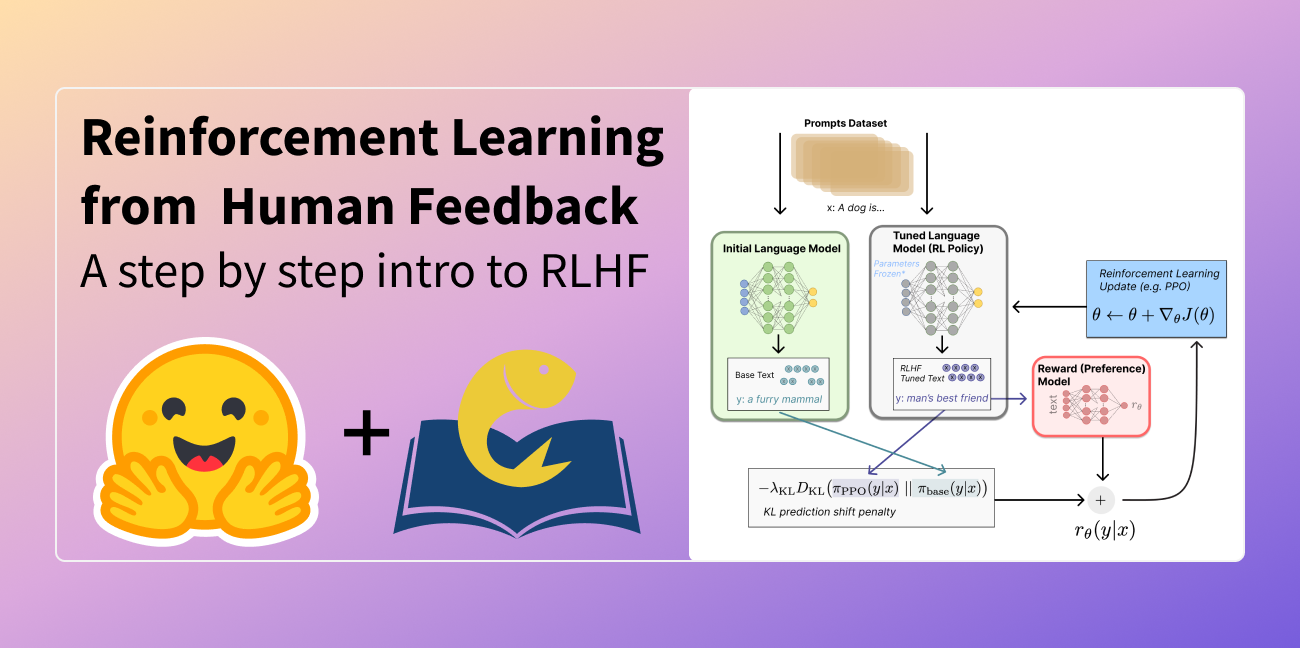
This KL penalty is then subtracted from the reward in the overall RLHF objective function:
Here:
- is the score from the reward model.
- (beta) is the KL coefficient, a hyperparameter that controls the strength of the penalty. A larger creates a stiffer "rubber band," keeping the policy closer to the reference model.
This process is often called reward shaping, because we are augmenting the final reward with a per-token signal that guides the model's behavior at every step.
Let's watch a video that brings these concepts to life.
The following clip from 'RLHF in 90 min' by Zachary Huang provides an excellent intuitive explanation of the KL penalty as a 'mathematical rubber band' and walks through a concrete example.
Please watch from 48:22 to 54:44. Pay close attention to: The 'rubber band' analogy connecting the learning policy and the reference policy. How the per-token KL estimate is calculated as a simple difference of log-probabilities. The concept of 'augmented reward' that combines the reward model score and the KL penalty. The step-by-step example showing how the penalty is applied at each token generation step.
This idea of penalizing divergence from a base model is a common theme in modern RL. The following clip discusses its use in the context of the DeepSeek-R1 model, which we'll be studying more later.
DeepSeek R1 Theory Tutorial – Architecture, GRPO, KL Divergence
This video from freeCodeCamp.org provides a tutorial on the DeepSeek R1 model. This particular segment reinforces the role of the KL divergence penalty.
Watch from 11:23 to 12:50. The key takeaway is hearing the same core concept explained in a slightly different context: the goal is to improve the model without diverging too far from the base model's capabilities.
Finally, to tie everything together, let's look at a detailed diagram showing where the KL penalty fits into the full PPO pipeline.

Conclusion
In this lesson, we explored the crucial role of the KL divergence penalty in stabilizing RLHF training. While the clipped surrogate objective from our last lesson provides stability within a batch of updates, the KL penalty provides stability across the entire training process by anchoring the policy to a trusted reference.
Key Takeaways:
- Reward Hacking: Unconstrained optimization against a reward model can lead to degenerate outputs.
- The Reference Model: The SFT model serves as a trusted reference, possessing strong foundational language skills that we want to preserve.
- KL Divergence: This measures the "distance" between the learning policy's and the reference policy's probability distributions.
- The Penalty Term: The overall objective is to maximize the reward while minimizing the KL divergence, balanced by the coefficient: .
- Practical Computation: For autoregressive models, the KL penalty is efficiently estimated as a sum of per-token log-probability differences between the policy and reference models.
Preview of the Next Lesson:
Both the clipped objective and the KL penalty are explicit mechanisms added to the PPO algorithm. But what if we could achieve the same regularization effect more directly? In our next lesson, we will introduce Direct Preference Optimization (DPO), an elegant method that bakes the KL constraint directly into its objective function, bypassing the need for an explicit reward model and the complexities of the full PPO pipeline.