Introduction
Welcome back! In our last lesson, we outlined the complete three-step Reinforcement Learning from Human Feedback (RLHF) pipeline, culminating in the policy optimization stage. We identified the four models at play—the policy, the reward model, the reference model, and the value model—and saw how they work together to align the language model.
Today, we're going to dive into the mathematical heart of Proximal Policy Optimization (PPO), the algorithm that powers this final stage. Our goal is to understand the PPO clipped surrogate objective. This is the core formula that allows us to update our policy model effectively and, most importantly, stably.
You will learn:
- The fundamental problem with naive policy updates and why they can be unstable.
- How PPO uses a "clipped" objective function to constrain policy changes.
- The specific role of each component in the PPO objective function and why this design leads to more reliable training.
This lesson directly addresses the learning outcome: Describe the PPO clipped surrogate objective and why clipping stabilizes policy updates.
The Challenge: Unstable Policy Updates
The basic idea of any policy gradient algorithm is simple: if an action leads to a good outcome, we want to increase the probability of taking that action in the future. If it leads to a bad outcome, we want to decrease its probability.
For efficiency, instead of collecting new data after every single update, we'd prefer to collect a batch of experiences and perform several updates on that same batch. This is called an off-policy approach. However, this creates a problem. The data was collected with an "old" policy, but we are updating a "new" policy. This mismatch can lead to instability.
To correct for this, we use importance sampling, which re-weights the updates using a ratio, , of the probabilities between the new and old policies:
If this ratio becomes very large (meaning the new policy is much more likely to take an action than the old one), the updates can become huge and chaotic, potentially destroying all the learning the policy has done. This is the core instability problem PPO was designed to solve.
The following video provides an excellent intuitive walkthrough of this problem and introduces the concept of the surrogate objective function.
Proximal Policy Optimization (PPO) - How to train Large Language Models
The video 'Proximal Policy Optimization (PPO) - How to train Large Language Models' by Serrano.Academy introduces the core ideas behind PPO using a simple grid-world example.
Please watch from 22:46 to 31:13. Focus on understanding the 'surrogate objective function' (the ratio multiplied by the gain/advantage) and the problem that arises when the probability ratio becomes very large, leading to chaotic updates.
The PPO Solution: The Clipped Surrogate Objective
PPO's brilliant solution is to modify the objective function to remove the incentive for making excessively large policy updates. It achieves this by "clipping" the probability ratio to keep it within a narrow range around 1.
The PPO clipped surrogate objective function is:
This looks complex, but let's break it down:
- : The probability ratio we just discussed.
- : The advantage estimate. This is a value that tells us how much better or worse the chosen action was compared to the average action at state . A positive advantage means the action was good; a negative one means it was bad.
- (epsilon): A small hyperparameter (e.g., 0.2) that defines the clipping range
[0.8, 1.2]. This range acts as a "trust region." clip(...): This function simply constrains the ratio to stay within the range[1 - ε, 1 + ε]. If is 1.5, it's clipped to 1.2. If it's 0.7, it's clipped to 0.8.min(...): This is the most important part. PPO takes the minimum of the original, unclipped objective () and the new, clipped objective.
How Clipping Stabilizes Training
Let's continue with the Serrano.Academy video, which gives a great visual explanation of how this clipping works in practice.
Proximal Policy Optimization (PPO) - How to train Large Language Models
This next segment demonstrates the clipping mechanism visually and explains why it's necessary.
Watch from 31:13 to 36:55. Pay close attention to how the clipping range [1-ε, 1+ε] prevents the surrogate objective function from becoming too large or small, thus stabilizing the training process.
To deepen this understanding, let's look at the behavior of the objective function under different scenarios, as visualized in the diagram below.
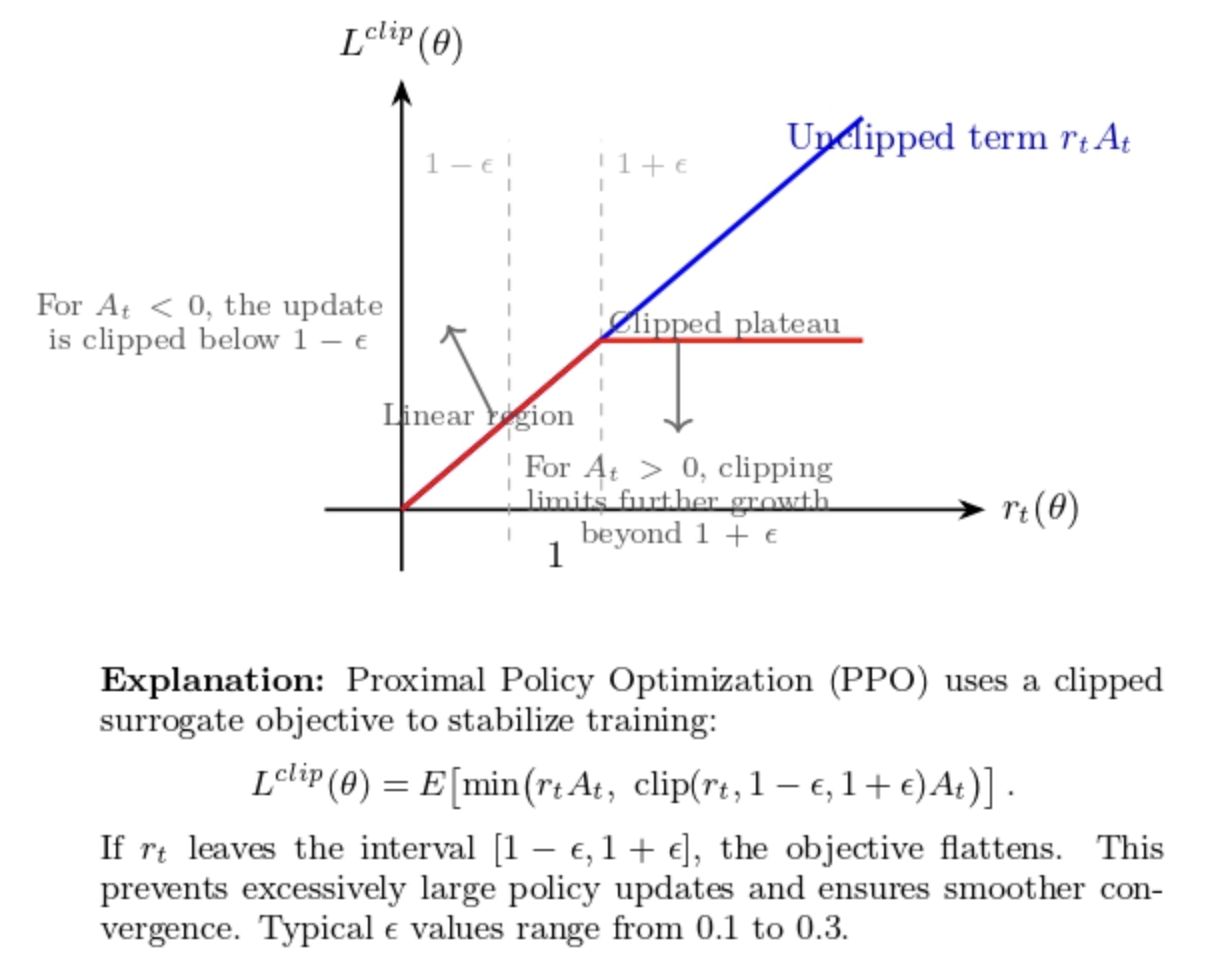
Let's analyze the two main cases based on the advantage :
-
Case 1: Positive Advantage ()
- The action was good, so we want to increase its probability (i.e., increase ).
- The
minfunction will choose the smaller of the two terms. If the policy update is too aggressive and goes above1 + ε, the unclipped term becomes larger than the clipped term. - The objective is then capped at
(1 + ε) * Â_t. The function flattens out. - Effect: This removes the incentive for the policy to change too drastically. We get the reward for improving, but we don't allow an overly greedy update that could destabilize the model.
-
Case 2: Negative Advantage ()
- The action was bad, so we want to decrease its probability (i.e., decrease ).
- When we multiply by a negative , the objective becomes negative. Maximizing the objective means we want it to be as close to zero as possible.
- If goes below
1 - ε, the unclipped termr_t(\theta) * Â_tbecomes more negative than the clipped term(1 - ε) * Â_t. - The
minfunction will choose the unclipped (more negative) term. - Effect: The policy is still strongly penalized for making bad actions, as there is no cap on the penalty. The clipping primarily serves to moderate overly optimistic updates.
This thoughtful design makes PPO much more stable than older policy gradient methods.
The following video provides a more mathematical and nuanced explanation of how the min operator and clipping work together.
Proximal Policy Optimization (PPO) & Group Relative Policy Optimization (GRPO) | Paper Explained
Let's watch a final clip from the 'Outlier' channel to get a concise, rigorous explanation of the objective.
Watch from 19:24 to 21:10. The narrator gives a clear case-by-case breakdown of why we use the minimum operator and how it affects updates for both good and bad actions.
For a detailed textual breakdown, the following article from Hugging Face is an excellent resource to review. It methodically walks through the different situations that can arise.
Proximal Policy Optimization (PPO)
This blog post from Hugging Face, titled 'Proximal Policy Optimization (PPO)', provides a clear written explanation of the objective function, complete with helpful diagrams.
Please read the sections 'Introducing the Clipped Surrogate Objective' and 'Visualize the Clipped Surrogate Objective'. This will reinforce your understanding by analyzing the objective function case by case.
Conclusion
In this lesson, we delved into the core mechanism of Proximal Policy Optimization—the clipped surrogate objective. We moved from a high-level understanding of the RLHF pipeline to the specific formula that makes stable policy optimization possible.
Key Takeaways:
- Standard policy gradient methods can be unstable when using importance sampling because the probability ratio can lead to excessively large and destructive policy updates.
- PPO solves this by introducing a clipped surrogate objective function that constrains the policy update to a small "trust region" around the old policy.
- The objective function is
L_CLIP = min(unclipped_objective, clipped_objective). - When an action has a positive advantage, the clipping prevents the policy update from being too large, thus ensuring stability.
- The use of the
minoperator ensures that the final objective is a pessimistic, or lower, bound, which contributes to the algorithm's robustness.
Preview of the Next Lesson:
The clipped surrogate objective is the most common and successful variant of PPO. However, the original PPO paper proposed an alternative method for achieving the same goal of stability. In the next lesson, we will briefly explore this alternative: using a KL divergence penalty to ensure the new policy doesn't stray too far from the reference model. This will give you a complete picture of the stabilization techniques at the heart of PPO.