Introduction
Welcome back. In our previous lesson, we analyzed the mechanics of DAP's autoregressive interleaving, where the model generates a plan by alternating between predicting the future scene and the ego-vehicle's action. We established that for each future timestep , DAP first generates the scene tokens and then, conditioned on that prediction, generates the action token .
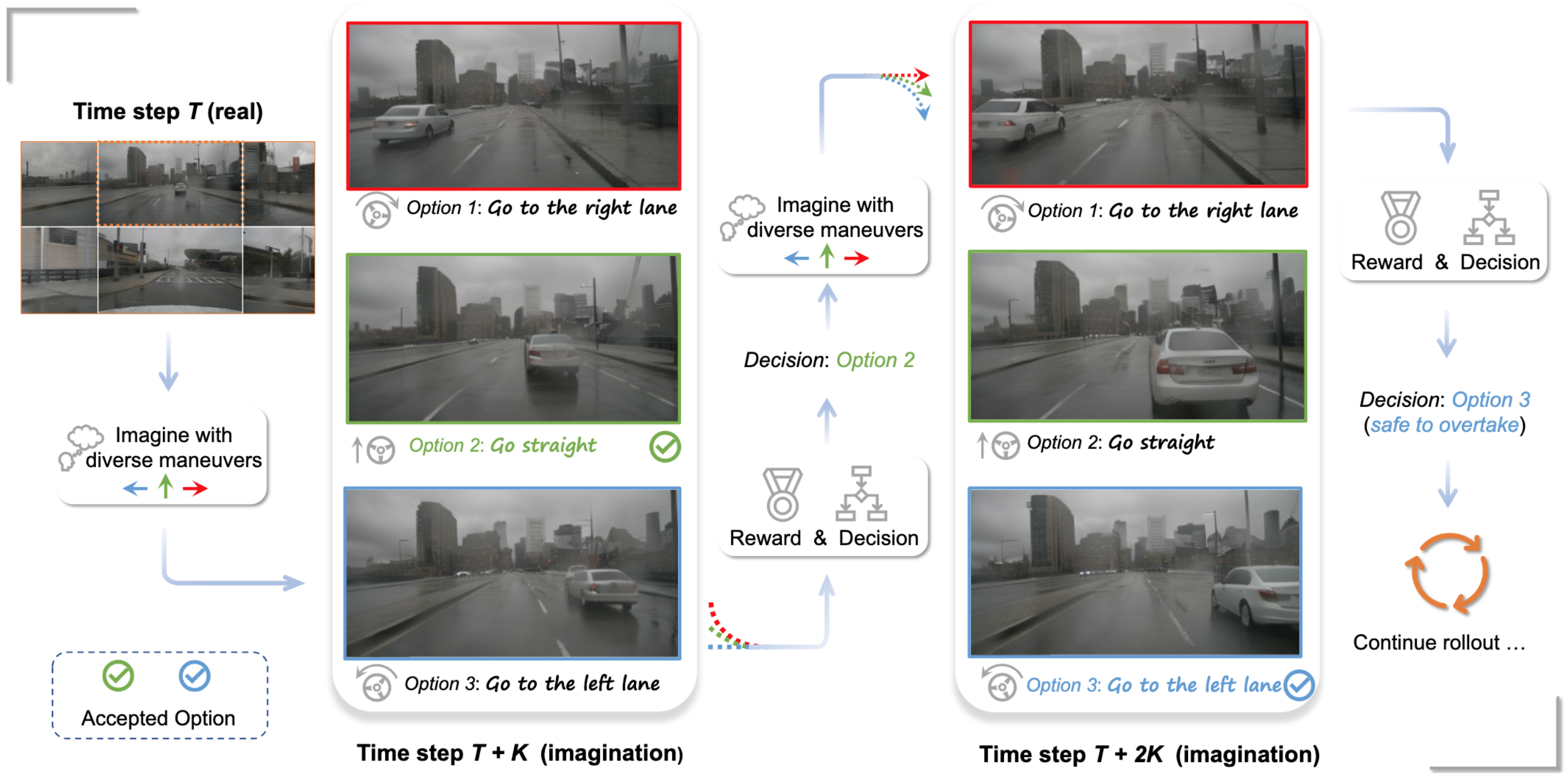
This lesson addresses the crucial follow-up question: Why is this architecture so effective? Our learning outcome is to describe how predicting the next scene state before acting effectively embeds a world model inside the planner.
We will first define what a "world model" is in the context of artificial intelligence. Then, we will connect this concept directly to the predict-then-act generation process you learned about, showing how this forces the planner to learn the dynamics of its environment and make more intelligent, proactive decisions.
Part 1: What is a World Model?
At its core, a world model is an internal representation of an environment that an agent (like a self-driving car) learns. This internal model allows the agent to simulate or predict how the environment will evolve over time. It's the difference between simple reaction and predictive reasoning.
A human driver uses a world model constantly. When approaching an intersection, you don't just react to the current positions of other cars. You run mental simulations:
- "That car is slowing down; it will probably stop at the sign."
- "That pedestrian is looking at their phone; they might step into the road without looking."
- "The light just turned yellow; the cars in front will either speed up or brake hard."
You then plan your actions based on these predictions of the future. An AI with a world model can do the same.
World Models for Autonomous Driving: An Initial Survey
This survey paper on world models in autonomous driving provides a concise and accurate definition of the concept. Let's start here.
Please read the subsection titled 'World Model Module'. Focus on the two primary functions it describes: estimating missing information and, most importantly for our discussion, predicting future states of the environment.
As the resource explains, the world model's ability to simulate potential future scenarios is what enables a system to prepare and adjust its strategies proactively. This is the key capability we want to embed in our planner.
Part 2: How Autoregressive Interleaving Builds a World Model
The previous lesson showed that DAP is trained to predict the next BEV scene tokens before it predicts its own action token . This training objective is precisely what forces the Transformer to become a world model.
Consider what the model must learn to successfully predict the next BEV map:
- Physics and Dynamics: It must learn that a vehicle token at a certain position with a certain velocity will likely appear in an adjacent position in the next timestep.
- Traffic Rules: It must learn that cars tend to stop at red lights and stay within lane boundaries.
- Agent Behaviors: It must learn common patterns, like cars in a turn-only lane are likely to turn.
The ground-truth BEV map sequence from the training data acts as the supervision signal. By minimizing the error in predicting these future scenes, the model is implicitly forced to learn the rules that govern how scenes evolve. This is the essence of building a world model.
The DAP paper repeatedly emphasizes this point, stating that this architecture "couples scene understanding with motion generation." The model cannot generate a good plan without first demonstrating that it understands how the scene is likely to unfold.

Part 3: The Planner as a User of the World Model
Once the model has predicted the future scene , the second part of the interleaved process begins: predicting the action . Because the action is conditioned on this predicted future, the planner is no longer just reactive; it is proactive.
Its decision is based on an anticipated future state. For example:
- Input: The planner sees a car in the adjacent lane at time .
- World Model Prediction: The scene prediction module generates , which shows that car having moved into the ego-vehicle's lane.
- Planner Action: Conditioned on this predicted incursion, the planner generates a "brake" or "slow down" action token to avoid a collision that hasn't happened yet, but is predicted to happen.
This ability to plan around a distribution of possible futures, rather than just the single most likely one, is critical for safety.
Motion Planning and Control (Waabi CVPR 23 Tutorial on Self-Driving Cars)
The following video discusses the 'lookout' model, which formalizes this idea of planning based on possible future scenarios. It provides a great intuition for why a world model is essential for robust and safe decision-making.
Watch from 38:43 to 42:24. The speaker explains that simply planning for the most probable future is unsafe because it ignores low-probability but high-risk events (like a car running a red light). A better strategy is to choose a short-term action that keeps you safe across multiple possible futures, which are generated by an internal world model.
While the 'lookout' model is different from DAP, the underlying principle is identical: use a predictive world model to generate possible futures, and then plan an action that is robust to those possibilities.
The UniAD framework, another end-to-end model, provides excellent visualizations of this in practice. It uses its internal world model (called 'Occuformer') to predict future occupancy, and the planner then uses this information to navigate.
CVPR23 Plenary Talk | [Best Paper] UniAD: Planning-oriented Autonomous Driving
This presentation on the UniAD framework shows exactly how a planner module uses the outputs of a predictive world model.
First, watch from 03:04 to 04:42. Notice how the planner uses an 'ego vehicle query' to attend to BEV features and the 'predicted occupancy' to adjust its path. Then, watch the visualization from 05:42 to 06:28. The attention masks show the planner focusing on obstacles predicted by the upstream modules, demonstrating how it uses the world model's output to make safe decisions.
Conclusion
In this lesson, we moved from the how of autoregressive interleaving to the why. By forcing the model to predict the next scene state before deciding on an action, we are implicitly training it to develop an internal world model.
Key Takeaways:
- A world model is an internal representation of an environment that allows an AI agent to predict future states and simulate the outcomes of its actions.
- DAP's interleaved generation (
predict scene -> predict action) is a training strategy that forces the Transformer to learn a world model. To accurately predict the next BEV map, it must learn the underlying dynamics of the environment. - The planner then uses this predicted future as context to make more robust and proactive decisions, rather than simply reacting to the present.
- This tight coupling of environmental prediction and ego-motion planning is a core strength of modern generative planning architectures, leading to safer and more intelligent behavior.
Preview of the Next Lesson:
We have now followed DAP's process from input tokenization to the generation of a sequence of discrete action tokens, guided by an internal world model. However, these discrete tokens represent coarse commands (e.g., "turn slightly left, accelerate moderately"). A real vehicle requires a smooth, continuous path. In our final lesson on DAP, we will cover post-tuning refinement, the process that converts this sequence of discrete tokens into a smooth, comfortable, and dynamically feasible trajectory for the vehicle to execute.