Introduction
Welcome back to our study of the Discrete-token Autoregressive Planner (DAP). In our last lesson, we constructed the full input sequence for the DAP Transformer by tokenizing the navigation command, ego history, and environmental context. We now know what the model sees: a sequence of discrete tokens, [Command, Scene_past, Action_past, ..., Scene_present, Action_present].
Today's lesson addresses the crucial next question: how does DAP use this context to generate a plan? We will focus on this learning outcome: Explain DAP's autoregressive interleaving: predicting future scene tokens before generating ego action tokens.
You will learn that DAP doesn't just predict its own future actions. Instead, it follows a "predict, then act" strategy, where it first forecasts how the world around it will change before deciding its own maneuver. This interleaved generation process is the core mechanism that embeds a predictive world model directly into the planner, a significant step beyond purely reactive models.
Part 1: From Reactive Imitation to Predictive Planning
Most basic end-to-end driving models operate reactively. They learn a direct mapping from sensory input to a driving action (Scene -> Action). This is pure imitation learning: the model learns to mimic human driver responses in similar situations. However, this approach has a key weakness: it doesn't explicitly reason about how the actions of other agents will evolve over time.
A more robust planner would try to answer two questions in sequence:
- Given the current state of the world, what is likely to happen next? (e.g., "That car in the other lane is probably going to merge in front of me.")
- Given that likely future, what is the best action for me to take? (e.g., "I should slow down to create space.")
This is precisely the logic that DAP's autoregressive interleaving is designed to capture. Instead of a simple Scene -> Action mapping, DAP learns a Scene -> next_Scene -> Action mapping.
Let's look at a diagram that contrasts these two approaches.

The model on the left is a classic imitation learning setup. It takes in history and directly outputs a future trajectory. The model on the right, DAP, inserts an intermediate step: predicting the future scene. This is the essence of interleaving.
Part 2: The Interleaved Generation Process
In the previous lesson, we established the input context sequence up to the present time, :
At inference time, the Transformer's task is to generate the sequence for future timesteps . DAP achieves this through a specific, two-stage prediction loop for each future step.
Let's break down the generation for a single future step, :
1. Predict the Future Scene:
The model first generates the sequence of BEV tokens that represent the environment at time . This is done autoregressively, token by token:
- Predict based on .
- Predict based on and the just-predicted .
- ...and so on, until the full scene forecast is generated.
This generated sequence is the model's "imagination" of what the world will look like in the next moment.
2. Predict the Ego Action:
After the future scene has been fully predicted, the model appends this new scene forecast to its context. It then makes a single prediction for its own action token, .
This means the action is conditioned not only on all past information but also crucially on the predicted future scene .
The entire generated sequence for step is therefore . This block of tokens is then appended to the context, and the process repeats to generate the plan for step .
This "predict, then act" cycle is the core of autoregressive interleaving.
The Mathematical Formulation
This process is clearly defined in the DAP paper. Let's examine the relevant section to see the formal mathematics.
DAP: A Discrete-token Autoregressive Planner for Autonomous Driving
The DAP paper formalizes this two-stage prediction in its 'Autoregressive Planning Transformer' section. The equations explicitly show the conditional dependency of the action token on the previously generated scene tokens.
Please read section 3.1, part 'b) Autoregressive Planning Transformer'. Pay close attention to equations (4a) and (4b). Note how equation (4b), which defines the probability of the action token A_{t+1}, includes V_{t+1,1:M} in its condition, confirming that the action is predicted after the entire scene.
To reinforce this, the following diagram from a review of the DAP paper provides another excellent visualization of the full architecture, highlighting the interleaved flow of tokens.
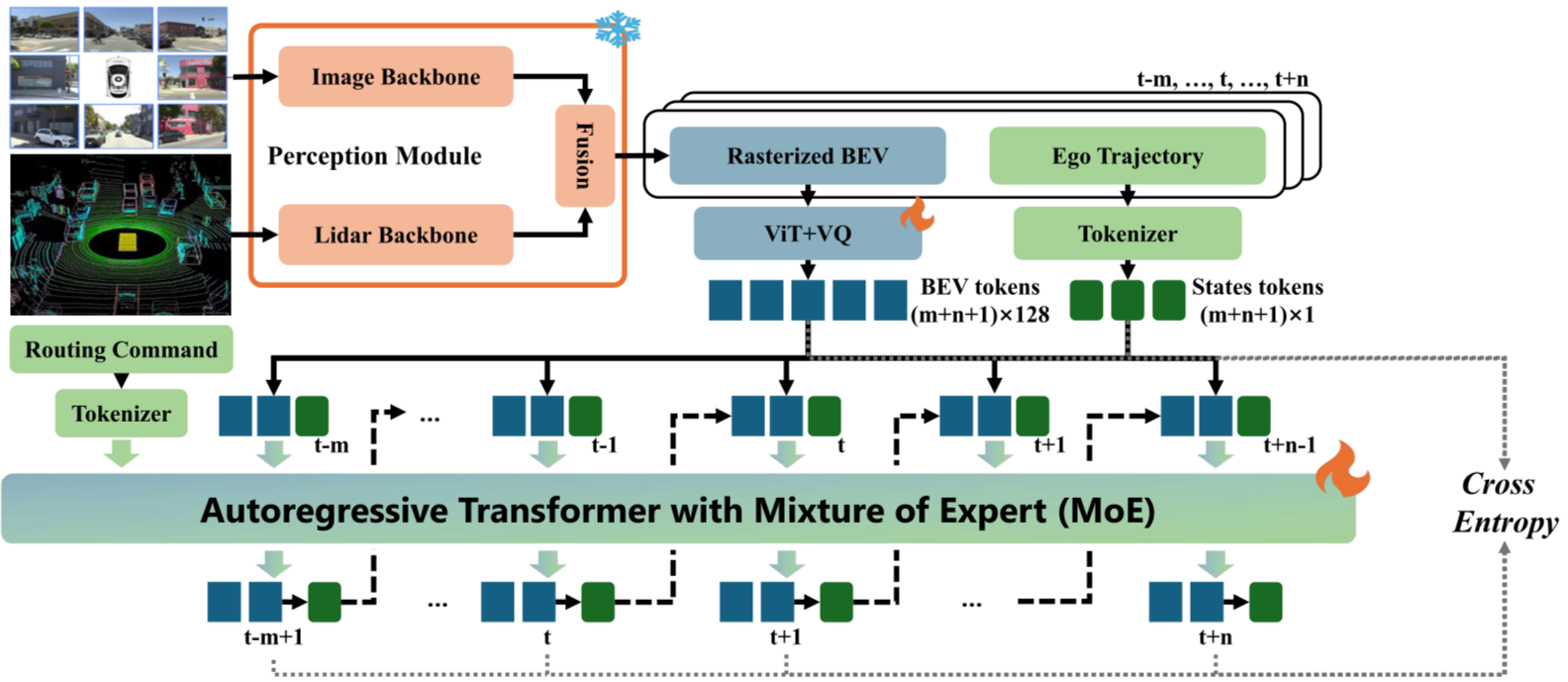
Part 3: The Benefit of Interleaving: An Embedded World Model
Why is this interleaved structure so important?
By forcing the model to predict the next scene state (V_{t+1}) before it can predict its own action (A_{t+1}), the training objective inherently teaches the model about the dynamics of the world. To be successful at predicting the next BEV map, the model must learn how other vehicles move, how traffic lights change, and how pedestrians behave. This forces the development of an internal, implicit world model.
This has several key advantages over reactive imitation:
- Improved Robustness: The model's decisions are grounded in a prediction of the future, not just a pattern-matched reaction to the past. As the paper states, this "improves robustness under closed-loop execution."
- Better Scene-Action Coupling: The model learns a tight connection between scene evolution and ego motion. For example, it learns that predicting an oncoming car in its lane should lead to a braking action. This helps prevent "embodied misalignment," where a model might identify a hazard in its reasoning but fail to act on it appropriately.
- Dense Supervision: During training, every token in the future BEV map provides a learning signal. This is a much richer, more "dense" form of supervision than simply having a single sparse label for the ego-vehicle's correct path.
The authors of the DAP paper performed an ablation study to prove this point. When they trained a version of the model that only predicted trajectory tokens (disabling the interleaved scene prediction), the performance was significantly worse.
DAP: A Discrete-token Autoregressive Planner for Autonomous Driving
The paper's ablation study provides strong evidence for the benefits of interleaving. Let's review the results.
Read the paragraph 'Ablation on interface and training regime' in Section 4.3. Note the performance difference between the 'only trajectory tokens' variant and the full joint BEV-trajectory model.
The concept of generating intermediate "reasoning" steps before an action is a powerful theme in modern generative AI. While DAP uses a future scene as its reasoning step, other models, like NVIDIA's Alpamayo, generate explicit text-based reasoning. The underlying principle is the same: breaking down a complex problem improves performance.
Inside NVIDIA Alpamayo 1: Making Autonomous Vehicles Reason
This short clip from NVIDIA provides a high-level perspective on why models that articulate a reasoning process (like predicting a future scene) before acting are more capable.
Watch from 09:28 to 11:21. The speaker explains that decomposing a complex task into steps (in DAP's case, predict-then-act) leads to better and more introspectable action generation.
Conclusion
In this lesson, we have dissected the core generative mechanism of the DAP planner: autoregressive interleaving. This "predict, then act" strategy is a fundamental departure from simpler reactive models.
Key Takeaways:
- Autoregressive interleaving is DAP's strategy for generating a plan by alternating between predicting the future scene and the ego-vehicle's action.
- For each future timestep, DAP first generates all the scene tokens () and then, conditioned on that prediction, generates the action token ().
- This forces the model to learn the environment's dynamics, effectively embedding a world model within the planner.
- The benefit of this approach is improved robustness and a tighter coupling between scene understanding and motion generation, as validated by ablation studies.
Preview of the Next Lesson:
We now understand how DAP generates a sequence of discrete action tokens like [A_{t+1}, A_{t+2}, ...]. However, a vehicle's controls require a smooth, continuous path. A sequence of discrete tokens can result in a "zig-zag" or jerky trajectory due to quantization error. In our next lesson, we will explore the final step of the DAP pipeline: post-tuning refinement, which smooths the discrete plan into an executable, comfortable, and safe trajectory.