Introduction
In our last lesson, we explored callbacks and how they allow us to control when code executes, especially in asynchronous scenarios. This was a crucial step in understanding how JavaScript manages operations that don't complete immediately.
Today, we'll tackle the final topic in our "Functions as First-Class Citizens" module by looking at a powerful pattern that uses functions to control where variables and logic live. This lesson focuses on the Immediately Invoked Function Expression (IIFE). You will learn to write an IIFE and, more importantly, understand its primary use case: creating private scope to achieve data encapsulation. For a software engineer, this pattern is fundamental for writing clean, non-conflicting, and modular code, a concept that was essential before the widespread adoption of modern module systems and remains relevant today.
1. What is an IIFE?
An IIFE (pronounced "iffy") is a JavaScript function that is defined and runs the moment it is created. The syntax might look a little unusual at first, but it follows directly from JavaScript's rules about functions and expressions.
Let's break it down.
// This is a function expression
(function() {
  console.log("This runs immediately!");
});

// The final pair of parentheses () is what invokes it
(function() {
  console.log("This runs immediately!");
})();
The key is the pair of parentheses ( ... ) that wraps the entire function() { ... } block. In JavaScript, a statement that starts with the function keyword is parsed as a function declaration. However, wrapping it in parentheses forces the parser to treat it as a function expression. Since it's now an expression that evaluates to a function object, we can immediately call it by adding another pair of parentheses () at the end.
To get a clear picture of the definition and syntax, let's start with a foundational article.
Chapter 42:Mastering Immediately Invoked Function Expressions ...
This article provides a clear, step-by-step introduction to the IIFE pattern.
Read the initial sections to solidify your understanding of the core concept. Focus on: The definition and its purpose. The syntax breakdown, paying attention to the role of both pairs of parentheses. The examples under Correct Syntax, including how to pass parameters.
The following video also offers a concise visual tour of the different ways you might see an IIFE written, including with modern arrow functions.
What is an IIFE? | Javascript IIFE Function Expressions Explained
This video from the Dave Gray channel effectively demonstrates the syntax variations.
Watch the first part of the video from the beginning until the end of the syntax examples. This will help you recognize the pattern in various forms you might encounter in different codebases.
2. The Core Purpose: Scope Encapsulation
Now for the crucial question: why use this pattern? The primary reason is to create a private scope.
Before let and const introduced block scoping, variables declared with var were function-scoped. Any var declared outside a function became a global variable. In large applications, especially when using multiple scripts or libraries, this "global namespace pollution" leads to variable name collisions and unpredictable bugs.
An IIFE solves this by wrapping a block of code in a function. Since every function in JavaScript creates its own scope, any variable declared inside the IIFE is local to that function and cannot be accessed from the outside. This is a powerful form of encapsulation.
The following video gives an excellent practical demonstration of this problem and its solution, showing how code in different script files can interfere with each other and how IIFEs prevent it.
IIFE in JavaScript | Why it so Special?
This video from CodAffection uses a multi-file example to show global scope pollution in action and then demonstrates how popular libraries like jQuery use IIFEs to solve it.
Watch the section from "avoids polluting outer scope". The visual of the debugger showing variables from one file appearing in the scope of another file makes the problem very clear.
3. The Module Pattern: Private State and Public APIs
The most significant use case for IIFE-based scope encapsulation is the Module Pattern. This pattern leverages closures to create components with private state and a public-facing API, a concept you are familiar with from object-oriented programming.
Here’s how it works:
- An IIFE creates a private scope.
- Inside this scope, you define variables and functions. These are your private members.
- The IIFE returns an object containing references to only the functions you want to expose to the outside world. These are your public methods.
- The public methods, by virtue of being closures, retain access to the private variables and functions defined within the IIFE's scope.
This image provides a perfect, compact example of the Module Pattern in action.
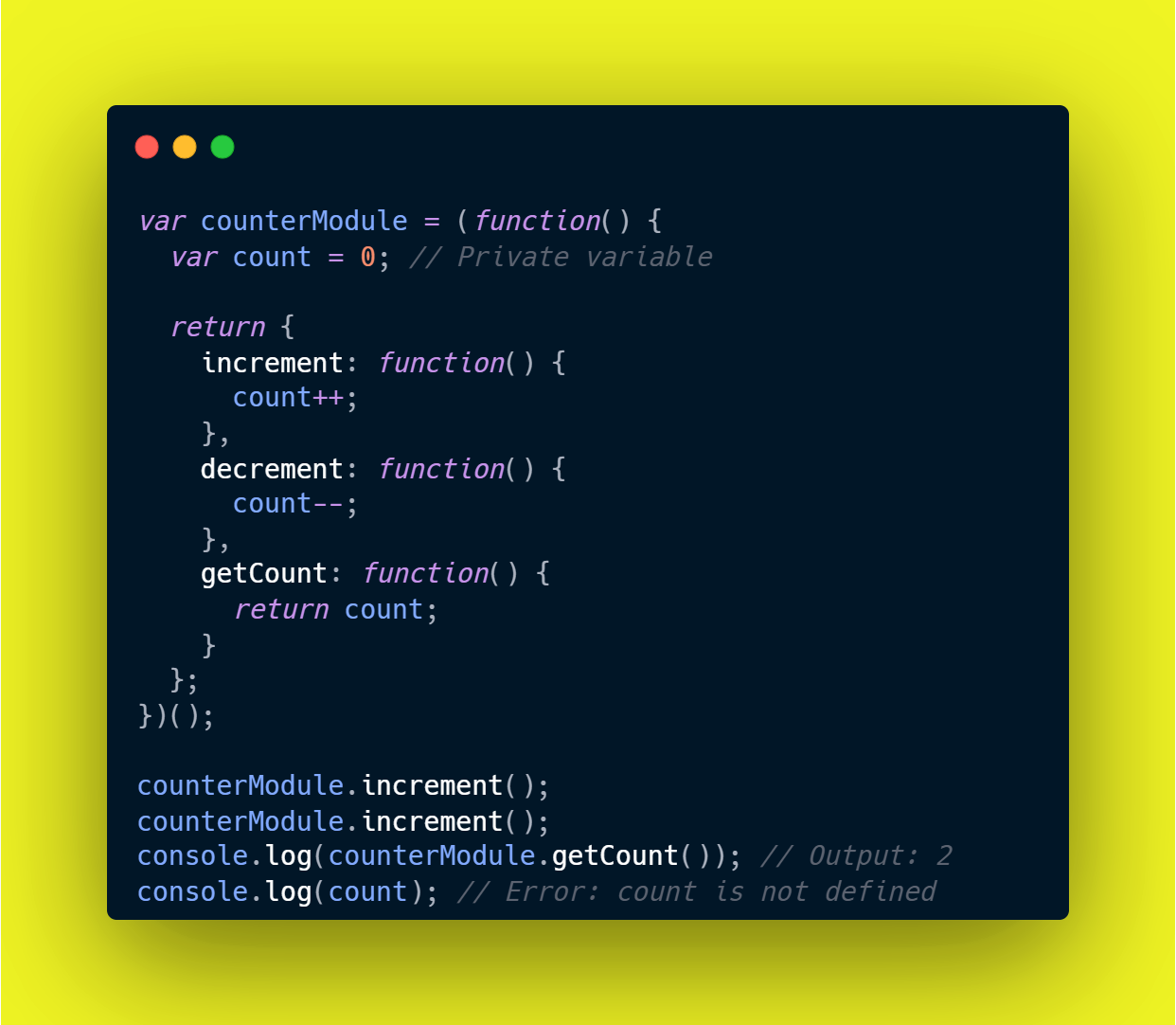
Let's trace the logic in the image:
- The
countvariable is declared inside the IIFE. It is completely private. - The IIFE returns an object with three methods:
increment,decrement, andgetCount. - These methods are assigned to the
counterModulevariable. They form the public API. - When
counterModule.increment()is called, it can access and modify the privatecountvariable because it's a closure that "remembers" the scope in which it was created. - As the last line shows, attempting to access
countdirectly from the global scope results in aReferenceErrorbecause it is not defined there.
This elegant pattern allows you to create self-contained modules that manage their own state without any risk of external interference.
For a more detailed walkthrough, this video segment explains how closures enable private variables within an IIFE and then builds up to the full module pattern.
What is an IIFE? | Javascript IIFE Function Expressions Explained
Dave Gray's video explains this concept clearly.
Watch the segment on creating private variables and methods using a closure. Then, continue with the next section explaining the module pattern, which formalizes this into a reusable structure.
4. Are IIFEs Still Relevant?
With the introduction of let, const, and native ES Modules (import/export), the original motivations for IIFEs have become less critical. However, the pattern is far from obsolete. You will still see it in legacy code, and it provides elegant solutions to modern coding challenges.
Thinking of an IIFE as a tool to create an inline expression that can contain complex logic and return a single value unlocks several clean patterns.
7 Modern Use Cases of IIFE - DEV Community
This article showcases how IIFEs remain a valuable tool in modern JavaScript.
Read these two compelling use cases: First, see how an IIFE allows you to use const with complex conditional logic in the section on const with switch. This avoids temporary let variables and makes the intent of the code clearer. Next, read the section on enabling async/await. This is a very common scenario in frameworks like React where you need to run an async operation inside a synchronous function callback.
These examples show that an IIFE is not just a historical artifact but a versatile pattern for improving code clarity and structure.
Conclusion
This lesson concludes our module on functions as first-class citizens by exploring one of their most powerful applications: the IIFE. This pattern is a testament to the flexibility of JavaScript, allowing developers to create scopes and encapsulate logic on the fly.
Key Takeaways:
- An IIFE is a function that is defined as an expression and executed immediately:
(function() { /*...*/ })(). - Its primary historical use case was to create a private function scope, preventing variables declared with
varfrom polluting the global namespace. - This encapsulation is the foundation of the Module Pattern, which uses closures to create private state and expose a public API—a cornerstone of pre-ES6 modular code.
- While modern features like
let,const, and ES Modules have reduced the need for IIFEs for scope control, they remain a useful pattern for initializing constants with complex logic and handlingasync/awaitin synchronous contexts.
You've now covered a wide range of topics related to JavaScript's execution model and the power of its functions. In our next module, "Debugging and Code Quality," we will shift our focus to the practical side of writing robust software. We'll start by setting up a professional development environment with tools that help catch errors and enforce consistent code style, building on the structural concepts we've learned here.