Introduction
In our last lesson, we explored the different ways to define functions in JavaScript, paying close attention to the distinctions between declarations, expressions, and arrow functions. We saw how arrow functions, with their concise syntax and lexical this binding, solve common problems and improve code readability. Today, we'll put that knowledge to immediate practical use.
This lesson focuses on a cornerstone of functional programming in JavaScript: using higher-order functions to process data collections. You'll learn how to use the "big three"—map, filter, and reduce—to write code that is more declarative, expressive, and often less error-prone than traditional imperative loops. As a software engineer, you'll appreciate how these tools allow you to describe what you want to achieve with your data, rather than getting bogged down in the mechanics of how to loop through it. This shift in mindset is key to writing elegant and maintainable JavaScript.
To start, here's a lighthearted but surprisingly accurate visual summary of what these three functions do.
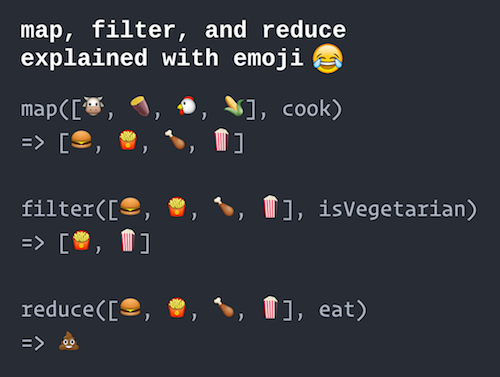
The Declarative Shift: From Loops to Functions
Before we dive into each function, it's important to understand the paradigm shift they represent. Coming from a background where you've likely written countless for loops, you're accustomed to an imperative style of programming: you explicitly tell the computer every step to take. You initialize a counter, define a condition to stop, increment the counter, and access array elements using an index.
Higher-order array methods enable a declarative style. You declare your intent—"I want a new array where every number is doubled"—and pass a function that defines the transformation. The underlying iteration is abstracted away. This leads to cleaner code with less boilerplate and fewer opportunities for off-by-one errors.
Let's see what this looks like in practice. The following video from Traversy Media provides an excellent comparison between using a traditional for loop and the filter method to accomplish the same task.
JavaScript Higher Order Functions & Arrays
This video, "JavaScript Higher Order Functions & Arrays," is a great practical guide. We'll focus on the filter section to see the contrast between imperative and declarative styles.
Watch the segment from the start of the filter section. Pay close attention to how the for loop requires you to create an empty array, manually check a condition, and push to the new array, while filter encapsulates all that logic. Note the evolution from a standard function callback to a concise one-line arrow function.
The benefits are clear:
- Readability:
ages.filter(age => age >= 21)reads almost like plain English. - Immutability: These methods don't modify the original array; they return a new one. This is a core principle of functional programming that prevents side effects and makes state management more predictable.
- Composability: As we'll see later, these functions can be chained together to create powerful data processing pipelines.
1. Map: One-to-One Transformation
The map method is your tool for transformation. It iterates over every element in an array, applies a callback function to it, and returns a new array of the same length, containing the results of that callback. It creates a one-to-one mapping from the input array to the output array.
Common use cases for map include:
- Extracting a specific property from an array of objects.
- Applying a calculation to each number in an array.
- Formatting each string in an array.
The following video provides a clear walkthrough of map, including a great real-world example.
map, filter & reduce 🙏 Namaste JavaScript Ep. 19 🔥
In this segment from "Namaste JavaScript," Akshay Saini explains the core concept of map and then applies it to a practical data manipulation task.
First, watch the conceptual introduction from the beginning to understand the idea of transformation. Then, skip to the practical example from transforming user data. This demonstrates how to use map to create a new array of full names from an array of user objects, a very common task when working with API data.
Here is the code from the video, which you can analyze:
const users = [
  { firstName: "akshay", lastName: "saini", age: 26 },
  { firstName: "donald", lastName: "trump", age: 75 },
  { firstName: "elon", lastName: "musk", age: 50 },
  { firstName: "deepika", lastName: "padukone", age: 26 },
];

// Using map to create an array of full names
const fullNames = users.map(user => `${user.firstName} ${user.lastName}`);

console.log(fullNames);
// Output: ["akshay saini", "donald trump", "elon musk", "deepika padukone"]
2. Filter: Conditional Selection
The filter method is for selection. It iterates over an array and returns a new array containing only the elements for which the provided callback function returns a truthy value. The new array's length will be less than or equal to the original's.
You use filter whenever you need a subset of an array based on a condition. For a deeper look at filter and its syntax, the following guide is an excellent resource.
How to Use Map, Filter, and Reduce in JavaScript | Envato Tuts+
This Envato Tuts+ article gives a great breakdown of each method, including comparisons to loops and potential gotchas.
In the article, find the section titled "Filter Out the Noise". Read from this point down to the end of the "Gotchas" subsection. It reinforces the concept with another task-based example and warns about the common pitfall of forgetting to return an explicit boolean, which can lead to silent bugs.
3. Reduce: Powerful Aggregation
The reduce method is arguably the most versatile and powerful of the three. It executes a "reducer" callback function on each element of the array, resulting in a single output value. While map and filter always return an array, reduce can return anything: a number, a string, an object, or even another array.
The reducer function takes two main arguments:
accumulator: The value resulting from the previous callback invocation. On the first call, it's theinitialValueif one is provided.currentValue: The current element being processed in the array.
Understanding how the accumulator carries the result from one iteration to the next is the key to mastering reduce. This can be tricky, so let's use a resource that builds the concept from the ground up, starting with a familiar for loop.
map, filter & reduce 🙏 Namaste JavaScript Ep. 19 🔥
We return to "Namaste JavaScript" for a brilliant explanation of reduce. The instructor first solves problems with a loop, then refactors to reduce, making the connection explicit.
Watch this segment on reduce, where the task of summing an array is shown first with a for loop and then with reduce. This directly translates the concept of an accumulating variable (sum) to the accumulator parameter. Next, watch the more advanced example from "how many users have a particular age". This is a fantastic demonstration of reduce's power. Here, the initial value is an empty object ({}), and the reducer builds up a frequency map. This pattern is extremely useful for data analysis and is a great way to challenge your understanding.
Here's the code for the age-counting example. Try to trace its execution mentally:
const users = [
  { firstName: "akshay", lastName: "saini", age: 26 },
  { firstName: "donald", lastName: "trump", age: 75 },
  { firstName: "elon", lastName: "musk", age: 50 },
  { firstName: "deepika", lastName: "padukone", age: 26 },
];

const ageReport = users.reduce((acc, curr) => {
  if (acc[curr.age]) {
    // If the age already exists as a key, increment it
    acc[curr.age] = acc[curr.age] + 1;
  } else {
    // If the age doesn't exist, initialize it to 1
    acc[curr.age] = 1;
  }
  return acc; // Always return the accumulator for the next iteration
}, {}); // The initial value is an empty object

console.log(ageReport);
// Output: { '26': 2, '50': 1, '75': 1 }
Chaining: Building Data Processing Pipelines
The true elegance of these functions is revealed when you chain them. Since map and filter both return new arrays, you can feed the result of one directly into the next, creating a clean, readable, and highly composable data processing pipeline.
For example, a common task is to process a list of items: first, you filter for the ones you care about, then you map them to the shape you need, and finally, you reduce them to a final result.
This final video demonstrates how to combine multiple methods to perform a complex data manipulation task in just a few lines of code.
JavaScript Higher Order Functions & Arrays
Let's return to the Traversy Media video to see chaining in action.
Watch the final segment on combining methods. The instructor chains map, filter, sort, and reduce to transform an array of numbers. This showcases how you can build a multi-step computation declaratively, without intermediate variables or multiple loops.
This declarative pipeline is much easier to read and reason about than a series of nested loops and temporary variables. Each step in the chain is a self-contained, predictable transformation.
Conclusion
In this lesson, we've moved from the imperative world of for loops to the declarative power of higher-order array methods. This is a fundamental skill for writing modern, professional JavaScript.
Key Takeaways:
- Higher-Order Functions like
map,filter, andreduceaccept other functions as arguments (callbacks) to process collections. maptransforms each element of an array, returning a new array of the same length. Think transformation.filterselects elements that meet a condition, returning a new, potentially smaller array. Think selection.reduceaggregates all elements into a single value (of any type), making it incredibly versatile. Think aggregation.- Chaining these methods allows you to build powerful, readable, and declarative data processing pipelines, which is a significant advantage over complex, stateful loops.
In our next lesson, we will take this idea of chaining one step further. We'll learn how to implement function composition, a technique for creating a reusable pipeline of operations that can be applied to any data, formalizing the powerful patterns we've explored today.