Welcome back! In our previous lessons, you've built the core engine of our vector database, culminating in a robust recovery system that can withstand crashes. You've engineered a durable, persistent backend. Now, the challenge shifts from internal mechanics to external presentation. How do we offer this powerful engine to the world in a clean, professional, and maintainable way?
This lesson marks the beginning of our final phase: turning our project into a distributable library. We will start by designing its public Application Programming Interface (API). You will learn how to use a fundamental C pattern—the opaque pointer—to hide all the complex internal machinery we've built, exposing only a clean and stable set of functions to the end-user. This is the difference between a one-off academic project and a piece of reusable, professional software.
The Power of Abstraction
So far, anyone using our code would need to know about HNSWGraph, Arena, Node, wal_t, and all the other internal components. This is undesirable for two main reasons:
- Complexity: It forces users to understand implementation details they shouldn't need to care about. They just want to insert and search for vectors.
- Brittleness: If we decide to change how
HNSWGraphis structured or how theArenaworks, every program that uses our library would break. The user's code becomes tightly coupled to our internal design choices.
To solve this, we need to apply the principle of abstraction or encapsulation. We will hide the implementation details and expose only a well-defined public interface. In object-oriented languages like C++, you'd use private members to achieve this. In C, one of the most powerful tools for this is the opaque data type.
The video below gives an excellent overview of why abstraction is crucial and how opaque types help achieve it in C.
Make your Data Type more Abstract with Opaque Types in C
This video from the Jacob Sorber channel introduces the concept of abstraction and how opaque data types provide a mechanism for information hiding in C.
Watch the first few minutes to understand the motivation behind hiding implementation details, from the introduction to abstraction to the parallel with private members in C++. Then, pay close attention to the example of the FILE pointer from the C standard library, which is a perfect real-world case of an opaque type.
As you saw, you've been using opaque types all along with FILE *. You can fopen, fread, fwrite, and fclose, but you never access the members of the FILE struct directly. We are going to build the same kind of interface for our vector database.
The Opaque Pointer Pattern
The technique we'll use is often called the "opaque pointer" or "incomplete type" pattern. It's a simple but elegant trick that relies on separating a type's declaration from its definition.
-
The Public Header File (
.h): This file is the public contract. It declares the existence of a struct but does not define its contents. It then creates atypedeffor a pointer to this incomplete type. This pointer becomes the "handle" that users will interact with. -
The Implementation File (
.c): This file contains the private details. It provides the full definition of the struct and implements the functions declared in the header. Because the full definition is here, these functions can access the struct's internal members.
The user's code only includes the header file. Since the compiler only sees an incomplete type, it will produce an error if the user tries to dereference the handle and access its members, thus enforcing our abstraction.
This article from Memfault's Interrupt blog provides a fantastic, practical walkthrough of this pattern.
Practical Design Patterns: Opaque Pointers and Objects in C
This article breaks down the opaque pointer pattern using a clear ring buffer example.
Read through the first few sections. Start with The Opaque Pointer Pattern to see the header and source file structure side-by-side. Then, read about the object lifecycle functions (create and destroy), which are analogous to constructors and destructors. Finally, review the sections on why the handle is an abstract handle and the core benefit of this pattern: Encapsulation.
As the article highlights, this pattern provides two key benefits:
- Encapsulation: It prevents users from meddling with the internal state of your data structures, which could lead to bugs and instability.
- Decoupling: It allows you to freely change the internal implementation without breaking user code, as long as the public API functions remain consistent.
A More Type-Safe Approach
At its core, an opaque pointer is just an address. The simplest way to represent a generic address is with a void*.
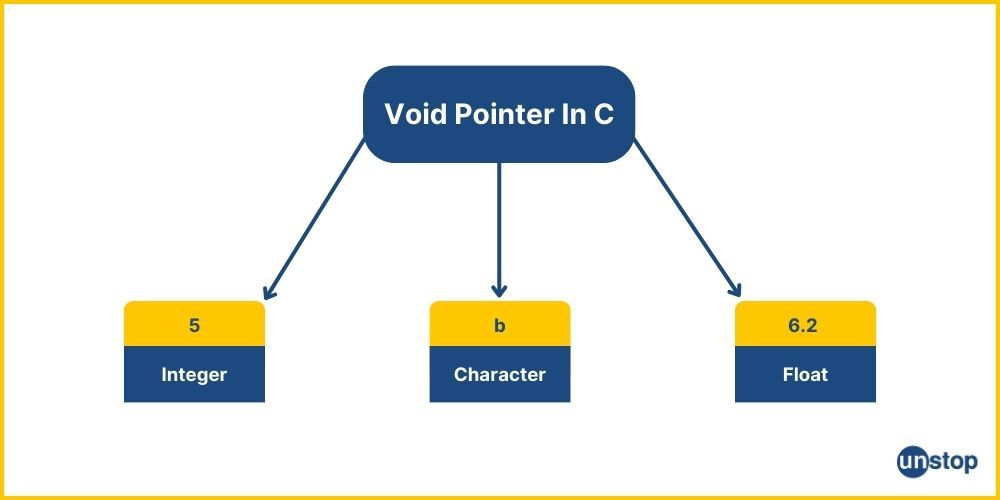
A void* can point to any type of data, such as an integer, a character, or a float. It is a generic pointer, but it carries no type information, making it less safe.
While you could design an API where every handle is a void*, this approach sacrifices type safety. A user could accidentally pass a handle from one library to a function from another, and the compiler would have no way of catching the error.
A much better approach is the one shown in the Interrupt article: creating a unique, albeit incomplete, type for each handle.
// In the public .h file
typedef struct my_object_ *my_object_handle_t;

// In the private .c file
struct my_object_ {
    int internal_field;
    // ...
};
With this pattern, my_object_handle_t is a distinct type. If a user tries to pass a FILE* to a function expecting a my_object_handle_t, the compiler will flag it as a type mismatch. This provides the same level of abstraction as void* but with the added benefit of compile-time safety.
This blog post on "Opaque Data Pointers" explores this distinction and the implementation details further.
Opaque Data Pointers - Ruminations - Aaron Ballman
This article contrasts the raw void* approach with the safer forward-declaration method.
First, quickly look at the downside of using void* and the workaround of using a "magic" value described in the text from this section. This shows why a raw void* is not ideal. Then, focus on the superior technique, which uses unique types. Finally, read the section on forward declarations see a full example of how the header declares the API and the implementation file defines the private struct.
Designing the API for Our HNSW Database
Now, let's apply this pattern to design the API for our HNSW vector database. We will create a single handle that represents an entire database index. Let's call it hnsw_index_t. This handle will be an opaque pointer to a private struct containing all the state we've managed so far: the graph, the memory arenas, the file descriptors, the WAL, etc.
Here is a proposed design for our public header file, which we might call hnsw.h:
#ifndef HNSW_H
#define HNSW_H

#include <stddef.h>
#include <stdint.h>

// --- Opaque Handle Definition ---

/**
 * @brief An opaque handle to the HNSW index.
 * All operations are performed through this handle.
 */
typedef struct HnswIndex HnswIndex;


// --- Public API Functions ---

/**
 * @brief Loads an existing HNSW index from a file or creates a new one.
 *
 * @param path Path to the database file.
 * @return A handle to the index, or NULL on failure.
 */
HnswIndex* hnsw_load(const char* path);

/**
 * @brief Destroys the HNSW index handle and releases all resources.
 * This function also ensures all data is synced to disk.
 *
 * @param index The handle to the index.
 */
void hnsw_destroy(HnswIndex* index);

/**
 * @brief Inserts a vector into the index.
 *
 * @param index The handle to the index.
 * @param vec Pointer to the vector data (must have 'dim' elements).
 * @param id A unique identifier for this vector.
 * @return 0 on success, -1 on failure.
 */
int hnsw_insert(HnswIndex* index, const float* vec, uint32_t id);

/**
 * @brief Searches for the K-nearest neighbors to a query vector.
 *
 * @param index The handle to the index.
 * @param query_vec The vector to search for.
 * @param k The number of neighbors to find.
 * @param out_ids A user-provided array to store the IDs of the neighbors.
 * @param out_dists A user-provided array to store the distances of the neighbors.
 * @return The number of neighbors found (can be less than k).
 */
size_t hnsw_search(HnswIndex* index, const float* query_vec, size_t k, uint32_t* out_ids, float* out_dists);

#endif // HNSW_H
And in our implementation file, hnsw.c, we would define the HnswIndex struct:
#include "hnsw.h"
#include "hnsw_graph.h" // Our internal graph structures
#include "arena.h"      // Our memory allocator
#include "wal.h"        // Our write-ahead log

// The actual, private definition of our index structure.
// Users of the library cannot see this.
struct HnswIndex {
    HNSWGraph* graph;
    Arena* node_arena;
    Arena* data_arena;
    wal_t* wal;
    int data_fd;
    char* db_path;
    // ... any other configuration or state
};

// Implementation of hnsw_load(), hnsw_destroy(), etc. goes here...
This design achieves our goal perfectly. The user interacts with a simple HnswIndex* handle and a small set of functions, completely unaware of the complex machinery running underneath.
The following video provides two more concrete examples—a motor controller and a PID controller—that reinforce how an opaque pointer is used to protect internal variables while exposing a clean public API. This will be very familiar given your interest in systems programming.
Firmware Engineer C Fundamentals | Opaque Pointers
This video from MetalSilicon demonstrates implementing opaque pointers for a motor controller and a PID controller, showing how to protect internal state.
Watch the section from the motor controller example. Notice how the header file (motor.h) only contains the function declarations and the opaque pointer typedef, while motor.c has the "secret definition". The key takeaway is when an attempt to access an internal variable from main.c results in a compile-time error. Then, briefly review the PID controller example, which shows the same pattern applied to a different problem.
Conclusion
In this lesson, you've learned a cornerstone of professional C library design: hiding implementation details using opaque pointers. This technique provides encapsulation and stability, allowing your library to evolve internally without breaking the code of those who use it. It is a critical step in elevating your project from a self-contained program to a reusable and robust piece of software.
Key Takeaways:
- API as a Contract: A public header file defines the stable "contract" between your library and its users.
- Encapsulation in C: Hiding internal data structures is crucial for maintainability and preventing misuse.
- Opaque Pointers: The "incomplete type" pattern (
typedef struct T* t_handle;) is the standard, type-safe way to create handles to hidden data structures in C. - Lifecycle Functions: An API using opaque pointers typically includes
*_create()or*_load()and*_destroy()functions to manage the object's lifetime. - Our API Design: We have sketched a clean, minimal API for our vector database (
hnsw_load,hnsw_destroy,hnsw_insert,hnsw_search) centered around a single opaque handle,HnswIndex*.
In our next lesson, we will move from design to implementation. You will write the C code for these API functions, wiring them up to the backend logic you've already built and tested.