Introduction
Welcome to our final lesson in the Geomorphology course. We have journeyed from the Earth's molten core to its dynamic surface, exploring the forces that shape our world. In our last two lessons, we saw how rivers carve valleys and how glaciers sculpt mountains. Now, we move from water and ice to another powerful, invisible force: the wind.
This lesson addresses the last learning outcome in our syllabus: identifying the major landforms created by wind action. We will focus on the arid and semi-arid desert regions where the wind's effects are most dramatic. You will learn to identify key erosional features, like the distinctive mushroom rock, and major depositional features, particularly the different types of sand dunes. Mastering these concepts is crucial for the physical geography questions you'll encounter in your SSC CGL exam and will complete your foundational knowledge of geomorphology.
How Wind Shapes the Land
In deserts, the lack of vegetation and moisture means that loose sand and rock fragments are easily picked up and transported by the wind. This process of shaping the land by wind is known as aeolian (or eolian) action. The wind acts as an agent of erosion and deposition through three primary mechanisms.
To understand these fundamental processes, let's turn to a concise summary based on G.C. Leong's well-regarded physical geography text.
GC Leong Summary of Arid or Desert Landforms - EduRev
This article from EduRev provides clear, exam-focused explanations of the key mechanisms of wind erosion. Understanding these processes is the first step to identifying the landforms they create.
Please navigate to the sub-heading "Action of Wind". Read the descriptions for the three main processes: Deflation, which is the lifting and blowing away of loose material; Abrasion, the "sandblasting" effect of wind-carried particles; and Attrition, where particles collide and wear each other down.
Erosional Landforms: Carved by Wind
Wind abrasion is most effective within a few feet of the ground, where the wind can carry the largest, most abrasive sand particles. This leads to some uniquely shaped landforms where the base of a rock is eroded more quickly than its top.
The most classic example of this is the Mushroom Rock, also known as a Rock Pedestal.
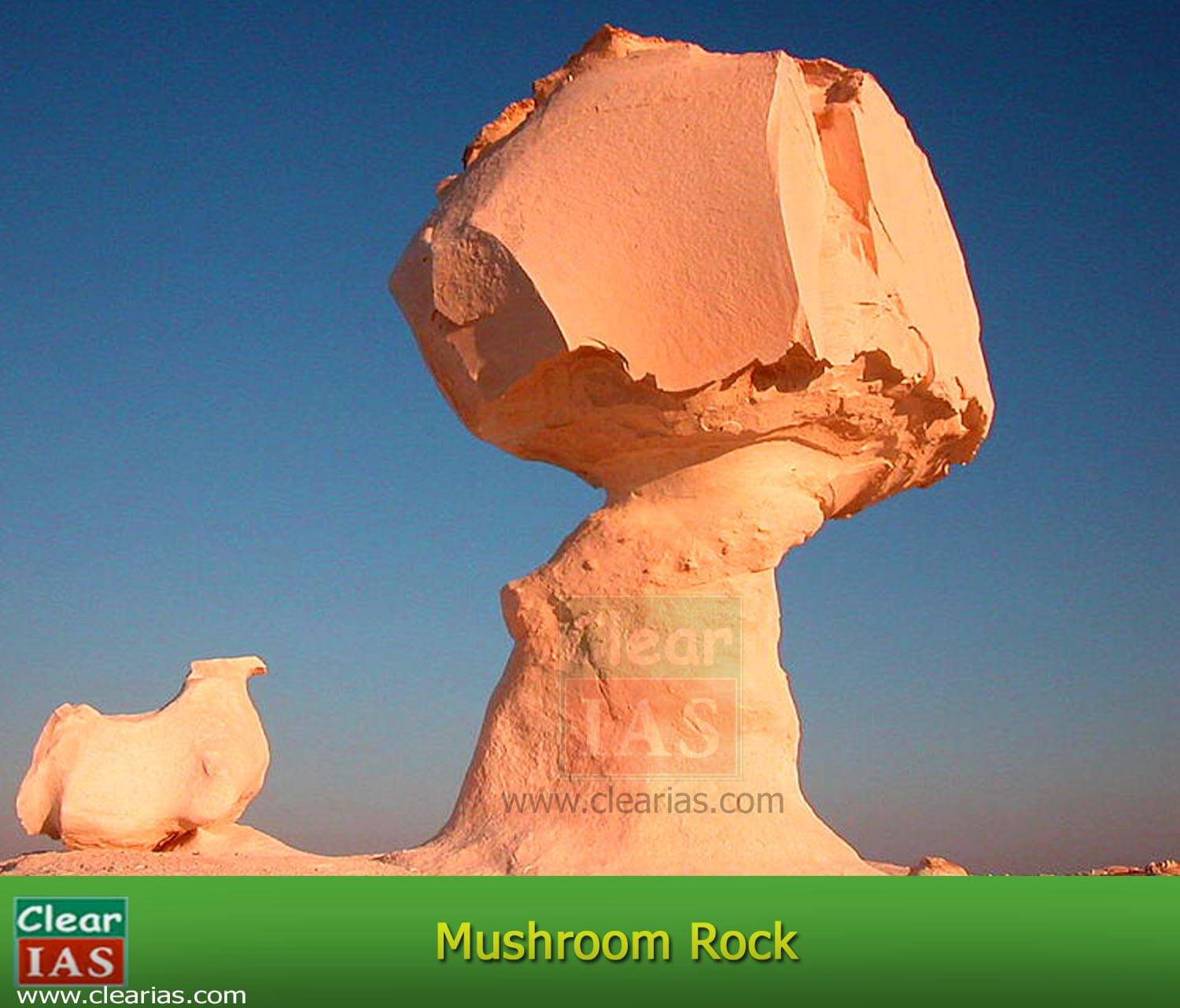
Besides mushroom rocks, wind erosion in deserts carves out several other important features that are frequently tested in exams. These are primarily formed in areas where there are alternating layers of hard and soft rock.
Let's return to the EduRev article for clear definitions of these features.
GC Leong Summary of Arid or Desert Landforms - EduRev
This section of the article clearly defines the most important wind-eroded landforms you need to know.
Under the heading "Landforms of Wind Erosion in Desert," please read the descriptions for the following: Rock pedestals / Mushroom rocks: This reinforces the concept we just discussed. Zeugen: Note that these form where horizontal layers of hard rock protect softer rock underneath. Yardangs: Contrast these with Zeugen. Here, the bands of hard and soft rock are vertical and aligned with the wind. Isenberg: These are isolated, steep-sided hills of hard rock that remain after the surrounding landscape has been eroded away.
Depositional Landforms: Built by Wind
When the wind slows down or meets an obstacle, it loses its energy and drops the sediment it is carrying. The heaviest particles, like sand, are deposited first and accumulate to form vast sandy deserts (known as ergs) and distinct hills of sand called dunes. Finer material, like silt, can be carried much further before being deposited as a fertile blanket known as loess.
Sand Dunes are the most characteristic feature of sandy deserts. They are not random piles of sand; their shape is determined by the wind's direction and strength, as well as the amount of available sand.
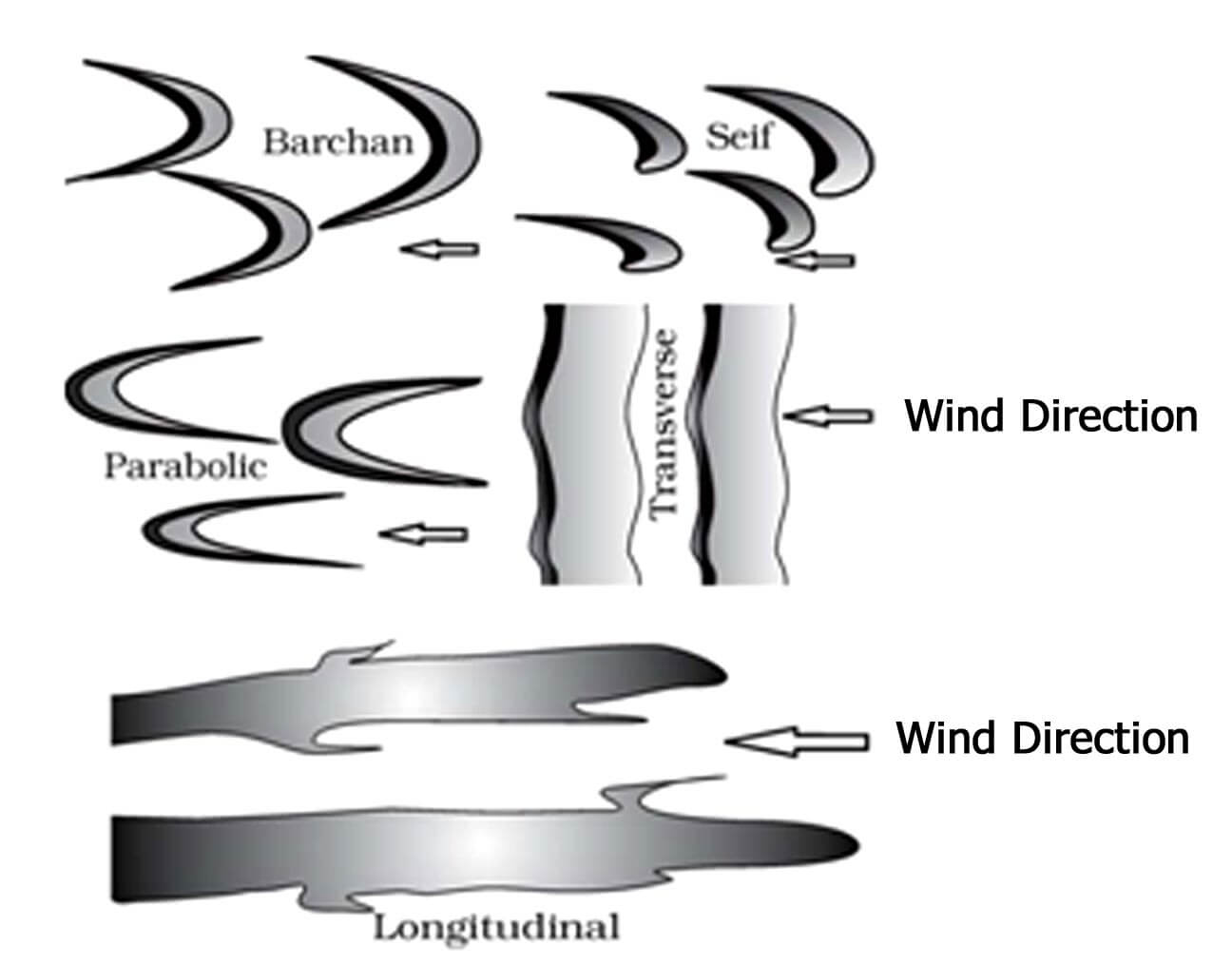
For your exam, it's important to be able to identify the most common types:
- Barchans: These are crescent-shaped dunes that form where the wind direction is constant and the sand supply is limited. Their "horns" point downwind.
- Seif (or Longitudinal) Dunes: These are long, narrow ridges of sand that lie parallel to the direction of the prevailing wind.
- Transverse Dunes: These are long ridges of sand that form at right angles to the wind direction. They look like waves on a sea of sand.
- Parabolic Dunes: These are U-shaped dunes, but unlike barchans, their open end faces upwind. They often form where vegetation anchors parts of the dune.
To get the precise definitions needed for your exam, we'll consult our EduRev resource one last time.
GC Leong Summary of Arid or Desert Landforms - EduRev
This final section covers the key depositional features, providing the definitions you'll need to memorize for exam questions.
Under the heading "Landforms of Wind Deposition in Deserts," read the descriptions for Dunes, paying close attention to the characteristics of the Barchan. Then, read about Seif dunes and finally, the definition of Loess.
Conclusion
This lesson concludes our rapid tour of Geomorphology. We have explored how wind, operating in arid environments, acts as a powerful sculptor of the land. By understanding the processes of deflation and abrasion, you can now confidently identify the resulting landforms.
Key Takeaways:
- Wind erodes through deflation (lifting loose particles) and abrasion (sandblasting).
- Major erosional landforms include Mushroom Rocks (undercut at the base), Zeugen (formed in horizontal hard/soft rock layers), and Yardangs (formed in vertical hard/soft rock layers).
- Major depositional landforms include Sand Dunes (like Barchans, Seif/Longitudinal, and Transverse dunes) and Loess (deposits of fine wind-blown silt).
You have now covered the Earth's internal structure, the rock cycle, plate tectonics, and the major landforms created by volcanoes, earthquakes, rivers, glaciers, and wind. This provides a complete and concise foundation for the Geomorphology section of your SSC CGL General Awareness paper. Well done on completing the course