Hey there! Welcome back. I hope you're ready for our next step on this thermodynamics journey.
In our last conversation, we set the stage. We learned how to draw a metaphorical circle around any part of the universe we want to study, defining it as a system. We distinguished it from the surroundings and figured out how to classify it as open, closed, or isolated based on what crosses its boundary.
That's a fantastic start. But now that we've defined our system—be it a car engine, a can of soup, or a planet—we need a way to describe it. What condition is it in? How do we measure its characteristics?
That's our goal for today. We're going to learn about thermodynamic properties. These are the measurable characteristics that define a system's state, like its temperature, pressure, or the space it occupies. We'll discover that all properties fall into two major categories: intensive and extensive. Understanding this distinction is like learning the difference between nouns and adjectives in a new language—it's fundamental to describing everything that follows.
The Big Idea: The "Splitting Test"
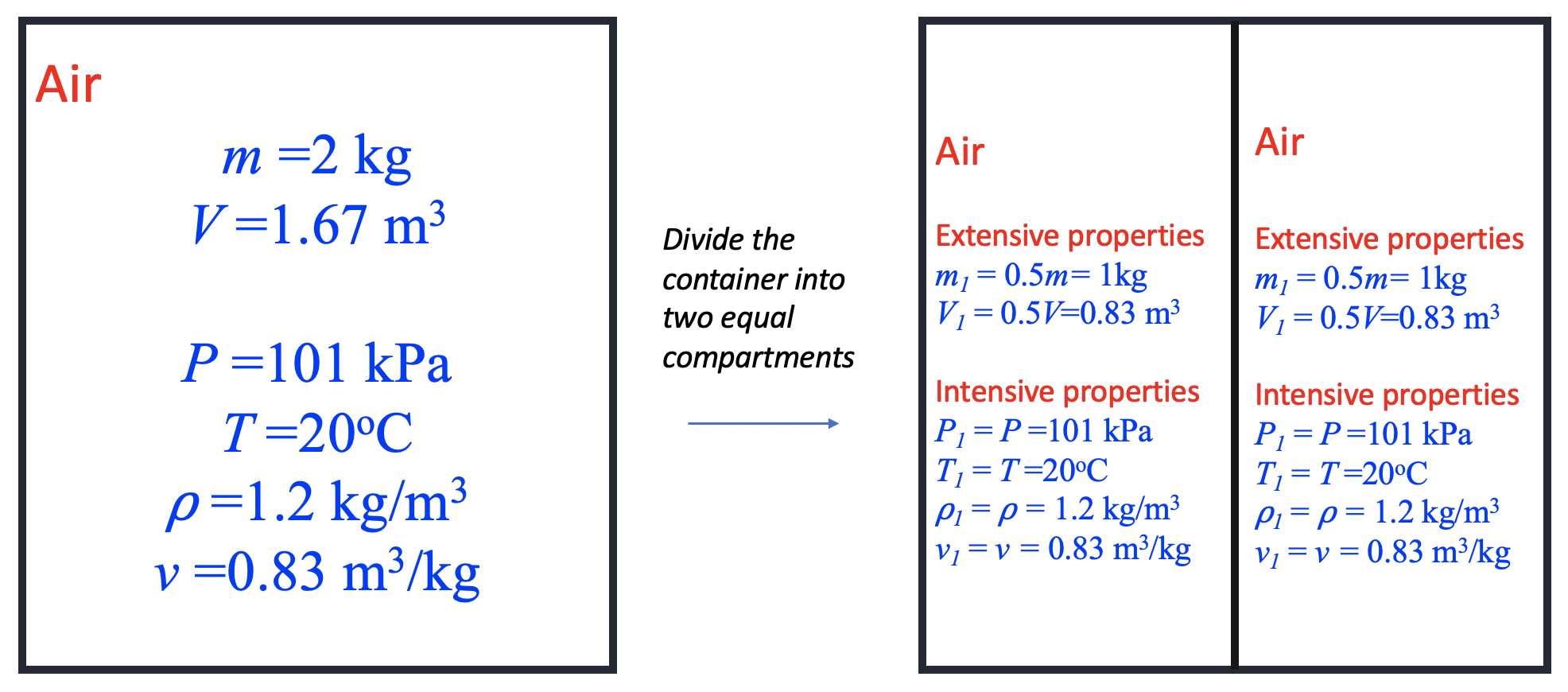
Let's start with a simple thought experiment. Imagine your room is the system. It's filled with air. Let's say the air in the room has a certain mass, it takes up a certain volume, and it has a uniform temperature and pressure throughout.
Now, let's mentally draw an imaginary wall right down the middle of the room, splitting it into two equal halves.
Let's ask what happened to the properties of the air in each new, smaller "system":
- Volume: The original volume was the whole room. The volume of each half is now exactly half of the original. So, volume depends on the size of the system.
- Mass: The original mass was all the air in the room. The mass in each half is now half of the original. So, mass also depends on the size of the system.
- Temperature: If the room was 20°C before, what's the temperature in each half? It's still 20°C. Temperature does NOT depend on the size of the system.
- Pressure: The atmospheric pressure was the same everywhere in the original room. It's still the same in each half. Pressure also does NOT depend on the size of the system.
This simple "splitting test" is the core intuition. We've just discovered the two families of properties:
- Extensive Properties: These depend on the size or amount (mass) of the system. If you split the system in half, the property gets halved. (Examples: Mass, Volume).
- Intensive Properties: These are independent of the size or amount of the system. If you split the system in half, the property stays the same. (Examples: Temperature, Pressure).
A helpful mnemonic is that INtensive properties are INdependent of size.
Getting a Clearer Picture
Let's watch a short video that does a great job of explaining this with another visual example.
Thermo: Lesson 2 - Intensive vs. Extensive Properties and Units
The presenter, Jeff Hanson, uses beakers of 'slime' to make the distinction between intensive and extensive properties very clear. Pay attention to how he applies the 'splitting test' logic to classify different properties.
Watch from 1:59 to 6:24. First, he'll give you the formal definitions of intensive and extensive properties and the mnemonic I just mentioned (1:59 - 3:40). Then, he'll apply these definitions to a list of properties like temperature, mass, volume, and pressure, using his two beakers as the example (3:40 - 6:24).
To summarize and reinforce this, here’s a great image showing the splitting test in action for a container of air.
The Clever Trick: Creating Intensive from Extensive
This is where things get really interesting and powerful. You can create an intensive property by dividing one extensive property by another.
The most famous example is density.
The formula for density, which you might remember, is:
Think about it:
- Mass is extensive (more stuff = more mass).
- Volume is extensive (more stuff = more volume).
But their ratio, density, is intensive. A tiny iron pellet and a giant iron girder have the exact same density. If you double the amount of material, you double both the mass and the volume, so their ratio stays constant!
This idea of dividing an extensive property by the system's mass is a common theme in thermodynamics. We call such properties specific properties.
Specific Property = An Extensive Property / Mass
The most important one for us right now is specific volume. Volume (V) is extensive. But if we divide it by mass (m), we get a new property that is intensive.
A crucial convention: In thermodynamics, we often use a capital letter for an extensive property (like for total volume) and a lowercase letter for the corresponding intensive specific property (like for specific volume). So if you see (total internal energy) and (specific internal energy), you'll know is extensive and is intensive.
The beauty of specific properties is that they let us talk about a substance's characteristics without needing to know how much of it we have. The specific volume of water at a certain temperature and pressure is a fixed value, whether you have a drop or a swimming pool. This is why data for materials is always given in terms of intensive properties.
Let's see this concept of creating intensive properties from extensive ones explained in another way.
1.3 Extensive and intensive properties
This short textbook section, 'Extensive and intensive properties' from BCcampus, reinforces what we've just discussed and formally defines specific properties.
Read the two main paragraphs of this section (ignore the 'Continuum' part for now). Focus on how it uses the container-of-air example and explicitly states that all specific properties are intensive.
Why Do We Care?
This isn't just academic labeling. This distinction is critical for a few reasons:
- Defining a State: To describe the condition, or "state," of a system, we use its properties. Typically, we use intensive properties like temperature and pressure.
- Identifying Substances: Intensive properties like density, boiling point, and melting point are like a substance's fingerprint. We can use them to identify what something is. You can't tell a substance by its mass, but you can by its density.
- Engineering Calculations: When we analyze engines or power plants, we often want to know things "per kilogram" of fluid passing through. This is where specific properties (, , etc.) become essential.
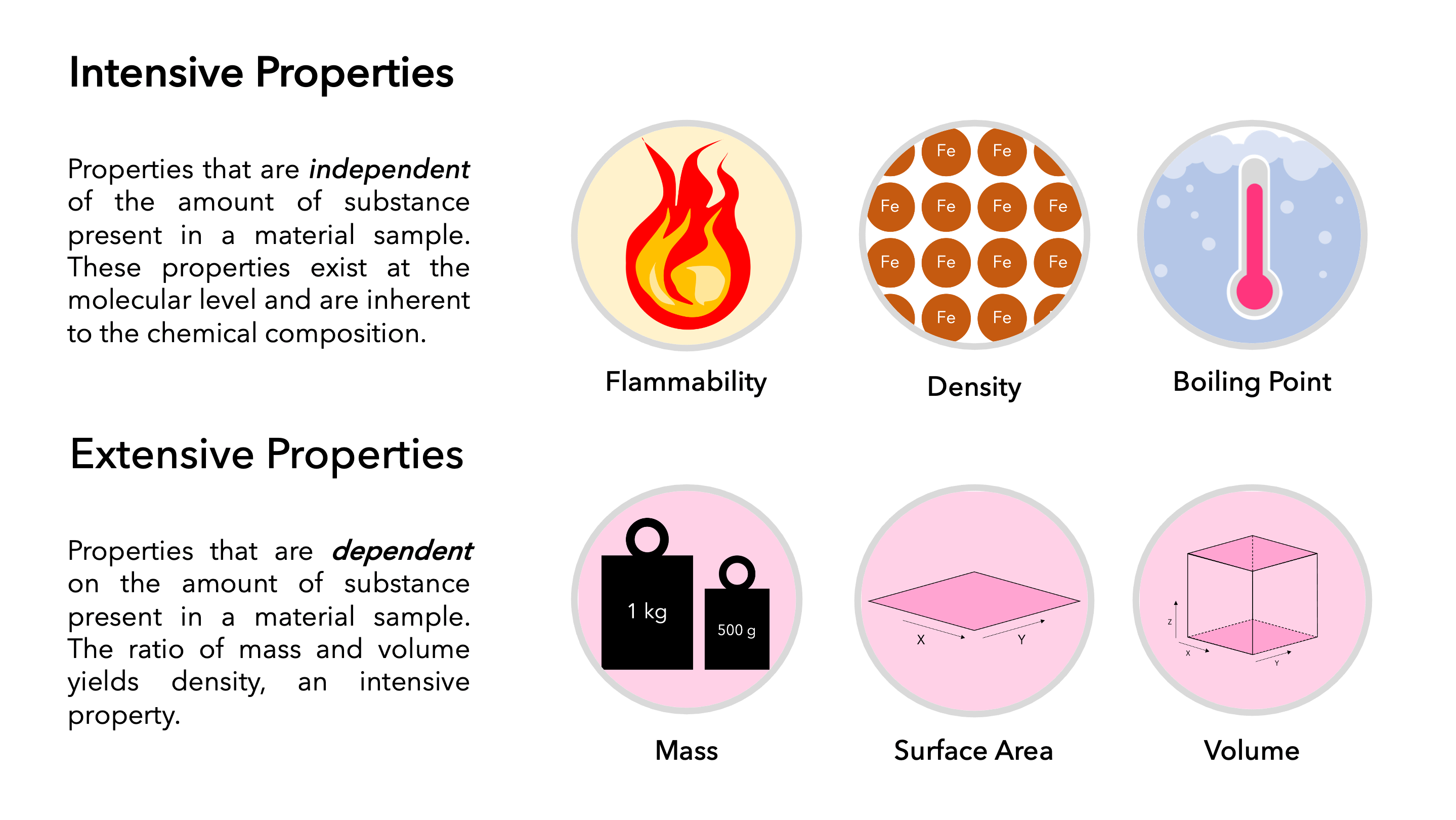
Here is a quick visual summary of some common examples.
Time to Practice
Let's put this into action. Answer the conceptual questions first, then we'll tackle some numbers.
Conceptual Questions
Test your understanding!
Question 1: For each property below, classify it as intensive or extensive.
- a) Color
- b) Weight (Hint: Weight = mass × acceleration due to gravity)
- c) Length
- d) Boiling Point
- e) Total energy stored in a battery
Show answers
- a) Intensive. A small piece of gold is the same color as a large gold bar.
- b) Extensive. Weight depends directly on mass. More mass means more weight.
- c) Extensive. If you have more of something, it's generally longer, wider, or taller. It depends on the extent of the system.
- d) Intensive. A pot of water boils at 100°C (at sea level) whether it's a small pot or a huge one.
- e) Extensive. A larger battery stores more total energy than a smaller one of the same type.
Test your understanding!
Question 2: You have a glass of very salty water. You pour half of it out. Which of these properties of the remaining water have changed, and which have stayed the same?
- Mass
- Temperature
- Volume
- Saltiness (concentration)
- Density
Show answers
- Changed (Extensive):
- Mass: You have half the water, so you have half the mass.
- Volume: You have half the water, so it takes up half the volume.
- Stayed the Same (Intensive):
- Temperature: Pouring it out doesn't change its temperature.
- Saltiness (concentration): The remaining water is just as salty as the original.
- Density: The density of the salty water is unchanged.
Worked Numerical Problems
Let's do some calculations.
Problem 1: Finding Specific Volume
A rigid tank contains 2 kg of air. The volume of the tank is 1.5 cubic meters (m³).
a) What is the total volume of the air?
b) What is the specific volume of the air?
Solution:
- Step 1 (a): Find the total volume.
- The air fills the entire tank. The system is the air, and its volume is determined by the container.
- Total Volume, . This is an extensive property.
- Step 2 (b): Calculate the specific volume.
- Specific volume is an intensive property, found by dividing the total volume by the total mass.
- So, each kilogram of air in that tank occupies 0.75 cubic meters.
Problem 2: Additive Properties
You have two blocks of aluminum.
- Block A has a mass of 5 kg and a volume of 0.00185 m³.
- Block B has a mass of 10 kg.
You melt them down and combine them into a single large block, Block C.
a) What is the total mass of Block C?
b) What is the density of aluminum?
c) What is the total volume of Block C?
Solution:
- Step 1 (a): Find the total mass of Block C.
- Mass is an extensive property, which means it is additive.
- Step 2 (b): Find the density.
- Density is an intensive property. We can calculate it from the information for Block A, and it will be the same for Block B and Block C.
- Step 3 (c): Find the total volume of Block C.
- Volume is also an extensive, additive property. We can find it in two ways.
- Method 1: Using density. Now that we know the density and the total mass of Block C, we can rearrange the density formula.
- Method 2: Adding the volumes. We can find the volume of Block B first, then add it to Block A's volume.
- Both methods give the same answer, demonstrating how extensive and intensive properties relate to each other.
Lesson Summary
Excellent work today! We've added another crucial layer to our understanding.
- Properties are the measurable characteristics we use to describe a system.
- Extensive Properties depend on the size or mass of the system (e.g., mass, total volume). They are additive.
- Intensive Properties are independent of the size or mass of the system (e.g., temperature, pressure, density). They are not additive.
- The "Splitting Test" is our go-to mental model to figure out if a property is intensive or extensive.
- Specific Properties (like specific volume, ) are created by dividing an extensive property by mass. All specific properties are intensive.
Preview of the Next Lesson
So far, we have defined a system and learned the language to describe its properties. The next question is, what happens when those properties stop changing? If you leave a cup of coffee in a room, it will eventually cool down to room temperature and then just... sit there. Its properties become constant.
In our next lesson, we will explore this idea of Thermodynamic Equilibrium. We'll then formally define what a state, a process, and a cycle are. This will set the stage for us to start analyzing the changes that happen within a system—the very heart of thermodynamics.