Hey there! Welcome to our very first lesson in thermodynamics. I'm excited to start this journey with you. Think of these lessons as a conversation we're having while walking through the world, noticing how things work. Our goal today is to get a handle on the most fundamental ideas in this field: energy, heat, and work.
Before we can understand the powerful engines and complex refrigerators you're interested in, we need to learn the language they speak. Energy, heat, and work are the basic vocabulary. By the end of our chat today, you'll have an intuitive feel for what these terms really mean, how they're different, and how they're all connected. Let's begin at the very beginning.
What is Energy? The Universe's Currency
So, what is energy?
At its heart, energy is the capacity to cause change. That's it. If you want to make something happen—move an object, warm it up, light a room, or even just think a thought—you need energy. It's like the universal currency. You can't create it or destroy it, but you can move it around and change its form to get things done.
You encounter energy in many forms every single day:
- Kinetic Energy: The energy of motion. A moving car has kinetic energy. The faster it goes, the more it has.
- Potential Energy: Stored energy due to position. A book held high on a shelf has gravitational potential energy. If you let it go, that potential energy converts into kinetic energy as it falls.
- Chemical Energy: Energy stored in the bonds of atoms and molecules. The food you eat, the battery in your phone, and the gasoline in a car tank all contain chemical energy.
- Electrical Energy: The energy of moving electrons, which powers our homes.
In thermodynamics, we are especially interested in one particular form: thermal energy.
Thermal Energy vs. Temperature: Total vs. Average
Imagine zooming into any object—a glass of water, the air in a room, a block of steel. You'd see that it's made of trillions of tiny particles (atoms or molecules) that are constantly jiggling, vibrating, and moving around. Each of these tiny particles has a bit of kinetic energy.
Thermal Energy is the total kinetic energy of all those particles added together. It's the grand sum of all that microscopic chaos.
Temperature, on the other hand, is a measure of the average kinetic energy of the particles. It tells us, on average, how energetic those particles are.
This distinction is crucial. Let's watch a short video from Khan Academy that explains this beautifully.
Thermal energy, temperature, and heat | Khan Academy
This video does a fantastic job of visualizing the difference between thermal energy (the total) and temperature (the average). It also introduces how energy gets transferred.
Please watch the following three segments: The explanation of thermal energy (00:31 - 02:43). The explanation of temperature and how it differs from thermal energy (02:43 - 05:12). The final summary using the analogy of a hot cup of water vs. the ocean (10:30 - 11:32). Focus on the core idea of 'total' versus 'average' and the ocean analogy.
So, let's recap that key idea. An iceberg has a very low temperature (low average energy per particle), but because it's massive and contains an immense number of water molecules, its total thermal energy is huge. A tiny cup of boiling water has a very high temperature (high average energy per particle), but because it has far fewer particles, its total thermal energy is much smaller than the iceberg's.
This is our first big takeaway:
- Thermal Energy is about the quantity of microscopic motion.
- Temperature is about the intensity of that motion.
Heat: Energy in Transit
This brings us to our next big concept: heat.
In everyday language, we say things "have heat." In thermodynamics, this is incorrect. An object doesn't contain heat. An object contains thermal energy.
Heat is the transfer of thermal energy from a hotter object to a colder one.
It's energy on the move. It only exists at the boundary of a system as energy crosses it. Think of it like this:
- Analogy: Rain
A cloud doesn't "contain" rain; it contains water vapor. "Rain" is the name we give to the process of that water falling from the cloud to the ground. Similarly, a hot object doesn't "contain" heat; it contains thermal energy. "Heat" is the name for the process of that energy moving to a colder object.
So, when you touch a hot stove, you don't "get heat" from it. What's happening is that thermal energy is being transferred from the high-temperature stove to your low-temperature hand. That transfer process is what we call heat.
As the video you just saw mentioned, this transfer can happen in three ways:
- Conduction: Direct contact. The particles of the hot object bump into the particles of the cold object and transfer their energy. (e.g., the handle of a metal spoon in hot soup getting warm).
- Convection: Through the movement of fluids (liquids or gases). Hot, less dense fluid rises, and cool, denser fluid sinks, creating a current that transfers energy. (e.g., boiling water, or a radiator warming a room).
- Radiation: Through electromagnetic waves. This is how the sun warms the Earth across the vacuum of space. (e.g., the warmth you feel from a campfire).
Work: Organized Energy Transfer
If heat is the disorganized transfer of energy through random molecular collisions, then work is the organized transfer of energy.
Work is done when a force acts on an object and causes it to move a certain distance.
- Analogy: A Crowd
- Heat: Imagine a dense crowd of people all jiggling and bumping into each other randomly. The "energy" of the crowd spreads out chaotically. This is like heat transfer.
- Work: Now, imagine that same crowd organizes and pushes together in one direction against a giant wall, moving it. This is a coordinated, directional transfer of energy. This is like work.
When a piston in a car engine is forced down by the explosion of fuel and air, that's work. When you lift a heavy box, you are doing work. You are applying an organized force to cause a displacement.
The simplest way to calculate mechanical work is with the formula:
Where:
- is Work
- is the force applied in the direction of motion
- is the distance the object moves
This article gives a very clear explanation of the conceptual difference between heat and work.
What Conceptual Ideas Distinguish Heat from Work?
Let's read a quick article from RevisionDojo that nails the conceptual difference between heat and work. It reinforces this idea of random vs. organized energy transfer.
Please read the first two main sections, starting from 'What conceptual ideas distinguish heat from work?' down to the end of the paragraph that begins 'These ideas become crucial in thermodynamics.' Focus on how it describes heat as 'random' and work as 'organized' or 'directed'.
Putting It All Together: The Interrelationship
So, let's tie this all together.
Energy (specifically, a system's internal energy, which is mostly thermal energy for our purposes right now) is a property of a system. It's the money in your bank account.
Heat and Work are not properties. They are not things you have; they are things you do. They are the two ways to transfer energy into or out of a system. They are the deposits and withdrawals that change your account balance.
- You can increase the energy of a can of air by placing it over a fire (adding heat).
- You can also increase its energy by using a pump to compress the air into the can (doing work on it).
In both cases, the final internal energy of the air increases, and its temperature goes up. Heat and work are just different methods of getting the energy there.
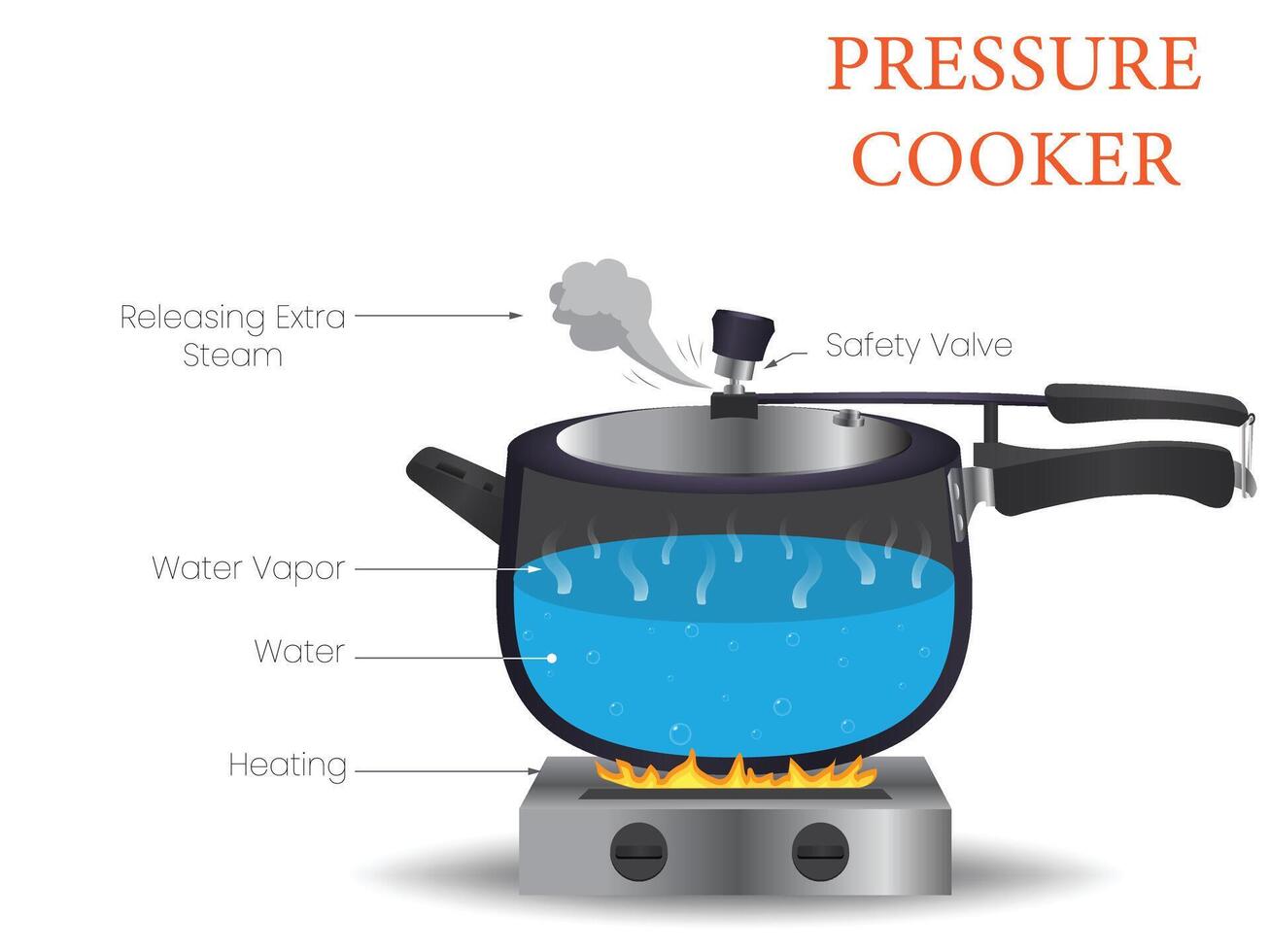
Look at this diagram of a pressure cooker. It’s a perfect everyday example of these concepts in action.
Let's pause here and test our understanding.
Test your understanding!
Conceptual Questions
- You have two logs of wood, a big one and a small one, both at the same room temperature. Which one has more thermal energy? Why?
- Is putting your cold hands over a warm fire an example of work or heat transfer? Explain which of the three types of transfer is most dominant.
- When you pump air into a bicycle tire, the pump gets warm. Is this primarily because of work being done or heat being added from the outside?
- Describe the energy transfers happening when a pot of water is boiled on an electric stove to make tea. Use the terms thermal energy, heat, and work (if applicable).
Show answers
- The big log has more thermal energy. Even though they are at the same temperature (meaning the average kinetic energy of their molecules is the same), the big log has far more molecules. Since thermal energy is the total kinetic energy of all molecules, the bigger log has more.
- This is heat transfer. The dominant form is radiation. The fire emits infrared radiation (a form of light) that travels through the air and is absorbed by your hands, transferring energy and making them feel warm.
- This is primarily due to work being done. You are applying a force to a piston (the pump handle) to compress the air. This organized energy transfer increases the internal energy and temperature of the air inside the pump. The pump body then gets warm via conduction from the hot air.
-
- Electrical energy from the wall outlet is converted into thermal energy at the stove's heating element.
- The hot element transfers heat to the bottom of the pot via conduction.
- Heat is then transferred through the water via convection, causing the overall thermal energy of the water to increase.
- When the water boils, the steam might lift the pot's lid slightly. This lifting action is a form of work being done by the steam on the lid.
Numerical Problems
Let's try a couple of simple calculations for work. Remember, . For lifting problems, the force you need to overcome is gravity, which is , where is the acceleration due to gravity, approximately .
-
Problem: A person pushes a heavy crate across a flat floor with a constant force of 250 Newtons (N) over a distance of 5 meters (m). How much work did the person do on the crate?
Show solution
- Given:
- Force () = 250 N
- Distance () = 5 m
- Formula:
- Calculation:
- Answer: The person did 1250 Joules of work on the crate. (The Joule, J, is the standard unit of energy and work. 1 J = 1 N·m).
- Given:
-
Problem: You lift a 10-kilogram (kg) bag of groceries from the floor to a countertop that is 0.9 meters high. How much work did you do against gravity?
Show solution
- Step 1: Find the force required.
- The force is the weight of the groceries, which you must overcome.
- Force () = mass () acceleration of gravity ()
- Step 2: Calculate the work done.
- Distance () = 0.9 m
- Work () =
- Answer: You did 88.2 Joules of work to lift the groceries.
- Step 1: Find the force required.
Lesson Summary
Great job today! We've laid the very first, and most important, foundation stone. Let's quickly recap the big ideas:
- Energy is the fundamental capacity to cause change. The energy stored in the random motion of molecules is called thermal energy.
- Temperature is not energy; it's a measure of the average energy of those molecules.
- Heat is not something an object contains. It is the transfer of energy because of a temperature difference—a disorganized, chaotic transfer.
- Work is also a transfer of energy, but it's done in an organized way by a force acting over a distance.
- Heat and work are the two ways we can change a system's internal energy. They are like energy deposits and withdrawals.
Preview of the Next Lesson
Now that we have a feel for the "currencies" of thermodynamics, we need to define our "bank account." In our next lesson, we'll focus on Thermodynamic Systems, Surroundings, and Boundaries. We'll learn how to draw an imaginary box around whatever we want to study (an engine, a human body, a cloud) and precisely define how it interacts with the rest of the universe. This is a crucial skill for keeping our energy accounting clear and organized.
See you on our next walk