Hey there, welcome back!
In our last chat, we got our hands dirty with the nuts and bolts of engineering calculations: units and dimensions. We learned the vital difference between energy (a quantity, like money in the bank) and power (a rate, like your monthly salary). You now have the essential tool—dimensional analysis—to make sure our equations are always making sense.
We've laid the foundation. Now, it's time to build the first floor. Today, we're going to get up close and personal with the specific forms of energy that are most visible in our world and the most common way to transfer that energy.
Our learning outcome for this lesson is to solve introductory problems calculating kinetic energy, potential energy, and mechanical work.
Here's our game plan:
- Define Kinetic Energy: The energy of motion.
- Define Potential Energy: The stored energy of position.
- Define Mechanical Work: The primary way to transfer energy by force and motion.
- Connect them all: See how these three concepts are tied together through the work-energy principle.
This lesson is all about the energy you can see—a speeding car, a falling apple, a piston being pushed. Grasping these mechanical forms of energy is the perfect stepping stone to understanding the more invisible forms, like heat and internal energy, which are coming up next.
Let's get started.
1. Kinetic Energy: The Energy of Motion
Imagine you're standing on a sidewalk. A bicycle rolls past you slowly. No big deal. Now, imagine a massive truck roars past at 60 miles per hour. You feel the ground shake a little, you hear the noise—you can intuitively sense the immense energy it carries. That "energy of motion" is what we call kinetic energy.
The word "kinetic" comes from the Greek word kinetikos, meaning "moving." It's that simple. Anything that has mass and is moving has kinetic energy.
The two factors that determine an object's kinetic energy are its mass () and its speed (). The mathematical relationship is:
Let's break that down:
- is the mass in kilograms (kg).
- is the speed in meters per second (m/s).
- is the kinetic energy in Joules (J).
Notice the speed is squared (). This is incredibly important. It means that if you double an object's speed, you don't just double its kinetic energy—you quadruple it ()! This is why driving at high speeds is so dangerous; the energy involved in a potential crash increases exponentially, not linearly.
To see a clear explanation and some great examples of kinetic energy in action, let's watch a segment from this introductory video.
Work, Energy, and Power - Basic Introduction
This clip from 'Work, Energy, and Power' will introduce the concept and formula for kinetic energy and then test our intuition about how mass and speed affect it.
First, watch from 1:19 to 2:13 to get the formal definition of kinetic energy. Then, jump to the conceptual problem from 29:48 to 31:36, where he explores the powerful effect of that 'v-squared' term.
2. Potential Energy: Stored Energy
Now, let's talk about the other side of the coin: potential energy. This is energy that is stored in an object due to its position or its configuration. It's called "potential" because it has the potential to be converted into another form of energy, like kinetic energy.
Think about these examples:
- A rock perched at the top of a cliff. It's not moving, but it has stored energy because of its height. If it falls, that stored energy becomes energy of motion (kinetic energy).
- A stretched rubber band. It has energy stored in its stretched state. Let it go, and it snaps back, converting that potential energy into kinetic energy.
- A compressed spring in a toy gun. The spring's compression stores energy, which is released to launch the projectile.
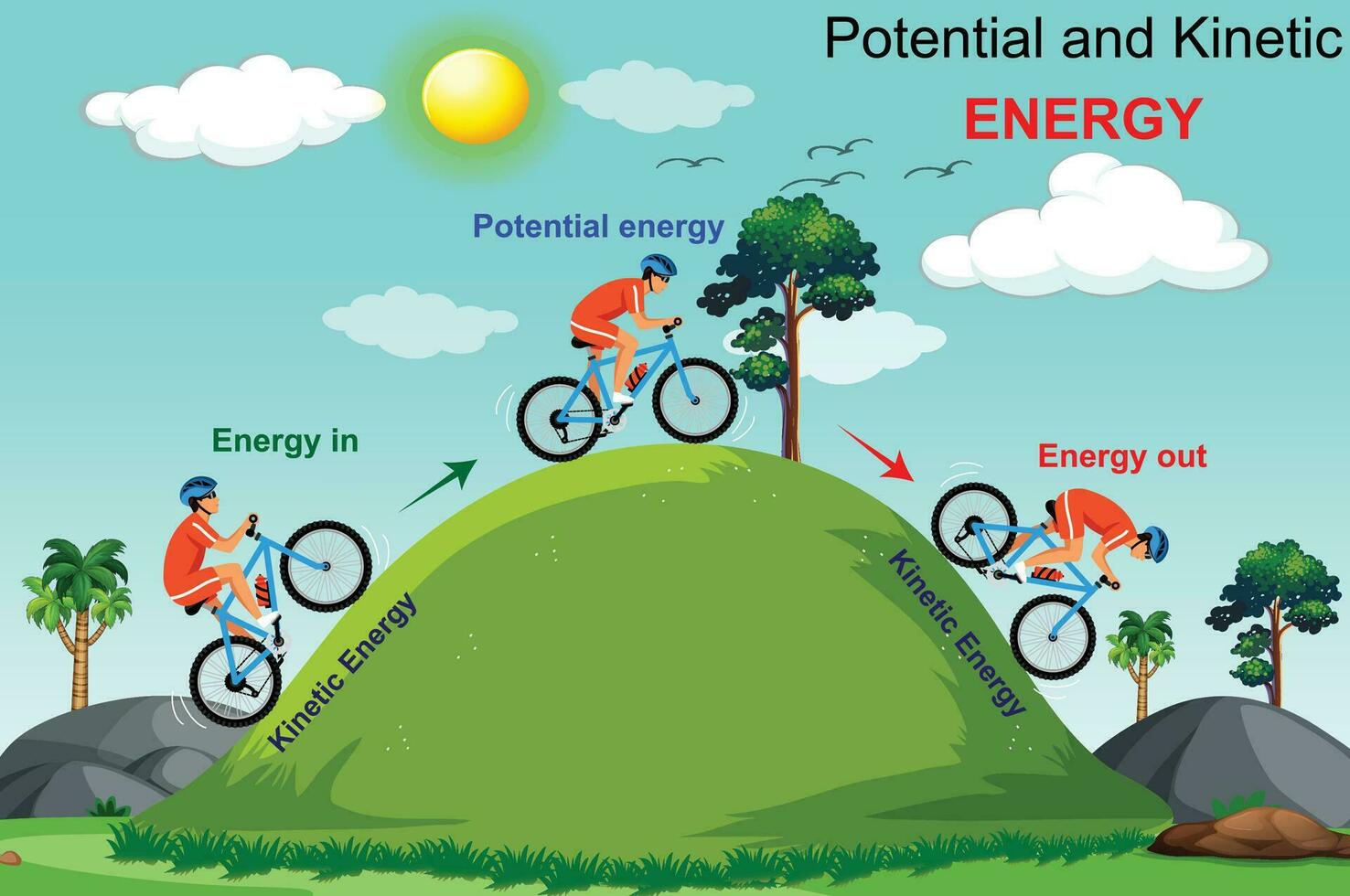
In thermodynamics, the most common type we deal with is Gravitational Potential Energy, the energy stored due to an object's height in a gravitational field. The formula is:
Where:
- is the mass (kg).
- is the acceleration due to gravity (a constant, approximately on Earth).
- is the height (m) relative to a chosen zero point.
- is the potential energy in Joules (J).
An important point here is that height is relative. You have to define a "zero" level, or a datum. For example, is the height of a book measured from the floor or from the tabletop it's sitting on? The choice is yours, but you must be consistent throughout the problem. In most cases, it's the change in potential energy that we care about, not its absolute value.
Let's watch a video that builds this intuition for potential energy.
This video from Manocha Academy gives a great intuitive feel for what potential energy is, using examples like a hammer and a spring.
Watch from 0:38 to 4:09 to understand the concept of stored energy in different forms. Then watch from 6:13 to 9:27, where the video explains how work is done to store potential energy and derives the formula PE = mgh.
Quick Recap
So far, we have two types of mechanical energy:
- Kinetic Energy (): Energy of motion.
- Potential Energy (): Stored energy of position.
The sum of these two is called the Total Mechanical Energy: .
But how do we change an object's energy? How do we give a stationary object kinetic energy, or lift it to give it potential energy? The answer is: we have to do work.
3. Mechanical Work: Transferring Energy by Force
In everyday language, "work" means any kind of effort. In physics and engineering, the definition is much more precise: Work is the energy transferred to or from an object by applying a force along a displacement.
Let's break that down with the classic example: pushing a heavy box.
- You push on the box, but it's too heavy and doesn't move. You're exerting a force, you're sweating, but since there is no displacement, you have done zero work on the box.
- You push harder, and the box slides across the floor. Now you have a force and a displacement. You have done work on the box. You have transferred energy to it, which shows up as an increase in its kinetic energy (it started moving) and as heat generated by friction.
The formula for work done by a constant force is:
Where:
- is the work done (in Joules).
- is the magnitude of the constant force applied (in Newtons).
- is the magnitude of the displacement (in meters).
- (theta) is the angle between the direction of the force and the direction of the displacement.
The part is key:
- If you push in the exact direction of motion, , and . The work is positive and maximal: . You are adding energy to the object.
- If you carry a suitcase horizontally at a constant velocity, the force you apply is upward (to counteract gravity), but the displacement is horizontal. The angle is , and . You do zero work on the suitcase, even though you might get tired!
- The force of friction always opposes motion, so for friction, , and . The work done by friction is negative: . Friction removes mechanical energy from a system (converting it to heat).
A Special Kind of Work: Boundary Work (PV Work)
In thermodynamics, we are often interested in the work done by a gas expanding or being compressed in a piston-cylinder device. This is fundamental to how engines and compressors work. This is called boundary work because it's done by the system on its boundary (the moving piston).
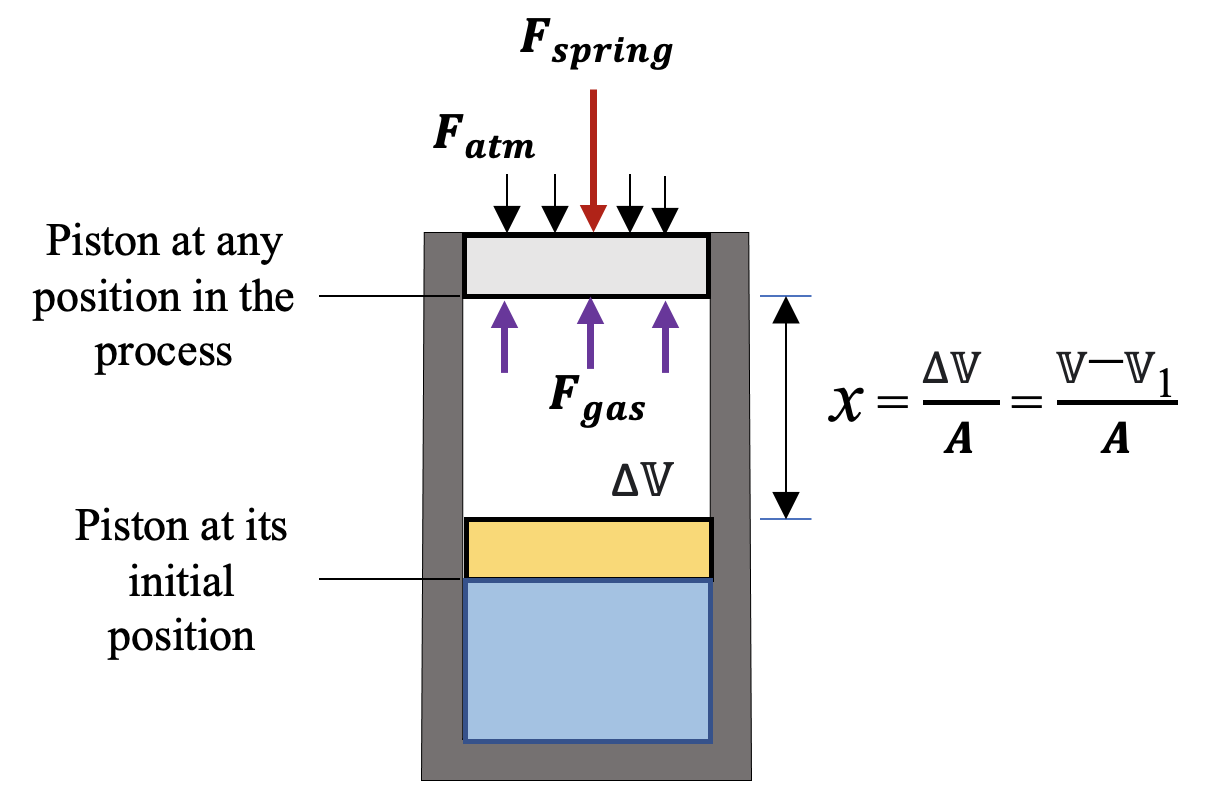
Let's think about it.
- Pressure () is Force per unit Area (), so .
- When the gas expands, it pushes the piston a small distance . The tiny amount of work it does is .
- But is just the small change in volume, .
- So, .
To find the total work for a process, we need to sum up all these tiny bits of work. Since you're comfortable with calculus, you'll recognize this sum as an integral:
This is one of the most important equations we'll encounter. It tells us that the work done by a gas is the area under the process curve on a Pressure-Volume (P-V) diagram.
- Expansion (): The gas pushes the piston out. Work is done by the system. is positive.
- Compression (): The surroundings push the piston in. Work is done on the system. is negative.
For a deep dive into the different types of work and the crucial connection between work and energy, let's go back to our main video resource.
Work, Energy, and Power - Basic Introduction
This is a longer but very comprehensive segment from 'Work, Energy, and Power'. It covers the definition of work, the importance of the angle, the work-energy theorem, and the difference between conservative and non-conservative forces.
Please watch these segments in order: 0:13 - 1:19: The basic definition of work. 4:53 - 8:14: The work-energy theorem (how work changes kinetic energy). 8:14 - 13:00: How the angle between force and displacement determines if work is positive, negative, or zero. 16:20 - 22:57: The critical difference between conservative forces (like gravity) which conserve mechanical energy, and non-conservative forces (like friction) which don't.
Let's Practice: Problems and Questions
Time to solidify these concepts with some calculations. Engineering is an applied science, so let's apply this!
Worked Problems
Problem 1: Kinetic Energy of a Car
A car with a mass of 1200 kg is traveling at a speed of 90 km/h. What is its kinetic energy in Joules?
Solution:
-
Convert Units: Our formula needs speed in m/s. We'll use the factor-label method from last lesson.
-
Calculate Kinetic Energy: Now plug the values into the KE formula.
That's a lot of energy!
Problem 2: Potential Energy of a Diver
A diver with a mass of 60 kg stands on a 10-meter high diving platform. What is her potential energy relative to the surface of the water?
Solution:
- Identify the Datum: We are asked for the PE relative to the water surface, so the water is our level.
- Calculate Potential Energy: This is the amount of energy that will be converted to kinetic energy as she falls.
Problem 3: Work Done by a Gas
A gas in a piston expands at a constant pressure of 200 kPa from an initial volume of 0.01 m³ to a final volume of 0.03 m³. How much boundary work did the gas do?
Solution:
- Identify the Process: This is a constant pressure expansion.
- Apply the Work Formula: Since pressure is constant, it can come out of the integral.
- Convert Units and Calculate: Pressure must be in Pascals (Pa) to get Joules. 1 kPa = 1000 Pa. Since the result is positive, this confirms that work was done by the system.
Conceptual Questions
Test your understanding!
Question 1: Two cars are driving on the highway. Car A has twice the mass of Car B, but Car B is moving at twice the speed of Car A. Which car has more kinetic energy?
Show answer
Car B has more kinetic energy. Let Car A have mass and speed . Its . Let Car B have mass and speed . Its . Because speed is squared in the kinetic energy formula, Car B has twice the kinetic energy of Car A.
Test your understanding!
Question 2: An elevator lifts you from the 1st floor to the 10th floor. Then, you take a winding staircase down to the 5th floor. Is the work done by gravity on you positive, negative, or zero for the total trip?
Show answer
The work done by gravity is negative. Gravity is a "conservative" force, meaning the work it does only depends on the starting and ending points, not the path taken. You started on the 1st floor and ended on the 5th floor, so your net displacement was upward (a higher final position). Since the force of gravity is always downward, the force and the net displacement are in opposite directions (), so the work done by gravity is negative.
Test your understanding!
Question 3: Imagine you're in the gym. You lift a 100 kg barbell from the floor to over your head (a distance of 2 meters). Then you hold it there for 30 seconds. Finally, you lower it slowly back to the floor. When is the work you do on the barbell positive, negative, and zero?
Show answer
- Lifting it up: Your force is upward, and the displacement is upward. You do positive work on the barbell (transferring energy to it, increasing its potential energy).
- Holding it still: The displacement is zero. You do zero work on the barbell, even though your muscles are burning!
- Lowering it down: Your force is still upward (to control the descent), but the displacement is downward. You do negative work on the barbell (it is doing work on you, essentially). The barbell's potential energy is decreasing.
Lesson Summary
Fantastic job today! We've taken a huge step from abstract concepts to concrete calculations. These are the tools you'll use constantly as we move forward.
Here are the key takeaways:
- Kinetic Energy () is the energy of an object in motion, and it's highly sensitive to speed.
- Gravitational Potential Energy () is stored energy based on an object's height relative to a chosen zero point.
- Mechanical Work () is the transfer of energy via a force acting over a distance. It's the mechanism for changing an object's mechanical energy.
- Boundary Work () is the specific work done by an expanding or contracting gas, which is the heart of many thermodynamic devices.
- Energy Conservation: In a simple mechanical system without friction, energy is not lost but merely converted between kinetic and potential forms. Work done by non-conservative forces like friction removes mechanical energy from the system.
Preview of the Next Lesson
We have now officially completed the "Foundations" module. We can define systems, describe their state, understand their properties, and calculate the mechanical energy they possess and the mechanical work they can do.
What's missing? Think about heating a pot of water on the stove. Its temperature rises, but it's not moving faster () and its height isn't changing (). Where did the energy from the stove go?
In our next lesson, we will enter Module 2 and answer that question by exploring the concepts of pressure, temperature, and the state of a gas. We'll look at pressure from a molecular level and define temperature in a new, more powerful way, which will lead us straight to the Zeroth Law of Thermodynamics. This will set the stage for understanding the hidden, internal energy of a system.