Hello! It's great to have you back.
In our last session, we saw how the Steady-Flow Energy Equation (SFEE) is like a master key. We used it to unlock the secrets of nozzles, diffusers, turbines, and compressors by simplifying the general equation to fit each device's specific purpose. The main strategy was always to start with the full equation and then, like a detective, eliminate the terms that were negligible.
Today, we're going to continue this investigation with the last two major devices on our list. These two are incredibly common in everyday life:
- Throttling Devices: These are simple but powerful components that cause huge pressure drops. They are the heart of every refrigerator and air conditioner.
- Heat Exchangers: These devices transfer heat between two fluids without letting them mix. They are everywhere, from car radiators to massive power plants.
Our goal is to apply the same SFEE analysis to these components, discover their simplified governing equations, and understand how they work in the real world.
Throttling Devices: The Art of Dropping Pressure
Let's start with one of the simplest-looking but most interesting devices. A throttling device is essentially any kind of flow restriction. It could be a partially open valve, a porous plug, or a long, thin tube called a capillary tube.
Imagine you're watering your garden and you put your thumb over the end of the hose. The water sprays out with less force, and its pressure drops dramatically. That's a form of throttling. The primary purpose is to cause a significant pressure drop in the fluid.
This pressure drop is often accompanied by a large temperature drop, which is why these devices are essential in refrigeration and air-conditioning. They are the component responsible for making the refrigerant cold right before it enters the cooling coils.
Simplifying the SFEE for a Throttling Valve
So, how does our master equation, the SFEE, simplify for a throttling device? Let's watch a short video that walks through the logic.
Steady Flow Systems - Throttling Valves | Thermodynamics | (Solved Examples)
This video from Question Solutions explains what a throttling valve is and neatly shows how the SFEE is simplified by applying the common assumptions for this device.
Please watch from the beginning to 2:04. The video first introduces the device and then goes through the SFEE term by term to arrive at a very simple final equation.
As the video explained, our detective work on the SFEE looks like this:
- Work (): Throttling valves have no moving parts like spinning shafts. So, .
- Heat Transfer (): The process happens very quickly in a small device. There's not enough time or surface area for any significant heat to be transferred to or from the surroundings. So, we assume it's adiabatic, meaning .
- Potential Energy (): The device is typically small with no significant change in elevation between the inlet and outlet. So, .
- Kinetic Energy (): The fluid's velocity might change, but in most cases, this change is tiny compared to the change in the fluid's other energy forms. So, we can safely neglect it, .
Let's apply these simplifications to the SFEE:
After crossing everything out, we're left with:
Dividing by the mass flow rate , we get an incredibly simple and powerful result:
This means the enthalpy of the fluid at the inlet is the same as the enthalpy at the exit. A process where enthalpy remains constant is called an isenthalpic process.
How Does the Temperature Drop?
This might seem strange. If the enthalpy doesn't change, how does the temperature drop so dramatically? Remember our definition of enthalpy: . Our equation really means:
Internal Energy + Flow Work = Constant
When a fluid is throttled, its pressure drops significantly (). This sudden drop in pressure allows the fluid to expand rapidly. Think of it like a compressed crowd of people suddenly entering a huge, empty hall—they spread out. This expansion requires energy, and the fluid takes this energy from its own pocket: its internal energy ().
So, the flow energy term () can change, forcing the internal energy term () to change in the opposite direction to keep the total sum () constant. For most real fluids, a decrease in internal energy results in a decrease in temperature. This is the "magic" behind your refrigerator.
Test your understanding!
You are told that an ideal gas flows through a throttling valve. Would you expect its temperature to drop, increase, or stay the same? Why?
Show answer
For an ideal gas, the temperature would stay the same. We learned that for an ideal gas, enthalpy is a function of temperature only (). Since the throttling process is isenthalpic (), and for an ideal gas enthalpy only depends on temperature, it must be that . No temperature change! The cooling effect of throttling is a real gas phenomenon.
Worked Numerical Problems: Throttling
Let's put this theory into practice. For these problems, we will need property tables (like the ones for steam or refrigerants).
Problem 1: Refrigerant in a Fridge
Refrigerant-134a (the fluid in many AC systems) enters the capillary tube of a refrigerator as a saturated liquid at 0.8 MPa. It is throttled to a pressure of 0.12 MPa. Find:
a) The temperature drop during the process.
b) The quality of the refrigerant at the exit.
Show step-by-step solution
Step 1: State the assumptions and the simplified equation.
This is a throttling process. We assume it's adiabatic with negligible KE and PE changes.
Therefore, our governing equation is .
Step 2: Find the inlet enthalpy, , and inlet temperature, .
The refrigerant at the inlet (state 1) is a saturated liquid at MPa. We look this up in the R-134a property tables.
- Under the table for saturated R-134a at MPa (or 800 kPa), we find the enthalpy of the saturated liquid, .
- kJ/kg.
- The temperature at this state is the saturation temperature, C.
Step 3: Use the enthalpy to find the exit state (state 2).
We know kJ/kg and MPa (or 120 kPa). Let's go to the R-134a tables for MPa.
At this pressure, we find:
- Enthalpy of saturated liquid, kJ/kg.
- Enthalpy of saturated vapor, kJ/kg.
Since our (95.47 kJ/kg) is between and , the refrigerant at the exit is a saturated liquid-vapor mixture.
Step 4: Calculate the exit quality, , and temperature, .
a) Because the refrigerant is a saturated mixture at 0.12 MPa, its temperature must be the saturation temperature at that pressure. From the table, C.
The temperature drop is C. A huge drop!
b) We find the quality using the formula: .
The refrigerant at the exit is a mixture that is 34% vapor by mass. This vaporization process is what absorbs the energy and causes the temperature to plummet.
Problem 2: Throttling Steam
Steam at 8 MPa and 500°C is throttled in a well-insulated valve down to a pressure of 6 MPa. What is the final temperature of the steam?
Show step-by-step solution
Step 1: State the assumptions and the simplified equation.
As before, for a throttling valve, we have .
Step 2: Find the inlet enthalpy, .
The inlet state (state 1) is steam at MPa and C. This is superheated steam. We go to the superheated steam tables.
- At MPa and C, we find kJ/kg.
Step 3: Use the enthalpy to find the exit temperature, .
We know the exit state (state 2) has MPa and kJ/kg.
We go back to the superheated steam tables and look under the section for MPa. We then scan down the enthalpy column to find our value.
- At C, kJ/kg.
- At C, kJ/kg.
Our value of 3399.5 is between these two. The exit temperature is between 450°C and 500°C. By linear interpolation (or using an online calculator), we find:
In this case, the temperature only dropped by about 10°C. The temperature change during throttling depends heavily on the fluid and its state.
Heat Exchangers: The Energy Swappers
Now let's move on to our second device. As the name implies, heat exchangers are devices where two moving fluid streams exchange heat without mixing. They are fundamental to so many processes.
- In a car, the radiator is a heat exchanger that transfers heat from the hot engine coolant to the outside air.
- In a power plant, a massive heat exchanger called a condenser uses river or ocean water to cool steam back into liquid water.
- In your air conditioner, one heat exchanger inside your house absorbs heat (making the room cold), and another outside rejects that heat to the air.
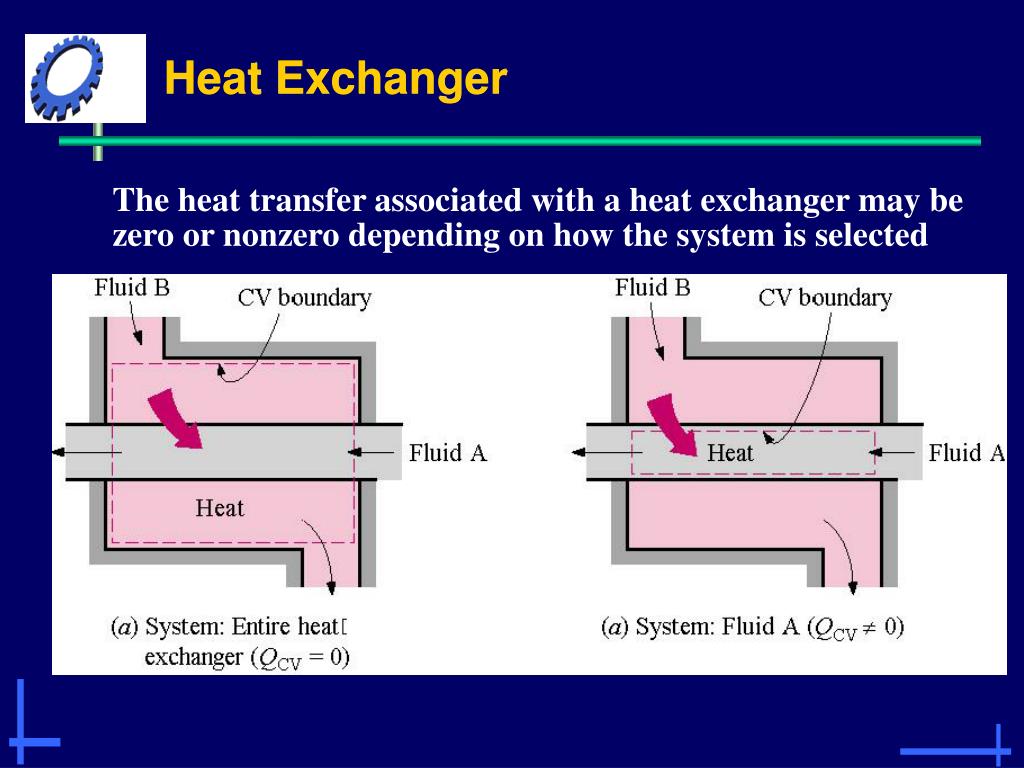
Simplifying the SFEE for a Heat Exchanger
To analyze the whole device, we'll choose the control volume on the left, encompassing the entire insulated heat exchanger. This is a multi-stream system, so we need to account for all energy streams in and all streams out.
Heat Exchangers and Mixing Chambers - THERMO - in 9 Minutes!
This video from Less Boring Lectures will walk us through the setup for a heat exchanger, explaining the assumptions and deriving the final energy balance equation.
Please watch from the beginning to 2:21. Pay attention to how the general SFEE with multiple streams is simplified to a very intuitive result.
Let's summarize the analysis for the entire heat exchanger:
- Work (): There are no moving parts. .
- Heat Transfer (): We assume the device is well-insulated from the surroundings. .
- KE and PE (): Changes in velocity and elevation for each stream are typically negligible compared to the enthalpy changes.
The SFEE for a multi-stream system is . Applying our assumptions, energy only comes in and out with the mass of the two fluids. Let's call them fluid 'A' and fluid 'B'.
Let's rearrange this by grouping the terms for each fluid:
This equation has a beautiful physical meaning:
Energy Gained by the Cold Fluid = Energy Lost by the Hot Fluid
The rate of heat transfer between the fluids, , can be found by looking at just one of the fluids (like the control volume on the right in the image above):
Worked Numerical Problems: Heat Exchangers
Let's solidify this with a problem.
Problem 3: Cooling Refrigerant with Water
In a condenser (a type of heat exchanger), Refrigerant-134a enters at 1 MPa and 70°C at a rate of 6 kg/min. It is cooled by water, which enters at 15°C and leaves at 25°C. The refrigerant leaves the condenser as a saturated liquid at 35°C and 1 MPa. Find:
a) The mass flow rate of the cooling water required.
b) The rate of heat transfer from the refrigerant to the water.
Show step-by-step solution
Step 1: State the assumptions and the simplified equation.
We assume the condenser is a steady-flow, adiabatic heat exchanger with no work and negligible KE/PE changes.
Our energy balance is: Energy Gained by Water = Energy Lost by Refrigerant.
Step 2: Find all the enthalpies.
We need four enthalpy values.
- Refrigerant Inlet (): Superheated R-134a at MPa, C. From tables: kJ/kg.
- Refrigerant Outlet (): Saturated liquid R-134a at C. From tables, we look up at 35°C: kJ/kg.
- Water Inlet (): Liquid water at C. We can approximate this as a saturated liquid at 15°C. From steam tables: kJ/kg.
- Water Outlet (): Liquid water at C. Similarly: kJ/kg.
Step 3: Calculate the mass flow rate of water.
First, note the refrigerant mass flow rate: kg/min.
Now, plug all values into our energy balance equation:
We need about 29.1 kg of water per minute to cool the refrigerant.
Step 4: Calculate the rate of heat transfer.
This is the energy gained by the water (or lost by the refrigerant). Let's calculate it for the water:
To express this in kW (kJ/s), we divide by 60:
Problem 4: Heating Water with Geothermal Water
A heat exchanger will heat water from 25°C to 60°C at a rate of 0.2 kg/s. The heating is done by hot geothermal water available at 140°C at a mass flow rate of 0.3 kg/s. What is the exit temperature of the geothermal water? (Use specific heat for water, kJ/kg·°C).
Show step-by-step solution
Step 1: State the assumptions and the simplified equation.
Same as before: Energy Gained by Cold Water = Energy Lost by Hot Geothermal Water.
For liquids, we can approximate the change in enthalpy as . So our equation becomes:
Step 2: Plug in the known values.
The specific heat is roughly the same for both streams.
- kg/s
- C
- C
- kg/s
- C
- kJ/kg·°C
We can cancel from both sides.
Step 3: Solve for the unknown exit temperature, .
The hot geothermal water leaves the heat exchanger at 116.7°C.
Conclusion
Excellent job today! We've now completed our tour of the most common steady-flow engineering devices. The process has been the same every time: start with the full energy balance and carefully cross out what doesn't matter.
Key Takeaways:
- Throttling Devices cause a pressure drop at constant enthalpy (). This isenthalpic process is fundamental to refrigeration cycles by causing a sharp temperature drop in the refrigerant.
- Heat Exchangers transfer energy between two fluids without mixing. For an insulated device, the core principle is that the energy lost by the hot fluid is gained by the cold fluid: .
- Mastering the analysis of these devices is about understanding their primary function and knowing which energy terms are dominant and which are negligible.
Preview of the Next Lesson
Throughout this module, we've relied heavily on property tables for steam and refrigerants, using them to look up enthalpy values. But what are these tables? How are they created? Why does a substance behave in such a complex way?
In our next lesson, we will begin Module 3: Properties of Pure Substances. We'll peel back the curtain on the property tables and explore the fascinating world of phase change. We will answer questions like:
- What happens to water as you boil it, step-by-step?
- How are pressure, temperature, and volume connected for a substance?
- What do terms like "saturated liquid," "superheated vapor," and "quality" really mean on a diagram?
This will give us a much deeper, more visual understanding of the properties we've been using to solve problems. See you then