Hello! I'm glad to see you again.
In our last lesson, we created our first "thermodynamic maps"—the T-s diagrams. We saw how the area on these maps represents heat and work, and we sketched out the paths of real engine cycles. A key thing we noticed was that ideal devices, like a perfect turbine, follow a straight vertical path. We called this path isentropic, meaning constant entropy. But real devices always seemed to have paths that slanted off to the right, showing that their entropy increased.
Today, we're going to zoom in and get to the very heart of that distinction. The goal of this lesson is to define precisely what an isentropic process is. It's one of the most important idealizations in all of thermodynamics because it represents the "perfect" or "best-case" scenario for many real-world devices. Understanding this benchmark is the first step to being able to measure the performance of actual engines, turbines, and compressors.
So, let's unpack what it really means for a process to be isentropic.
The Two Ingredients of Perfection: Adiabatic and Reversible
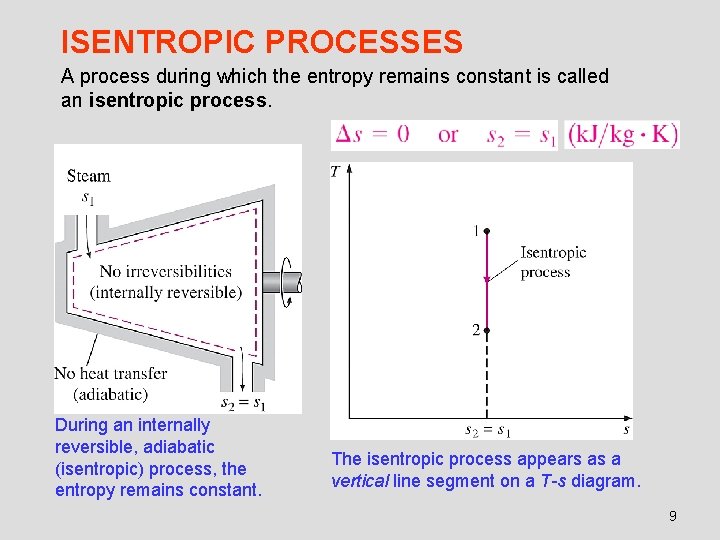
The term "isentropic" can be broken down into its two essential components. For a process to be isentropic, it must be both:
-
Adiabatic: This means there is no heat transfer between the system and its surroundings (). Imagine a process happening inside a perfect thermos flask, or a process that happens so incredibly fast that there's simply no time for heat to leak in or out, like the rapid compression of air in a cylinder.
-
Reversible: This means the process is perfectly smooth, with no "internal messiness." There's no friction, no turbulence, no sudden expansions—none of the real-world effects that generate chaos and waste energy. It's a process that could, in theory, be run in reverse to bring both the system and the surroundings back to their original states without leaving any trace on the universe.
When you have a process that is both perfectly insulated (adiabatic) and perfectly smooth (reversible), you get an isentropic process.
This image provides a great visual summary of the concept.
Why Do These Two Ingredients Result in Constant Entropy?
This is the most important question. Why does Adiabatic + Reversible = Isentropic? To understand this, let's bring back the full entropy balance equation, which is like the master equation for tracking entropy changes:
Let's break this down in plain English:
- is the total change in the entropy of our system.
- is the entropy that gets transferred across the boundary along with heat. If heat enters the system, it carries some entropy with it. If heat leaves, it takes entropy away.
- is the entropy that gets generated inside the system due to irreversibilities like friction. Think of this as the "entropy of messiness." It's always zero for a perfectly reversible process and greater than zero for any real, irreversible process.
Now, let's apply our two conditions for an isentropic process to this equation:
- The process is adiabatic. This means , so the entire term becomes zero. No entropy is transferred in or out.
- The process is reversible. This means there is no internal messiness, so . No entropy is generated internally.
When both of these are true, our master equation becomes:
And there it is. The total change in entropy is zero. The entropy remains constant. This is the very definition of an isentropic process.
To see this explained with a helpful diagram, watch the following short video segment.
Reversible Adiabatic Process/Isentropic Process. (PART-I) #thermodynamics #basicthermodynamics
This clip from All About Mechanical Engineering does an excellent job of explaining exactly why only a reversible adiabatic process is isentropic, by focusing on the role of entropy generation.
Please watch from 02:57 to 04:51. The speaker clearly explains the two components that contribute to entropy change (heat transfer and generation) and shows why both must be zero for entropy to remain constant.
Clarifying a Common Confusion: Adiabatic vs. Isentropic
This is a point that trips up many students, so let's be very clear.
- All isentropic processes are adiabatic. (By definition).
- Not all adiabatic processes are isentropic.
Let's think about that second point. Imagine a process that is adiabatic () but is irreversible (). What happens to its entropy?
Let's go back to our master equation:
Since it's adiabatic, . But since it's irreversible, is a positive number.
So, for an irreversible adiabatic process, the entropy increases.
This is exactly what we saw in our last lesson! The real turbine expansion was adiabatic (we assume the turbine is well-insulated) but it was irreversible (due to friction and turbulence), so its path on the T-s diagram slanted to the right, indicating an increase in entropy.
This comparison table neatly summarizes the key distinctions.
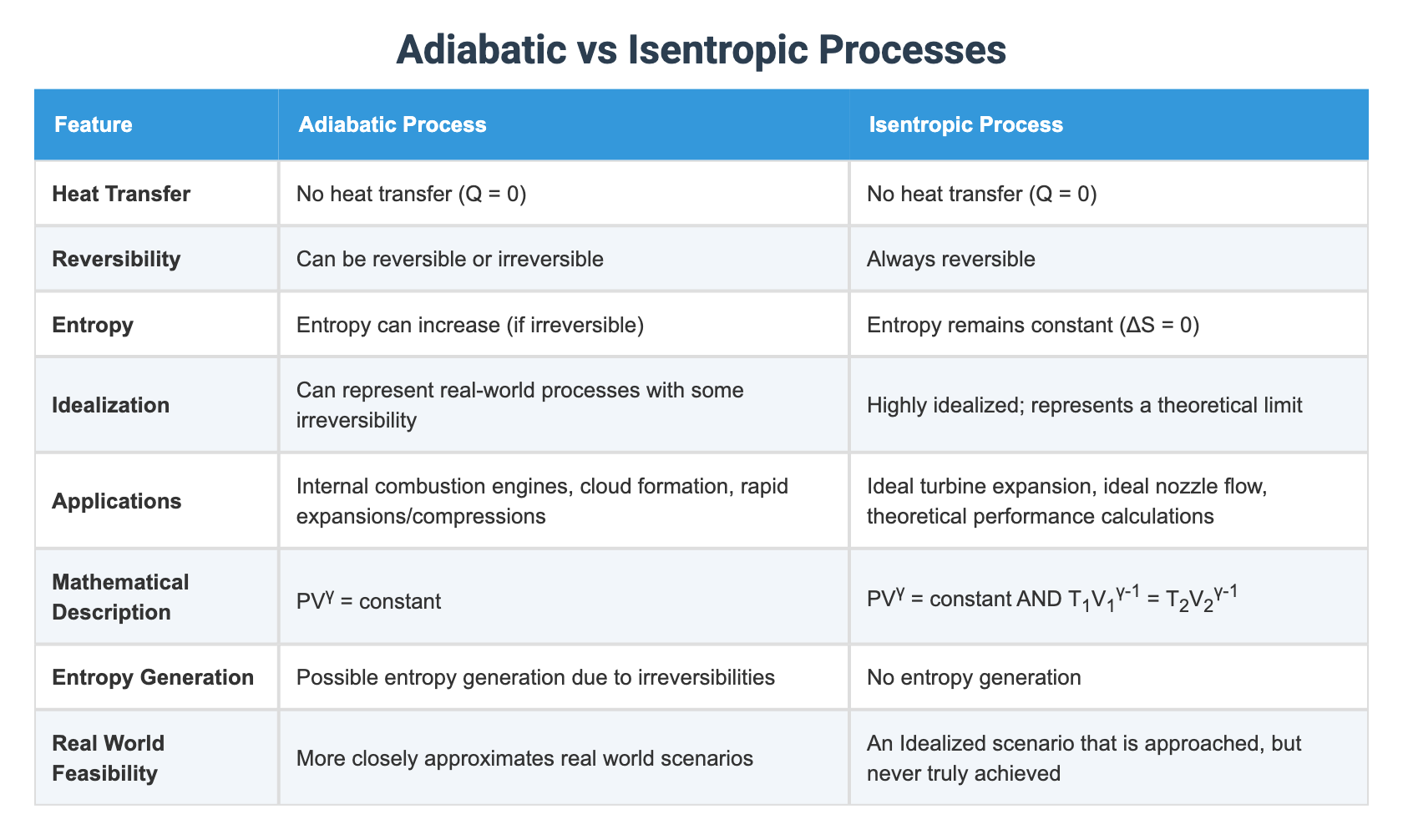
Take a moment to look at the rows for "Reversibility" and "Entropy." This is the core difference you need to internalize. An isentropic process is a perfect, idealized version of an adiabatic one.
Test your understanding!
Question: You rapidly pump air into a bicycle tire using a hand pump. The body of the pump gets quite hot. Let's consider the air inside the pump as our system. Would you model this compression process as being closer to isentropic or just adiabatic? Is it reversible?
Show answer
It is adiabatic because the compression happens so fast that there's little time for heat to escape to the surroundings. However, it is not isentropic. The fact that the pump gets very hot is a clue. There's a lot of friction (piston against the wall) and turbulence (air being forced through a small valve). These are major irreversibilities. These irreversibilities generate entropy, and the work done against friction turns into internal energy, significantly raising the air's temperature. So it's an irreversible adiabatic process, not an isentropic one.
Energy Consequences of an Adiabatic Process
Let's quickly connect this back to the First Law of Thermodynamics, which for a closed system is:
(Work done by the system)
For any adiabatic process (whether it's reversible/isentropic or not), we know that . So the law simplifies to:
This gives us a very direct and intuitive insight:
- Adiabatic Expansion (W > 0): If a gas expands and does work on its surroundings (like pushing a piston), that work energy has to come from somewhere. Since no heat can enter, the energy must be taken from the gas's own internal energy. So, will be less than , and the gas cools down.
- Adiabatic Compression (W < 0): If work is done on the gas (like a piston compressing it), that energy is added to the gas. Since no heat can escape, that energy is trapped and stored as internal energy. So, will be greater than , and the gas heats up. This is exactly why a bicycle pump gets hot.
Practice Scenarios
Let's test this with a couple of conceptual problems. The goal here isn't calculation, but correctly identifying and explaining the process based on our new definitions.
Worked Scenario 1: Stirring Water in a Thermos
Problem: You have a perfectly insulated thermos full of water. You use a small propeller to vigorously stir the water, and you notice its temperature increases slightly. Consider the water as your system. Is this process adiabatic? Is it isentropic? Explain why.
Solution:
-
Is it Adiabatic? Yes. The problem states it's a "perfectly insulated thermos," which is our code word for an adiabatic process. There is no heat transfer () between the water and the outside world.
-
Is it Isentropic? No. For a process to be isentropic, it must be both adiabatic and reversible.
- The vigorous stirring creates a lot of fluid friction and turbulence. This is a classic example of an irreversibility.
- This irreversibility generates entropy ().
- The work done by the propeller is converted into internal energy through this friction, which is why the temperature increases.
- Since , the total entropy of the water must increase (). Therefore, the process is not isentropic.
Worked Scenario 2: Ideal Nozzle
Problem: High-pressure steam flows through a well-insulated nozzle, designed to be perfectly smooth inside, in order to accelerate to a high velocity. Is it reasonable to model this process as isentropic? Why?
Solution:
-
Is it Adiabatic? Yes. The nozzle is "well-insulated" (). Also, the fluid passes through a nozzle very quickly, leaving little time for heat transfer. So, the adiabatic assumption is very reasonable.
-
Is it Reversible? Approximately, yes. A well-designed nozzle is shaped to be "perfectly smooth" to minimize friction and prevent turbulence. While no real device is perfectly reversible, a nozzle is one of the devices where the idealization is closest to reality. We can assume friction is negligible, so .
-
Conclusion: Since the process is approximately adiabatic and approximately reversible, it is very reasonable to model it as isentropic. This is, in fact, how engineers perform the baseline analysis for nozzles.
Summary of Key Takeaways
Great job today! We've formally defined a crucial concept that will be our benchmark for performance from now on.
- An isentropic process is one that is both reversible and adiabatic.
- This means the entropy of the system remains constant ().
- The reason entropy stays constant is that both pathways for entropy change are shut down: there is no heat transfer () and no internal entropy generation ().
- A process can be adiabatic but not isentropic if it involves irreversibilities (like friction). In this case, its entropy will increase.
- The isentropic process represents a perfect, ideal benchmark that real devices try to approach but can never perfectly achieve.
Preview of the Next Lesson
We have now defined our ideal process. The next logical question is: "How can we use it for calculations?"
In our next lesson, we will derive the specific mathematical relationships that apply to an ideal gas undergoing an isentropic process. This will give us powerful equations (like the famous ) that we can use to analyze ideal turbines, compressors, and nozzles and calculate their theoretical maximum work output or minimum work input. We're moving from definition to application