Hello! Welcome back to our journey into thermodynamics.
In our last lesson, we made a huge conceptual leap. We established that internal energy () is a property of a system, like its pressure or temperature—it only depends on the system's current state. In contrast, heat () and work () are path functions—they represent energy in transit and depend on the specific process used to get from one state to another. This is a profound distinction.
Today, we're rolling up our sleeves and putting the First Law to practical use. Our goal is to master the application of the closed system energy balance, which you'll remember is . Specifically, we will focus on stationary closed systems, where the equation simplifies to its most common form: .
The single most important skill you'll develop today is correctly handling the "bookkeeping" of energy—that is, using the right sign conventions for heat and work. Getting the signs right is everything in thermodynamics. Let's get started.
The Great Sign Convention Debate
One of the first things that can trip up students is that the First Law equation sometimes appears differently in different textbooks. You might see in a chemistry book, but in an engineering or physics book. Why the difference? It all comes down to perspective.
To understand this, let's watch a short video that explains the two viewpoints.
First Law of Thermodynamics, Basic Introduction - Internal Energy, Heat and Work - Chemistry
The Organic Chemistry Tutor provides a crystal-clear explanation for why different fields use different signs for work in the First Law equation. This will help you understand the logic behind the convention we are about to adopt.
Watch the segment from 5:12 to 8:30. The key idea is understanding the difference between the 'system's point of view' (chemistry) and the 'surroundings' point of view' (engineering/physics).
As the video explained:
- Chemistry (
ΔU = Q + W): Focuses entirely on the system. Any energy that crosses the boundary into the system, whether it's heat or work, is considered positive. - Engineering (
ΔU = Q - W): Takes a more practical, "device-oriented" view. We think about what we want to get out of a system (like work from an engine) versus what we have to put in (like heat from fuel).
From now on, we will exclusively use the engineering convention:
Let's cement this with a simple analogy. Think of your thermodynamic system as a small business.
- Internal Energy () is your company's bank account balance. is the change in that balance.
- Heat () is revenue you get from a client. When heat flows into the system, it's like money coming in. It's positive.
- Work () is a useful product or service you provide. When your business does work, you're producing something of value that goes out to the world. Work done by the system is considered a positive output.
So, the change in your bank account () is your revenue () minus your valuable output ().
The Official Sign Convention for Engineers
Let's formally define the signs for each term in . This is our rulebook for energy accounting.
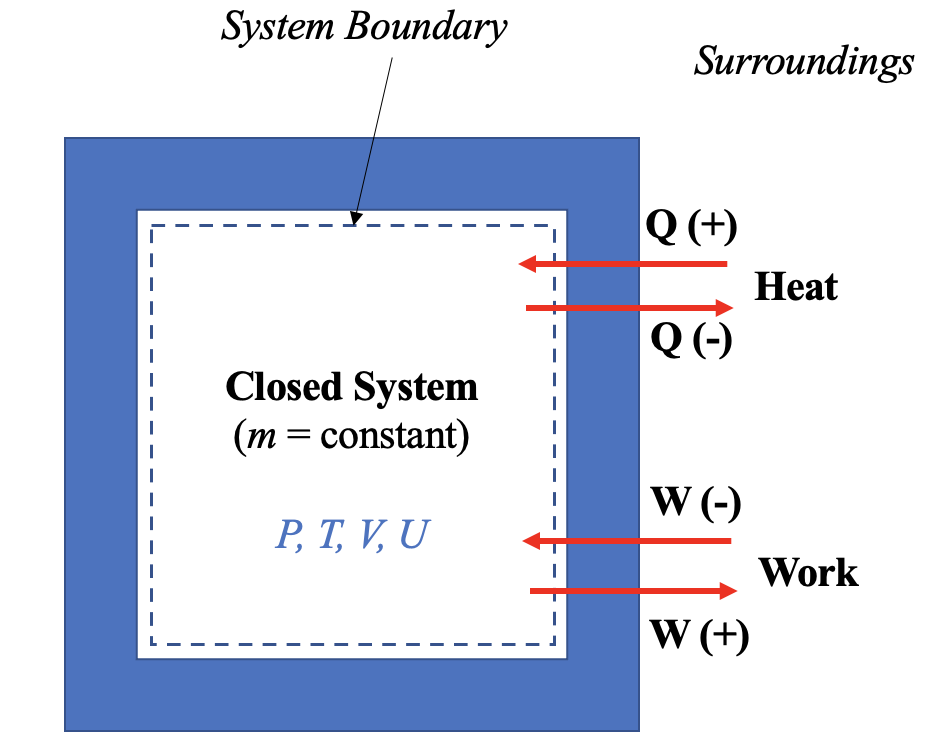
Let's break it down:
1. Heat Transfer (Q)
- : Heat is transferred from the surroundings TO the system.
- Analogy: Putting a pot of water on a hot stove. The water (system) gains heat.
- This is an endothermic process.
- : Heat is transferred from the system TO the surroundings.
- Analogy: A hot cup of coffee cooling on your desk. The coffee (system) loses heat.
- This is an exothermic process.
2. Work (W)
- : Work is done BY the system ON the surroundings.
- Analogy: The hot gas in an engine cylinder expands and pushes a piston up. The gas (system) is doing work. This is usually the desired output of a heat engine.
- : Work is done ON the system BY the surroundings.
- Analogy: You use a pump to compress air into a tire. You (part of the surroundings) are doing work on the air (the system).
3. Internal Energy Change ()
This one is straightforward. It's the result of the heat and work interactions.
- : The internal energy of the system increased.
- : The internal energy of the system decreased.
To see this all laid out, let's refer to a clear summary.
12.2 First law of Thermodynamics: Thermal Energy and Work
This section from the Texas Gateway resource 'First law of Thermodynamics: Thermal Energy and Work' clearly states the First Law and defines the sign conventions exactly as we've discussed. It's a great reference to solidify the rules.
Read the part titled 'The First Law of Thermodynamics'. Focus on the definitions of Q and W and the equation ΔU = Q - W. This reinforces our 'rulebook'.
Test your understanding!
You are observing a piston-cylinder device. You notice the gas inside is expanding, pushing the piston outwards. Later, you measure the temperature of the gas and find that it has increased. What are the signs of , , and ?
Show answer
- Work (): The gas is expanding and pushing the piston, so it is doing work on the surroundings. Therefore, is positive.
- Internal Energy (): The temperature of the gas increased. Since temperature is a measure of the average kinetic energy of the molecules (sensible energy), the internal energy has increased. Therefore, is positive.
- Heat (): We know . Rearranging for , we get . Since both and are positive, must also be positive. This means that for the gas to expand and get hotter, a significant amount of heat must have been added to it.
Recap Break
This is the core of today's lesson, so let's pause and lock it in.
- The Law:
- The Logic: Change in Stored Energy = Energy In (as Heat) - Energy Out (as Work)
- The Rules:
- Heat IN is positive
- Work OUT is positive
Now, let's use this to solve some problems.
Applying the First Law: Worked Examples
The best way to get comfortable with the signs is to see them in action. We'll use the same resource as before, which has some excellent, clear examples.
12.2 First law of Thermodynamics: Thermal Energy and Work
Let's look at the worked examples from the same Texas Gateway resource. These will show you how to apply the sign conventions to calculate the change in internal energy.
Read the section 'Solving Problems Involving the First Law of Thermodynamics' and follow the two worked examples carefully. Notice how they first identify the net heat and net work with the correct signs before plugging them into the formula.
Let's walk through our own examples step-by-step, just like you'd do on an exam.
Worked Problem 1: Basic Application
A closed, rigid tank contains a fluid. The fluid is stirred by a paddle wheel, which does 100 kJ of work ON the fluid. During this process, the fluid loses 25 kJ of heat to the surroundings. What is the change in the internal energy of the fluid?
- Identify the System: The system is the fluid inside the tank.
- Analyze Heat (Q): The fluid loses 25 kJ of heat. Heat is leaving the system.
- Analyze Work (W): Work is done on the fluid. Work is entering the system.
- Apply the First Law:
- Substitute Values:
Answer: The internal energy of the fluid increased by 75 kJ. Even though it lost some heat, the large amount of work done on it caused its overall energy to go up.
Worked Problem 2: Solving for Heat
A gas in a piston-cylinder assembly undergoes a process where its internal energy decreases by 200 kJ. During the process, the gas is compressed, and 50 kJ of work is done ON the system. How much heat was transferred, and in which direction?
- Identify the System: The system is the gas in the piston-cylinder.
- Analyze Internal Energy (): The internal energy decreases by 200 kJ.
- Analyze Work (W): Work is done on the system. Work is entering.
- Apply the First Law:
- Rearrange and Solve for Q:
Answer: is negative, which means 250 kJ of heat was transferred FROM the gas TO the surroundings. This makes sense: the gas was compressed (which tends to increase energy) but its internal energy dropped significantly, so it must have lost a lot of heat.
Time to Practice!
Now it's your turn. Use the same systematic approach: identify the system, determine the signs of the known quantities, and apply the First Law.
Conceptual Questions
-
Is it possible for the internal energy of a closed system to remain constant during a process () even if heat is added to it ()?
Show answer
Yes, absolutely. According to the First Law, $\Delta U = Q - W$. If $\Delta U = 0$, then $Q - W = 0$, which means $Q = W$. This describes a process where all the heat added to the system is immediately converted into work done by the system. For example, if you slowly add heat to a gas in a piston, and the gas expands to do work, it's possible for its temperature (and thus internal energy) to remain constant. -
You have a perfectly insulated thermos containing hot coffee. You shake it vigorously. What happens to the internal energy of the coffee? What are the signs of , , and ?
Show answer
* **Heat (Q):** The thermos is "perfectly insulated," which means it's adiabatic. No heat can be transferred. So, $Q = 0$. * **Work (W):** By shaking it, you are doing work *on* the coffee (this is a form of shaft work, stirring the fluid). Therefore, $W$ is negative. * **Internal Energy ($\Delta U$):** Using the First Law, $\Delta U = Q - W = 0 - W$. Since $W$ is negative, $\Delta U = -(-|W|) = +|W|$. Therefore, $\Delta U$ is positive. The internal energy (and temperature) of the coffee will increase slightly. -
An electric heater is used to heat a room. Let's define the room (the air, furniture, etc.) as our system. Is this a heat or work interaction?
Show answer
This is a classic trick question! From an engineering thermodynamics perspective, it's a **work interaction**. The electricity crosses the system boundary and does work on the resistor inside the heater. The resistor then heats up and transfers heat to the air, but that heat transfer is *internal* to the system (room). The energy entered the system as electrical work. So, for the room system, $W$ is negative (work done on the system), and $Q$ is zero (assuming the room is well-insulated from the outside). The result is $\Delta U = Q - W = 0 - (-W_{elec}) = +W_{elec}$, and the room's internal energy increases.
Numerical Problems
-
Problem: During an expansion process, a closed system does 150 kJ of work. Its internal energy is found to have decreased by 50 kJ. Calculate the heat transfer and state its direction.
Show step-by-step answer
1. **System:** The closed system. 2. **Work (W):** The system *does* work, so it's an output. $W = +150 \text{ kJ}$. 3. **Internal Energy ($\Delta U$):** The energy *decreased*. $\Delta U = -50 \text{ kJ}$. 4. **First Law:** $\Delta U = Q - W \implies Q = \Delta U + W$. 5. **Solve:** $Q = (-50 \text{ kJ}) + (150 \text{ kJ}) = +100 \text{ kJ}$. **Answer:** The heat transfer is 100 kJ. Since the sign is positive, the heat was transferred **into** the system. -
Problem: 2 kg of a substance is contained in a rigid, sealed vessel. It is heated by adding 500 kJ of heat. A paddle wheel inside the vessel is turned by an external motor, adding 100 kJ of work. What is the change in internal energy of the substance in kJ? What is the change in specific internal energy (energy per mass) in kJ/kg?
Show step-by-step answer
1. **System:** The 2 kg of substance in the vessel. 2. **Heat (Q):** Heat is *added*. $Q = +500 \text{ kJ}$. 3. **Work (W):** The vessel is rigid, so there is no expansion/compression work. However, the paddle wheel adds energy. This is work done *on* the system. $W = -100 \text{ kJ}$. 4. **First Law:** $\Delta U = Q - W$. 5. **Solve for $\Delta U$:** $\Delta U = (+500 \text{ kJ}) - (-100 \text{ kJ}) = 600 \text{ kJ}$. **Answer 1:** The change in internal energy is **600 kJ**.To find the specific internal energy change (, lowercase), we divide by the mass.
Answer 2: The change in specific internal energy is 300 kJ/kg.
Conclusion
Excellent work today! We've established the universal rules for energy accounting in engineering. This lesson was all about building a solid, reliable method for applying the First Law.
Key Takeaways:
- We use the engineering convention for the First Law: .
- This equation is an energy balance: Change in Stored Energy = Heat In - Work Out.
- Sign Convention is King:
- Heat INTO the system is positive Q.
- Work done BY the system is positive W.
- Energy flowing out of the system (heat loss or work input) is negative.
- Solving problems is a systematic process: identify the system, assign signs to the energy transfers, and then apply the equation.
Preview of the Next Lesson
We now have a robust way to balance the energy books for a closed system. But we're still missing a key piece of the puzzle. If , what does that mean for the system? How much did its temperature change?
In our next lesson, we will build the bridge between the abstract concept of internal energy and the tangible, measurable property of temperature. We will introduce specific heats ( and ), which are the crucial properties that tell us how much the energy of a substance changes when we heat it up. This will unlock our ability to solve a whole new class of powerful thermodynamic problems.