Hello again! It's great to have you back.
In our last lesson, we ran a fascinating thought experiment, heating water in a piston-cylinder and watching it transform from a cool liquid into a superhot gas. We saw that during the boiling process, something remarkable happens: the temperature flatlines, even though we keep pumping heat in.
Today, we're going to zoom in on that phase-change process and give formal names to the key concepts that govern it. Our goal is to define saturation temperature, saturation pressure, and latent heat. These three ideas are the absolute bedrock for understanding how substances like water and refrigerants behave, and they are the keys to unlocking the data hidden in steam tables.
The Unbreakable Link: Saturation Temperature & Saturation Pressure
Remember our discussion about pressure cookers and cooking on a mountain?
- In a pressure cooker, the pressure is high (maybe 2 atm), so water boils at a higher temperature (around 120°C).
- On a high mountain, the pressure is low, so water boils at a lower temperature (maybe 90°C).
This isn't a coincidence; it's a fundamental law for pure substances. When a substance is in the middle of a phase change (boiling or condensing), its temperature and pressure are locked together in a dependent relationship. You can't change one without changing the other.

This leads us to two definitions that are really two sides of the same coin:
- Saturation Temperature (T_sat): This is the temperature at which a substance starts to boil, given a certain pressure. For example, at a pressure of 1 atm, the saturation temperature of water is 100°C.
- Saturation Pressure (P_sat): This is the pressure at which a substance starts to boil, given a certain temperature. For example, at a temperature of 100°C, the saturation pressure of water is 1 atm.
Let's watch a short video clip that neatly defines these two terms using the same examples we've been discussing.
T-v Diagrams and PROPERTY TABLES for Thermodynamics in 13 Minutes!
This clip from the 'Less Boring Lectures' video gives clear, concise definitions for saturation temperature and saturation pressure.
Please watch from 2:46 to 4:34. He'll walk you through the definitions and connect them back to the pressure cooker and high-altitude examples.
So, to put it simply: saturation is the state of being on the verge of a phase change. If someone tells you that you have "saturated water," you know it's either about to boil or just starting to condense. And if you know its pressure, you automatically know its temperature, and vice-versa. They are not independent properties in this state.
To build a deeper intuition for why this happens at a molecular level, the following reading is excellent. It explains how the pressure of the air above the liquid makes it harder or easier for the water molecules to escape.
Why does water boil faster at high altitudes?
This article from tec-science explains with a simple particle model why the boiling point depends on pressure. It's a great intuitive dive into the 'why'.
Read the sections 'Cooking on Mount Everest', 'Explanation with the particle model', and 'Increase of boiling temperature at elevated ambient pressure (pressure cooker)'. Focus on the mental image of air molecules pushing down on the water surface.
The "Hidden" Energy: Latent Heat
Now for the second big question from last time: When water is boiling at 100°C, we're adding heat, but the thermometer's reading isn't changing. Where does that energy go?
As we touched on, the energy is doing something other than making the molecules move faster. It's doing the hard work of breaking the bonds that hold the molecules together in a liquid state, allowing them to fly free as a gas.
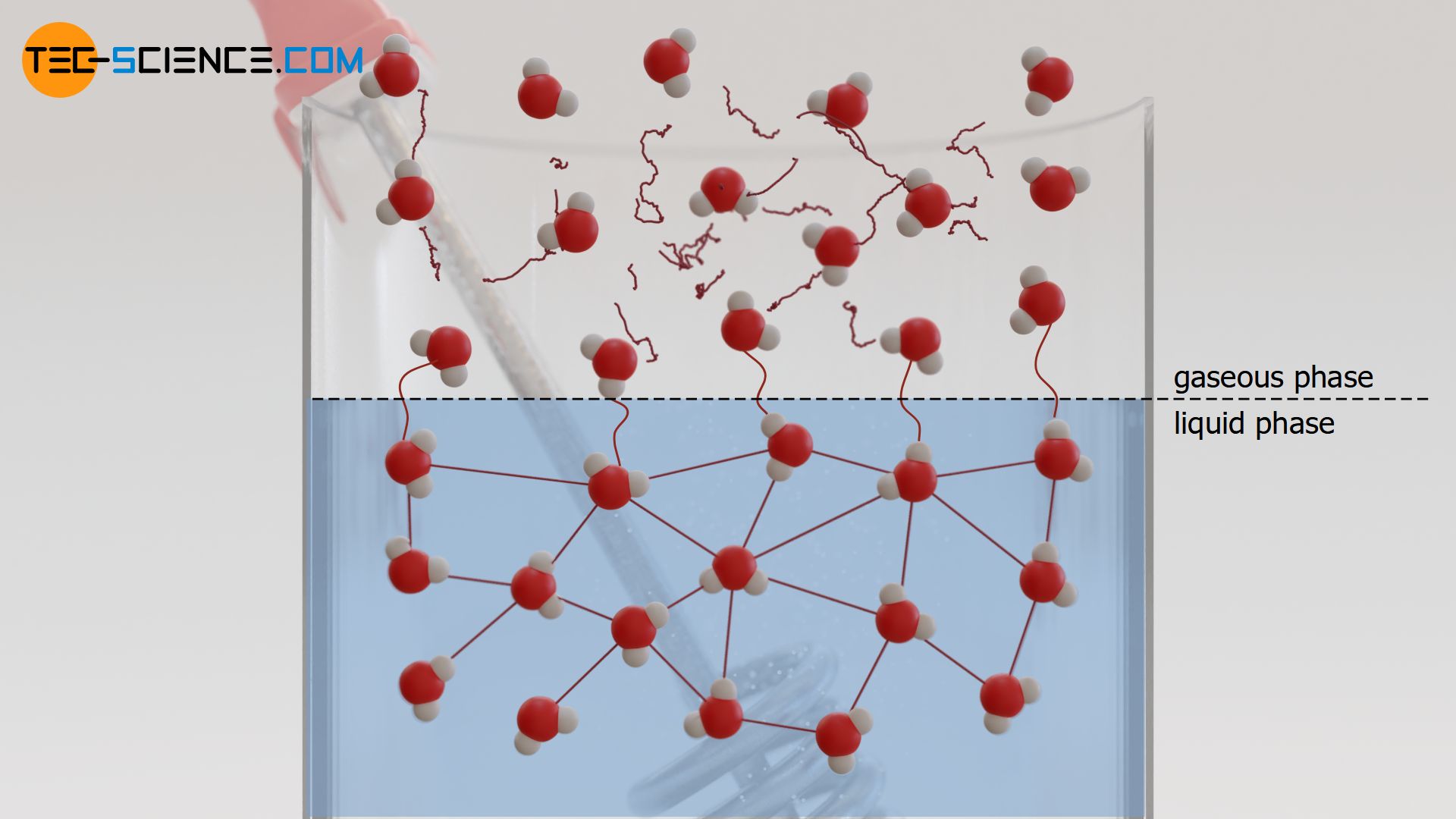
This gives rise to two important types of heat:
- Sensible Heat: This is the heat you can "sense" with a thermometer. When you add sensible heat, the temperature of the substance increases. (e.g., heating water from 20°C to 100°C).
- Latent Heat: This is the "hidden" heat that is absorbed or released during a phase change at a constant temperature.
The specific term for the latent heat involved in boiling or condensation is the Latent Heat of Vaporization (symbolized as ). It's the amount of energy you must add to 1 kg of a saturated liquid to turn it completely into 1 kg of a saturated vapor.
This next video provides a fantastic animated explanation of the difference between sensible and latent heat.
Latent Heat and Sensible Heat Explained | Humidity | Animation | #hvac #hvacsystem #hvacmaintenance
This video from Zebra Learnings clearly distinguishes between sensible heat and latent heat using animations of water molecules.
Watch from 0:27 to 2:53, and then the summary from 3:50 to 4:20. Pay close attention to how they describe what the heat energy is doing to the molecules in each case.
The amount of latent heat is not trivial. It takes a huge amount of energy to vaporize water. Let's look at some actual numbers.
Thermodynamics Basics: Phases of Water, Laws and ...
This document provides formal definitions and, importantly, gives the actual numerical values for the latent heats of water.
Please read the section titled 'Latent Heat' (it's on page 7). Look at Table 1.1 and find the value for 'Latent Heat of Vaporization'.
From that reading, you can see that the latent heat of vaporization for water at atmospheric pressure is about 2260 kJ/kg.
Let's put that in perspective. To heat 1 kg of water from 0°C to 100°C takes about 418 kJ of energy. But to turn that same 1 kg of 100°C water into 100°C steam takes 2260 kJ—more than five times as much energy! This massive energy storage capacity is why steam is such a powerful medium for running power plants.
Time for a Recap
Let's pause and consolidate what we've just defined.
- Saturation Temperature (T_sat): The boiling temperature for a given pressure.
- Saturation Pressure (P_sat): The boiling pressure for a given temperature.
- Latent Heat of Vaporization (h_fg): The "hidden" energy required to change 1 kg of saturated liquid into 1 kg of saturated vapor at a constant temperature and pressure.
These three concepts are the language we use to describe phase change. Now, let's put them to work.
Test Your Understanding
Time to see these concepts in action with some questions and problems.
Conceptual Questions
-
Why is a burn from 100°C steam much more severe than a burn from 100°C liquid water?
Show answer
Both are at the same temperature, so they will transfer sensible heat to your skin. However, when the 100°C steam hits your cooler skin, it will immediately condense back into 100°C liquid. In doing so, it releases its massive amount of latent heat of vaporization (2260 kJ/kg) directly onto your skin. This is a huge extra dose of energy that the liquid water doesn't have, leading to a much more severe burn. -
You're on a camping trip and you've just put a pot of water on the fire to boil. A friend tells you to put the lid on the pot to make it boil faster. Will this work?
Show answer
Your friend is partially right, but for the wrong reason. Putting the lid on will trap heat and prevent heat loss to the surroundings, so the water will reach its boiling point *sooner*. However, once it starts boiling, the lid will also trap the steam, increasing the pressure inside the pot (like a weak pressure cooker). This increase in pressure will *raise* the saturation temperature, so the water will now need to get even hotter (e.g., 101°C or 102°C) to continue boiling. So, the lid helps you get to the boiling point faster, but it actually raises the boiling point itself. -
Why does sweating cool you down on a hot day?
Show answer
When you sweat, you put liquid water on your skin. For this water to evaporate into water vapor, it needs to absorb energy from its surroundings. This required energy is the latent heat of vaporization. The water pulls this heat directly from your skin. As your skin loses heat, its temperature drops, and you feel cooler.
Worked Numerical Problems
Problem 1: Energy for Boiling
How much heat energy is required to completely vaporize 2 kg of saturated liquid water at atmospheric pressure?
- Step 1: Identify the process. We are converting a saturated liquid to a saturated vapor at constant pressure. The energy required is the latent heat of vaporization.
- Step 2: Find the required property. From the reading (and general knowledge), the latent heat of vaporization for water at 1 atm is .
- Step 3: Calculate the total heat. The total heat is the mass multiplied by the latent heat per unit mass .
- Answer: It takes 4520 kJ of energy.
Problem 2: Pressure Cooker Temperature
A pressure cooker operates at a gauge pressure of 100 kPa. If the local atmospheric pressure is 101 kPa, at what temperature does the water inside boil? Use the table snippet below (from standard steam tables).
| Pressure (kPa) | Saturation Temp. (°C) |
|---|---|
| 101.3 | 100.0 |
| 150 | 111.4 |
| 200 | 120.2 |
| 250 | 127.4 |
- Step 1: Find the absolute pressure inside the cooker. Remember, absolute pressure is gauge pressure plus atmospheric pressure.
- Step 2: Find the saturation temperature for this pressure. We are looking for T_sat at P = 201 kPa. Looking at our table, we have a value for 200 kPa. Since 201 kPa is very close, we can approximate the temperature as the value for 200 kPa.
- Answer: The water inside the pressure cooker will boil at approximately 120.2°C.
Conclusion
Excellent work today. We've taken the observations from our last lesson and attached rigorous, formal definitions to them. These are not just vocabulary words; they are fundamental concepts that describe how energy and matter interact during the most important process in thermodynamics.
Key Takeaways:
- Saturation Temperature (T_sat) and Saturation Pressure (P_sat) are two sides of the same coin: for a substance undergoing phase change, they are locked together.
- Latent Heat of Vaporization (h_fg) is the large amount of "hidden" energy needed to break molecular bonds and turn a liquid into a gas without changing its temperature.
- The concepts of sensible heat (changing temperature) and latent heat (changing phase) are distinct and crucial for energy calculations.
Preview of the Next Lesson
We've defined the key states (saturated liquid, saturated vapor) and the concepts that govern the transition between them. In the next lesson, we will put it all together by interpreting the full P-V, T-V, and P-T diagrams. These diagrams are the graphical roadmaps for pure substances. Mastering them will allow us to pinpoint the state of a substance and pave the way for using steam tables effectively to solve complex problems. See you then