Hello! Welcome to your next lesson in our "Indices, Quadratics, and Polynomials" module.
In our last lesson, we mastered the rules of indices (or exponents), learning how to manipulate expressions with powers. That knowledge is a perfect stepping stone for today's topic, as the expressions we'll be working with are defined by their highest power.
Today's learning outcome is to factorise (factor) quadratic expressions, including trinomials and the difference of squares. A quadratic expression is one where the highest index of the variable is 2, like . To factorise means to break it down into a product of simpler expressions, which are typically contained within brackets (parentheses).
This skill is the reverse of expanding brackets, a process you've likely seen before.

Factorising is a crucial skill in algebra, as it allows us to simplify complex expressions and, as we'll see in the next lesson, solve quadratic equations.
1. Factorising Trinomials where the Coefficient is 1
Let's begin with the most common type of quadratic expression: a trinomial (an expression with three terms) of the form . An example is .
The goal is to find two numbers that:
- Multiply to give the constant term, .
- Add to give the coefficient of the term, .
For , we need two numbers that multiply to 8 and add to 6. After a moment's thought, we find these numbers are 4 and 2. Therefore, the factorised form is .
This process can involve negative numbers as well. Let's watch a video that walks through the method step-by-step.
GCSE Maths - Factorising Quadratics - Part 1 - (When the x² Coefficient is 1) (2026/27 exams)
This video from Cognito, 'GCSE Maths - Factorising Quadratics - Part 1', provides a very clear system for factorising these types of expressions. It uses the British terminology you're familiar with.
Watch from 00:32 to 06:12. The video first demonstrates the method with an example where all terms are positive, and then with an example involving a negative constant term.
The key steps from the video are:
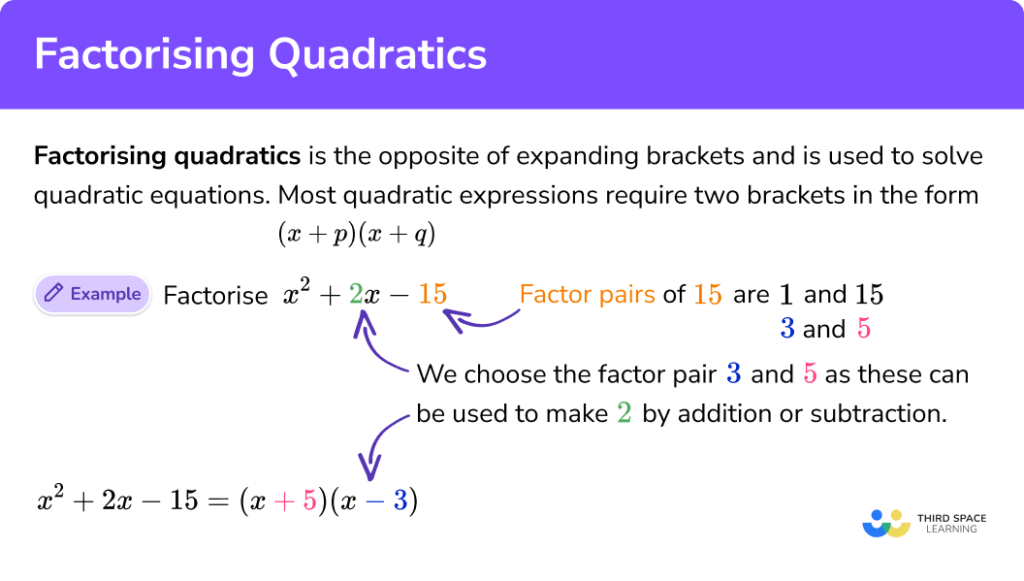
- Set up two empty brackets with an at the start of each: .
- List all the factor pairs of the constant term . Remember to include negative pairs if is positive, and mixed positive/negative pairs if is negative.
- Find the one pair from your list that adds up to the middle coefficient, .
- Place these two numbers into the brackets.
Here is a visual summary of the process for another example.
Test your understanding!
Factorise the quadratic expression:
Show answer
- We need two numbers that multiply to give +12 and add to give -8.
- The factor pairs of 12 are: (1, 12), (2, 6), (3, 4). Since they must add to a negative number (-8) but multiply to a positive number (+12), both numbers in the pair must be negative.
- The negative pairs are: (-1, -12), (-2, -6), (-3, -4).
- Checking their sums:
- -1 + (-12) = -13
- -2 + (-6) = -8 ← This is the pair we need.
- -3 + (-4) = -7
- The factorised expression is .
2. A Special Case: The Difference of Two Squares
Sometimes you will encounter a quadratic with only two terms, in the form . This is called a difference of two squares. Its characteristics are:
- Two terms, separated by a subtraction sign.
- Both terms are perfect squares (e.g., , 9, ).
This form has a simple and reliable factorisation pattern:
To better understand this, we'll consult a clear, text-based resource.
The guide 'Factorising quadratics' from mathcentre.ac.uk explains this special case very effectively. It shows how the general method still applies but leads to this simple formula.
Please read section 6, 'Special case 1 - the difference of two squares', on pages 7 and 8. It starts near the bottom of page 6. Pay attention to the general formula and the examples, including those where the x^2 term also has a square number coefficient.
Examples:
- To factorise , we recognise it as . Applying the formula, we get .
- To factorise , we recognise it as . Applying the formula, we get .
Sometimes, you must first take out a common factor.
- To factorise , we first take out the common factor of 2: . Now we have a difference of two squares inside the bracket: .
Test your understanding!
Factorise the expression completely:
Show answer
- First, look for a common factor. Both terms are divisible by 3.
- Now, the expression inside the brackets is a difference of two squares: .
- Factorise the difference of squares: .
- Combine everything for the final answer: .
3. Factorising Trinomials where the Coefficient is not 1
When the term has a coefficient other than 1 (e.g., ), the process is more involved. Trial and error can work, but a more systematic approach called the AC method is very reliable. Given your background in IT and systematic problem-solving, you may find this method particularly useful.
The steps are:
- Identify , , and in the expression .
- Calculate the product .
- Find two numbers that multiply to give and add to give .
- Split the middle term () into two terms using the numbers you just found.
- Factorise the resulting four-term expression by grouping in pairs.
Let's see this method explained in detail in the same guide we used earlier.
We will return to the 'Factorising quadratics' guide, which provides a clear, step-by-step walkthrough of this 'AC method'.
Please read section 5, 'Expressions where the coefficient of x² is not 1', on pages 5 and 6. Follow the examples for 3x^2 + 5x - 2 and 6x^2 - 5x - 4 carefully to understand how to split the middle term and then factor by grouping.
Let's summarise the process for :
- Step 1: .
- Step 2: The product is .
- Step 3: We need two numbers that multiply to -6 and add to +5. These are +6 and -1.
- Step 4: Split the middle term into . The expression becomes .
- Step 5: Factor by grouping:
- Group the first two terms: .
- Group the last two terms: .
- The full expression is .
- Notice the common bracket . Factor this out: .
This method transforms the problem into a more structured procedure. While an alternative trial-and-error method exists (as shown in the Cognito "Part 2" video), the AC method is often more direct.
Test your understanding!
Factorise the expression using the AC method:
Show answer
- Here, .
- The product is .
- We need two numbers that multiply to -24 and add to -5. After listing factor pairs of 24 (1,24; 2,12; 3,8; 4,6), we find that -8 and +3 work: and .
- Split the middle term: .
- Factor by grouping:
- Factor out the common bracket : .
Conclusion
In this lesson, you've learned the fundamental skill of factorising quadratic expressions. This is a cornerstone of algebra that you will use repeatedly.
Key Takeaways:
- Factorising is the reverse process of expanding brackets.
- For trinomials of the form , find two numbers that multiply to and add to .
- The difference of two squares, , factorises to .
- For more complex trinomials, , the AC method provides a systematic way to find the factors by splitting the middle term and grouping.
Preview of the Next Lesson:
Now that you can break quadratic expressions down into their factors, you have the main tool needed to solve quadratic equations. In the next lesson, we will learn how to solve quadratic equations by factorising (factoring). This involves setting the factorised expression equal to zero and finding the values of that make the equation true, which you'll come to know as finding the "roots" of the equation.