Hello! Welcome to your next lesson on quadratic equations.
In our last session, we learned the powerful technique of completing the square. We saw that it's a universal method that can solve any quadratic equation, but the process can be quite detailed.
Today, we'll build directly on that knowledge. As previewed, if you apply the method of completing the square to the general quadratic equation, , you derive a single, powerful formula. This is the quadratic formula, a master key that unlocks the solution to any quadratic equation without needing to go through the multi-step process of completing the square each time.
By the end of this lesson, you will be able to confidently apply the quadratic formula to find the roots of any quadratic equation.
The Quadratic Formula
For any quadratic equation written in the standard form:
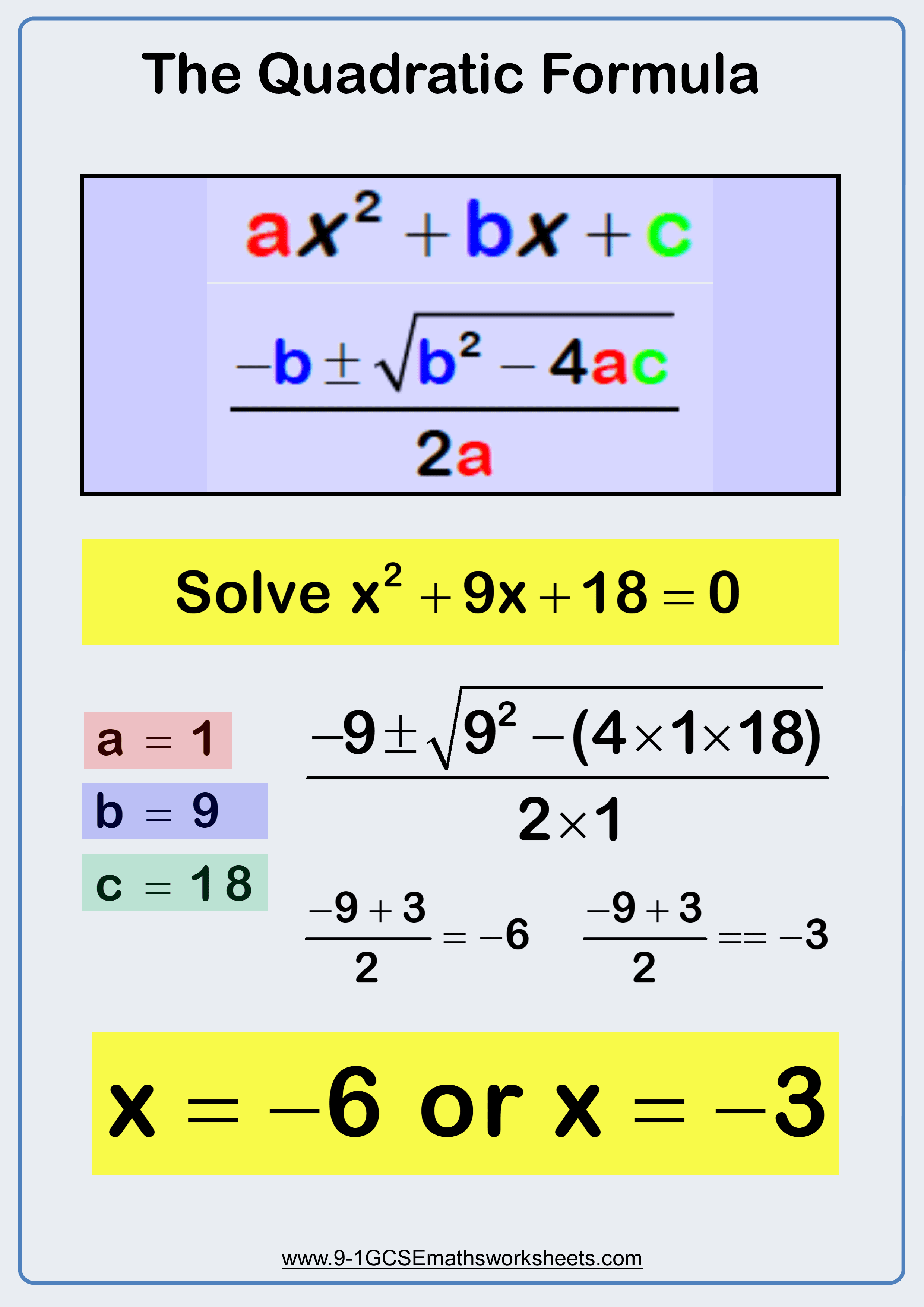
where , , and are constants and , the solutions (roots) for are given by the quadratic formula:
This formula is one of the most important in algebra, and it's highly recommended to commit it to memory. The symbol (plus-minus) indicates that there are generally two solutions, one calculated with a plus sign and the other with a minus sign.
The process is essentially a three-step procedure:
- Ensure the equation is in the standard form .
- Identify the values of , , and .
- Substitute these values into the formula and calculate the result.
Let's watch a video that introduces the formula and walks through the first example.
How to Use the Quadratic Formula | Grade 6-9 Maths Series | GCSE Maths Tutor
This video from 'The GCSE Maths Tutor' provides an excellent introduction. It reinforces the importance of the standard form and then demonstrates the substitution process with a clear, step-by-step example.
Watch from 00:51 to 08:03. Pay close attention to how the values of a, b, and c are identified from the equation and then carefully placed into the formula. Notice how the narrator uses a calculator to find the two separate solutions from the 'plus-minus' part.
Dealing with Negative Coefficients
The most common source of errors when using the quadratic formula is mishandling negative signs. It is crucial to be methodical.
Let's focus on two specific scenarios:
- When is negative: The term
-4acwill become positive because of the double negative. For instance, if , then . - When is negative: This is particularly important.
- The term at the start of the formula will become positive. If , then .
- The term must be calculated carefully. When you square a negative number, the result is positive. For instance, . When using a calculator, it is vital to use brackets, e.g.,
(-11)^2, to ensure the correct result. Typing-11^2might be interpreted as-(11^2), giving you -121, which is incorrect.
The following segments of the video we just watched address these specific points.
How to Use the Quadratic Formula | Grade 6-9 Maths Series | GCSE Maths Tutor
Let's continue with the same video to see how to handle negative coefficients correctly. These examples highlight the most common pitfalls.
First, watch the example with a negative 'c' value from 08:20 to 11:12. Then, pay very close attention to the example with a negative 'b' value from 15:42 to 18:31. The explanation of why you must use brackets when squaring a negative number in your calculator is crucial.
To summarise the key points for handling negatives:
- Always write down your values for , , and before you start, including their signs.
- When substituting into the formula, use brackets for negative values, especially for the term: .
- Be mindful of double negatives, such as in the and terms.
Test your understanding!
Use the quadratic formula to solve . Give your answers correct to 3 significant figures.
(This problem is also featured on the BBC Bitesize page 'Solving by quadratic formula - Higher' (LINK), which you can use for further review if needed.)
Show answer
-
Identify coefficients: The equation is in standard form.
-
Substitute into the formula:
-
Simplify and calculate:
-
Find the two solutions:
-
Round to 3 significant figures:
Exact Solutions (Surd Form)
Sometimes, particularly in non-calculator questions, you will be asked to give your answer in "exact form". This means leaving the square root in the answer, a form known as a surd. This requires you to simplify the surd if possible.
The process is the same, but instead of using a calculator at the end, you simplify the expression algebraically.
How to Use the Quadratic Formula | Grade 6-9 Maths Series | GCSE Maths Tutor
The final part of 'The GCSE Maths Tutor' video demonstrates this non-calculator approach. It brings together the quadratic formula with your knowledge of simplifying surds.
Watch from 21:47 to 29:39. Focus on the two-stage simplification: first, calculate the number under the square root. Second, simplify that square root (e.g., \sqrt{32} = 4\sqrt{2}). Finally, see if the whole fraction can be simplified by dividing each term on the top by the number on the bottom.
This method provides the precise mathematical answer, without any rounding. For a quick reference on the general method, the following resource is useful.
This document from mathcentre.ac.uk provides a concise, formal summary of the quadratic formula and its use.
Read section 4, 'Solving quadratic equations using a formula' on page 6. Notice how the examples are left in exact surd form. This is a good, quick summary of the process.
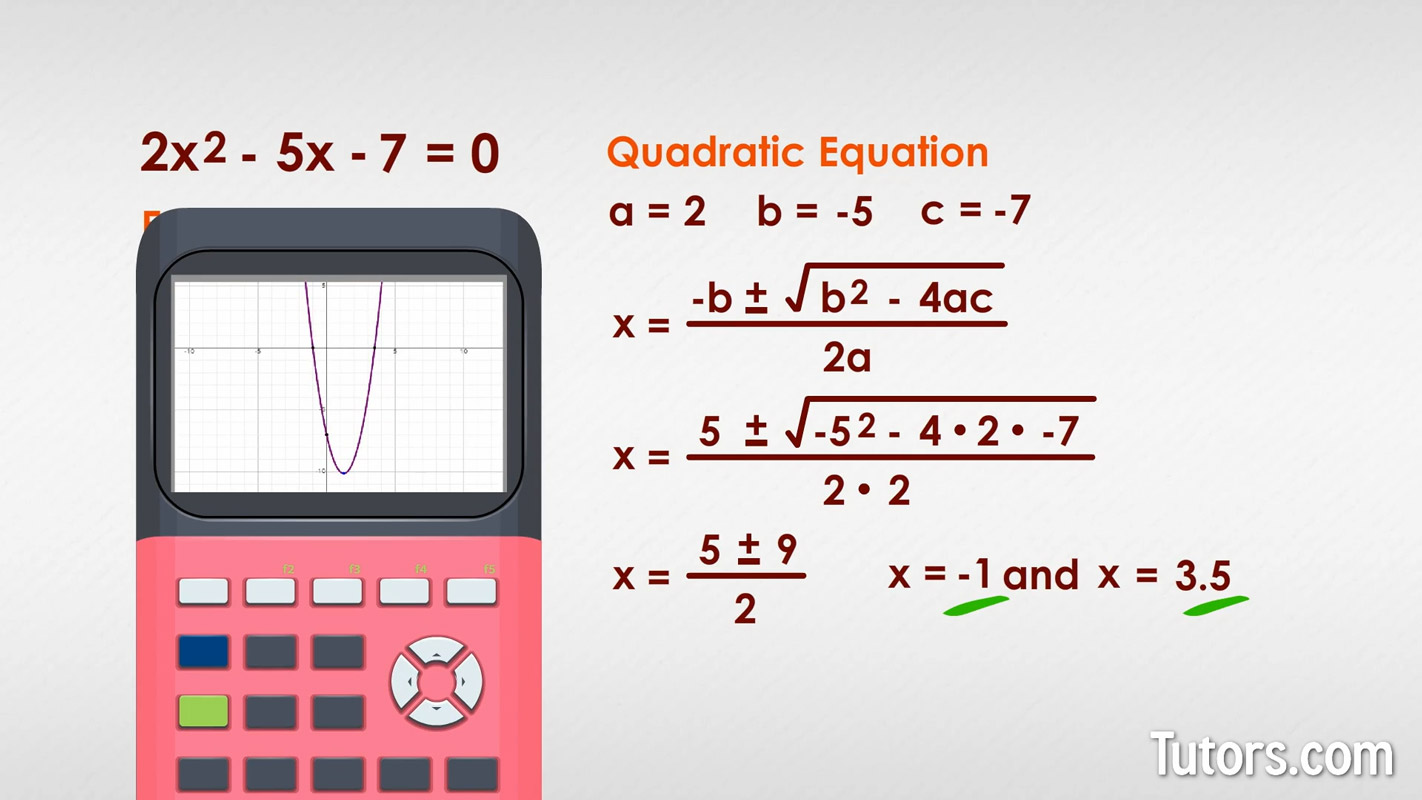
As we've seen before, the roots you calculate are the points where the parabola representing the function crosses the x-axis.
Conclusion
Congratulations! You have now mastered the most direct method for solving quadratic equations. The quadratic formula is your reliable tool for finding the roots of any quadratic, regardless of whether it can be factorised or how complex the numbers are.
Key Takeaways:
- The quadratic formula, , solves any equation in the form .
- The most crucial skill is substituting coefficients carefully, especially when they are negative. Use brackets!
- The sign yields two distinct solutions.
- Solutions can be expressed as decimal approximations (using a calculator) or as exact values in surd form (by simplifying algebraically).
For additional practice, you can work through the problems in 'Exercise 3' on page 7 of the "Quadratic Equations" PDF from mathcentre.ac.uk (LINK).
Preview of the Next Lesson:
We have now spent considerable time on quadratic polynomials (polynomials of degree 2), learning to factorise them and find their roots using various methods. In the next lesson, we will begin working with polynomials of higher degrees. We will start with a technique analogous to long division with numbers: polynomial long division. This is a fundamental skill that will allow us to factorise and find the roots of more complex polynomials like cubics and quartics.