Hello! Welcome to our final lesson in the "Introduction to Integration" module.
In our previous lessons, you've mastered the concept of the definite integral as a tool to find the signed area between a function's graph and the x-axis. You also learned the powerful substitution rule to handle more complex integrals. Today, we will combine these skills to solve a very common and practical problem: finding the area of a region enclosed between two curves.
This lesson directly addresses the learning outcome: Calculate the area of a region bounded by curves by setting up and evaluating a definite integral. We'll build on the idea of the area under a single curve to develop a general method for any region bounded by functions you can integrate.
1. The Core Idea: Area of Top Curve minus Area of Bottom Curve
Let's begin with the fundamental concept. Imagine we have two functions, and , and we want to find the area of the region enclosed between them from to .
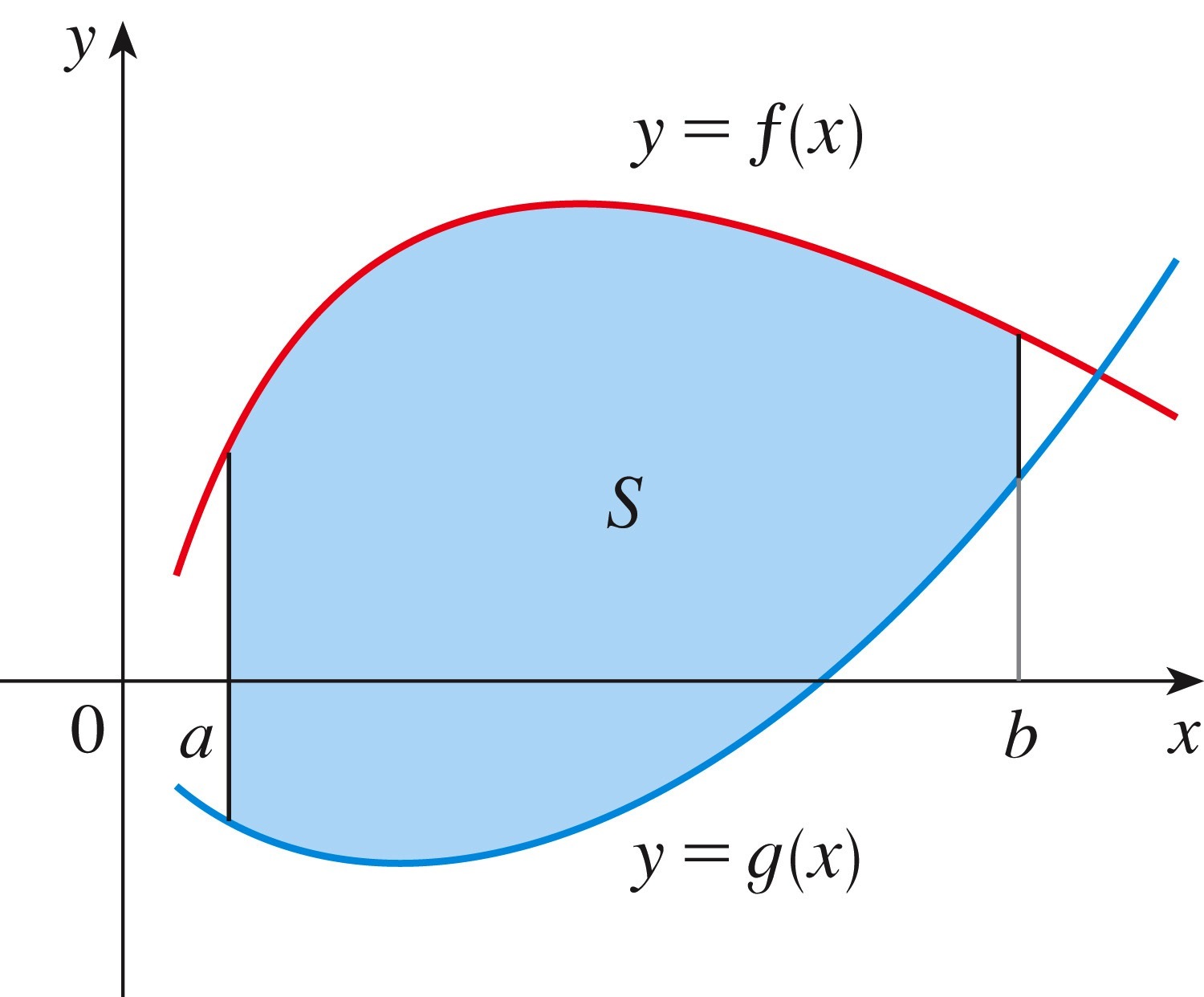
If is consistently above on the interval , we can think of this in three steps:
- The definite integral calculates the entire area under the top curve, , all the way down to the x-axis.
- The definite integral calculates the area under the bottom curve, , down to the x-axis.
- To get the area between them, we simply subtract the smaller area from the larger one.
So, the area is:
Using the properties of definite integrals, we can combine this into a single, more efficient expression:
Or, more intuitively:
The following video provides an excellent visual demonstration of this core principle.
Areas Between Curves (1 of 3: Establishing "top" minus "bottom")
Watch this segment from the video 'Areas Between Curves' by Eddie Woo. He does a fantastic job of visually explaining how subtracting the area under the lower curve from the area under the upper curve leaves you with exactly the area between them.
Watch from 04:32 to 08:08. Pay close attention to how he shades the area under the top curve (in blue) and the area under the bottom curve (in red) to show that their difference is the green shaded region we want to find.
2. A Step-by-Step Guide to Finding the Area
Now, let's establish a reliable process that you can use to solve these problems.
- Sketch the Curves: This is the most critical first step. A sketch helps you visualise the region, identify which function is on top, and see where they intersect.
- Find the Limits of Integration: The limits, and , are the x-coordinates of the points where the curves intersect. To find them, set the two functions equal to each other () and solve for . If the limits are explicitly given in the problem, you can use those.
- Set Up the Definite Integral: Write the integral using the formula . Be careful with brackets (parentheses), especially when the lower function is a polynomial. Forgetting to distribute the minus sign is a common error.
- Evaluate the Integral: Find the primitive (antiderivative) of the resulting function and then evaluate it using the Fundamental Theorem of Calculus.
Let's apply this to a classic example.
Example: Find the area enclosed by the line and the parabola .
-
Sketch: We have a straight line and a standard U-shaped parabola.

A sketch showing the region enclosed by the line y = x + 2 (upper curve) and the parabola y = x^2 (lower curve). -
Find Limits: Set the functions equal to find the intersection points.
This is a quadratic equation we can factorise (factor).
The solutions are and . So, our limits of integration are and . -
Set Up Integral: From our sketch, we can see the line is the upper function and the parabola is the lower function on the interval .
-
Evaluate: Now we find the antiderivative and evaluate.
The area of the enclosed region is or 4.5 square units.
This document provides more worked examples following this method.
This guide from mathcentre.ac.uk, 'Finding areas by integration', gives further examples. We are interested in the method for finding the area between two curves.
Please read sections 4 and 5, starting on page 7. Section 4 shows the 'subtracting two areas' logic, while section 5 shows the more direct 'integrate the difference' method we just used. Seeing both reinforces the concept.
Test your understanding!
Set up the definite integral that would calculate the area between the curves (an upside-down parabola) and the line . You don't need to evaluate it.
Show answer
- Find Limits: . The limits are and .
- Identify Upper/Lower: On the interval , the parabola is above the line .
- Set Up Integral:
3. Handling Complex Regions
Sometimes, the situation isn't as simple as one curve always being on top.
When Curves Cross
If the curves cross within the region of interest, the "upper" and "lower" functions switch places. In this case, you must split the area calculation into multiple integrals, one for each sub-interval where the top/bottom relationship is consistent.
For example, if is on top for and is on top for , the total area is:
The StudySmarter article below provides a worked example of this under the heading "Area Between Two Curves Examples", specifically the fourth example involving a parabola and a line that cross.
Integrating with Respect to
Occasionally, it's easier to think of the area as being made up of thin horizontal strips instead of vertical ones. This is useful when the curves are more easily expressed as in terms of (e.g., ).
In this case, the logic is "right minus left", and we integrate with respect to :
Here, and are the y-coordinates of the intersection points. This is an alternative approach to keep in mind, though we will focus on integrating with respect to for now.
Area Between Two Curves: Definition & Formula
The following article, 'Area Between Two Curves', provides a good summary of the steps and has several useful examples, including cases where curves cross and a brief explanation of integrating with respect to y.
First, read 'Area Between Two Curves Calculation Steps' to see the 3-step summary. Then, review the examples under 'Area Between Two Curves Examples'. Pay particular attention to the fourth example ('Calculate the area of the region bounded by the graphs of f(x) = -x² - 2x + 3 and g(x) = x-1...') which shows how to handle curves that cross by splitting the integral.
Conclusion
Congratulations on completing the final topic in your introduction to integration! You've moved from the abstract idea of an antiderivative to a concrete and powerful application.
Key Takeaways:
- The area between two curves is found by integrating the difference between the upper function and the lower function over a given interval: .
- A sketch is essential for identifying the region, the upper/lower functions, and the limits of integration.
- The limits of integration are typically the x-coordinates where the curves intersect, found by setting their equations equal to each other.
- If the curves cross within the desired region, you must split the area into multiple integrals at each crossing point.
- It's sometimes easier to integrate with respect to , using the formula .
With this module complete, you have a solid foundation in the basics of both differentiation and integration. In our next module, "Advanced Function Families," we will step back into algebra to explore more complex functions like polynomials and rational functions in greater depth. Our first lesson will focus on finding the roots of polynomials.