Hello!
In our last few lessons, we've built a strong foundation for integration. You learned how to find antiderivatives for basic functions and how to use the Fundamental Theorem of Calculus to evaluate definite integrals. This gave you the power to find the exact area under many curves.
However, many integrals you'll encounter won't be in a simple, basic form. For example, how would you find ? None of our current rules apply directly. This is where today's lesson comes in. We will learn a powerful new technique called integration by substitution, often called u-substitution. It is the integration equivalent of the chain rule from differentiation.
By the end of this lesson, you will be able to apply the substitution rule to evaluate both indefinite and definite integrals, significantly expanding the range of problems you can solve.
1. The "Why": Reversing the Chain Rule
Let's start by recalling the chain rule for differentiation. If you have a composite function, like , its derivative is:
Since integration is the reverse of differentiation, it follows that if we integrate the expression on the right, we should get back the function on the left (plus a constant):
This formula looks a bit intimidating, but it's the core idea behind substitution. The goal of substitution is to take an integral that looks like the one on the left and simplify it into a much easier form. We do this by introducing a new variable, which we'll call .
Let's set . If we differentiate this with respect to , we get . Thinking in terms of differentials, we can write this as .
Now, watch what happens when we substitute and into our complicated integral:
This new integral is much simpler! We just need to find the antiderivative of , which is simply . Afterwards, we can substitute back in for to get our final answer, .
The skill lies in identifying an integral that fits this pattern. You are looking for a composite function where the derivative of the 'inside' part is also present as a factor in the integral.
The following reading explains this concept formally.
This document from mathcentre.ac.uk provides a formal look at integrals of the form ∫f(g(x))g'(x)dx. It's a great way to solidify the theory behind why substitution works.
Read section 3, 'Finding ∫f(g(x))g'(x) dx by substituting u=g(x)', starting on page 5. Pay close attention to the side-by-side comparison of the specific example and the general case. This will help you learn to spot the pattern.
2. The Method for Indefinite Integrals
Now let's turn the theory into a practical, step-by-step method for solving indefinite integrals.
Here is the general procedure:
- Choose a substitution: Look for an "inner function" and let . A good choice for is often a quantity inside brackets (parentheses), under a root, or in the exponent.
- Find
du: Differentiate your substitution to find , and then rearrange to solve for in terms of . For example, if , then . - Substitute: Replace all expressions involving in the integral with their equivalent expressions in terms of . After this step, the integral should only contain the variable . If any 's remain, you may need to try a different substitution or rearrange your
uequation. - Integrate: Evaluate the new, simpler integral with respect to .
- Back-substitute: Replace with the original expression in to get the final answer. Remember to add the constant of integration, .
The following video provides an excellent walkthrough of this process. The presenter is British, so the terminology should be familiar.
Integration by Substitution : tutorial 1 : ExamSolutions
This video from ExamSolutions demonstrates the substitution method with a clear, step-by-step example.
Watch the entire video (around 3.5 minutes). Notice how he chooses 'u', finds 'dx' in terms of 'du', cancels out the remaining 'x' terms, integrates, and then substitutes back at the end.
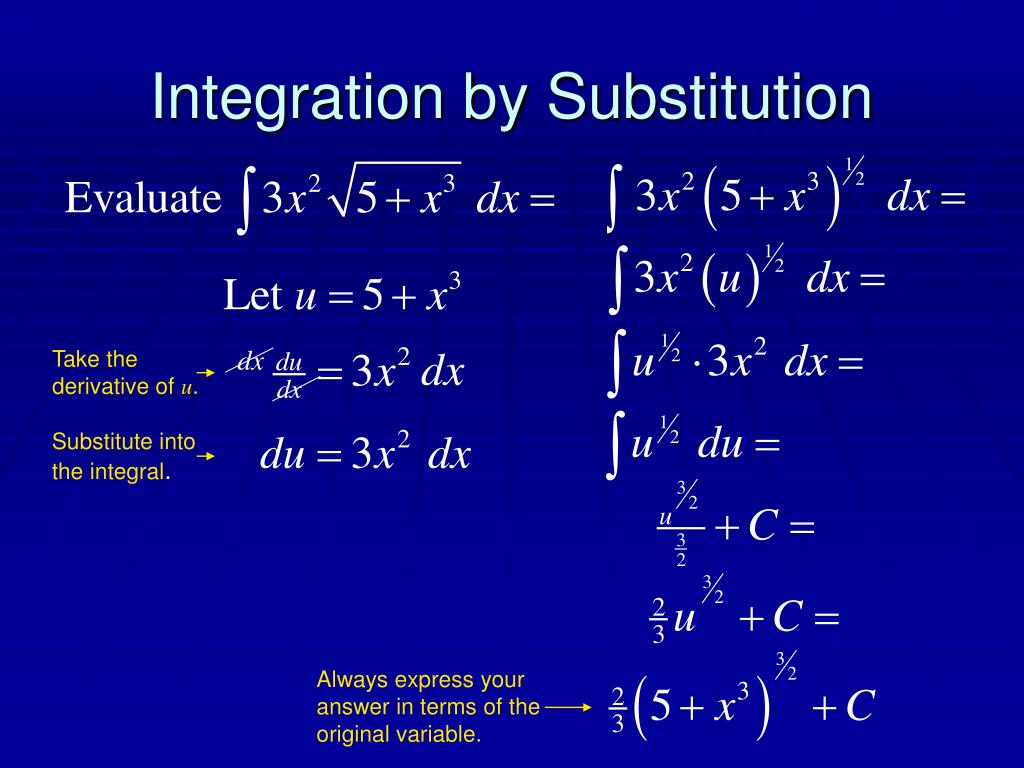
This image provides a great visual summary of the steps for an indefinite integral.
Test your understanding!
Evaluate the integral .
Show answer
- Choose
u: The "inner function" is . So, let . - Find
du: . Rearranging gives . - Substitute: The terms cancel out, leaving:
- Integrate:
- Back-substitute:
3. Substitution for Definite Integrals
The process for definite integrals starts the same way, but with one crucial and time-saving difference: we change the limits of integration.
When we change the variable from to , the limits of integration, which are -values, must also be converted to their corresponding -values.
The updated procedure is:
- Choose and find .
- Change the limits: If the original limits are from to , calculate the new limits using your substitution equation:
- New lower limit:
- New upper limit:
- Substitute , , and the new -limits into the integral.
- Integrate the -expression.
- Evaluate: Use the new -limits to evaluate the definite integral. There is no need to substitute back to .
This video demonstrates the method for definite integrals. It also shows a slightly more complex example where you have to rearrange the -equation to substitute for a leftover .
How to Integrate by substitution with limits (1) : ExamSolutions Maths Revision
This ExamSolutions video clearly explains how to handle limits of integration when using substitution.
Watch from the beginning to 5:14. Pay special attention to the part starting around 2:20 where he calculates the new limits for 'u'. Also, notice how at 3:49 he has to rearrange u=2x+1 to substitute for the 'x' that didn't cancel.
This infographic clearly lays out the steps for a definite integral.

Test your understanding!
Evaluate the definite integral .
Show answer
- Choose
u: Let . - Find
du: , so . - Change the limits:
- Lower limit: When , .
- Upper limit: When , .
- Substitute:
- Integrate and evaluate:
Conclusion
You've now learned one of the most fundamental techniques in calculus. Integration by substitution unlocks a vast number of integrals that were previously out of reach.
Key Takeaways:
- Integration by Substitution is the reverse of the chain rule. It's used to simplify an integral by changing the variable.
- For indefinite integrals, the process is: choose , find , substitute, integrate with respect to , and then substitute back in.
- For definite integrals, you follow the same process but must change the limits of integration to be in terms of . This allows you to evaluate the integral directly without back-substituting.
- A good choice for is often the "inside" part of a composite function, whose derivative also appears as a factor in the integral.
Mastering substitution is largely a matter of practice and learning to recognise the patterns. The more you do, the more intuitive it will become.
In our next lesson, we will put your new integration skills to use in a very practical application: calculating the area of a region bounded by two or more curves.