Hello! Welcome back to our journey through mathematics.
In our last lesson, we defined logarithms as the inverse of exponential functions, focusing on how to evaluate them and understand their graphical properties. We ended with a preview that the laws of indices (exponents) have direct counterparts in the world of logarithms.
Today, we will explore these powerful properties. The learning outcome for this lesson is to apply properties of logarithms to expand and condense logarithmic expressions. We will learn three fundamental "laws of logs" that will allow you to rewrite complex logarithmic expressions in simpler forms. Mastering these rules is essential for solving logarithmic and exponential equations, which we will tackle in the coming lessons.
1. The Laws of Logarithms
Since a logarithm is simply a power (an index), the rules you already know for manipulating powers have direct parallels for logarithms.
- Index Law 1 (Multiplication):
- Index Law 2 (Division):
- Index Law 3 (Power of a Power):
These three laws lead directly to the three main laws of logarithms. Understanding where these laws come from can make them much easier to remember.
7.3 Product & Quotient Laws of LOGARITHMS (full lesson) | grade 12 MHF4U | jensenmath.ca
To see how the first law of logarithms is derived directly from the laws of indices, watch the beginning of the following video from JensenMath. This proof provides a solid foundation for why the properties work the way they do.
Watch the first 3 minutes of the video (00:00 - 02:55). The presenter clearly walks through the proof for the product law of logarithms.
This logic of converting to exponential form, applying an index law, and converting back is the basis for all three properties. Here they are:
The Three Main Laws
-
The Product Rule (Addition Law):
The logarithm of a product is the sum of the logarithms.
This corresponds to the index law . -
The Quotient Rule (Subtraction Law):
The logarithm of a quotient (division) is the difference of the logarithms.
This corresponds to the index law . -
The Power Rule:
The logarithm of a number raised to a power is the power multiplied by the logarithm of the number.
This corresponds to the index law .

It is crucial to remember that these rules only apply when the logarithms have the same base.
For a more detailed textual explanation of how each of these laws is derived from the laws of indices, you can refer to the Logarithms PDF from mathcentre.ac.uk. Sections 5, 6, and 7 on pages 3-5 cover the First, Second, and Third laws, respectively.
2. Expanding Logarithmic Expressions
The first application of these laws is expanding expressions. This means taking a single logarithm with a complicated argument and breaking it down into a sum or difference of simpler logarithms.
The general strategy is:
- Use the Quotient Rule to handle any division.
- Use the Product Rule to handle any multiplication.
- Use the Power Rule to move any exponents to the front as coefficients.
Logarithms Part 3: Properties of Logs, Expanding Logarithmic Expressions
Let's watch a clear demonstration of how these rules are applied in sequence to expand a complex expression. The video from 'Professor Dave Explains' provides a concise walkthrough.
Watch from 01:24 to 05:14. The first part (01:24 - 03:39) introduces each of the three rules. The second part (03:39 - 05:14) shows a complete example of expanding a complex logarithmic expression from start to finish.
As you saw, expanding an expression like involves systematically applying the rules:
- Quotient Rule:
- Product Rule:
- Be careful with the brackets! The minus sign distributes:
- Power Rule & Simplification:
- Rewrite as .
- (Note: because )
Test your understanding!
Expand the following logarithmic expression completely:
Show answer
- Apply the Quotient Rule:
- Apply the Product Rule to the first term:
- Apply the Power Rule and evaluate :
3. Condensing Logarithmic Expressions
The second application is the reverse process: condensing. This involves taking an expression with multiple logarithms (that have the same base) and combining them into a single logarithm.
This is essentially the expansion process in reverse:
- Use the Power Rule to turn coefficients into exponents.
- Use the Product and Quotient Rules to combine the terms. Terms being added go in the numerator, and terms being subtracted go in the denominator.
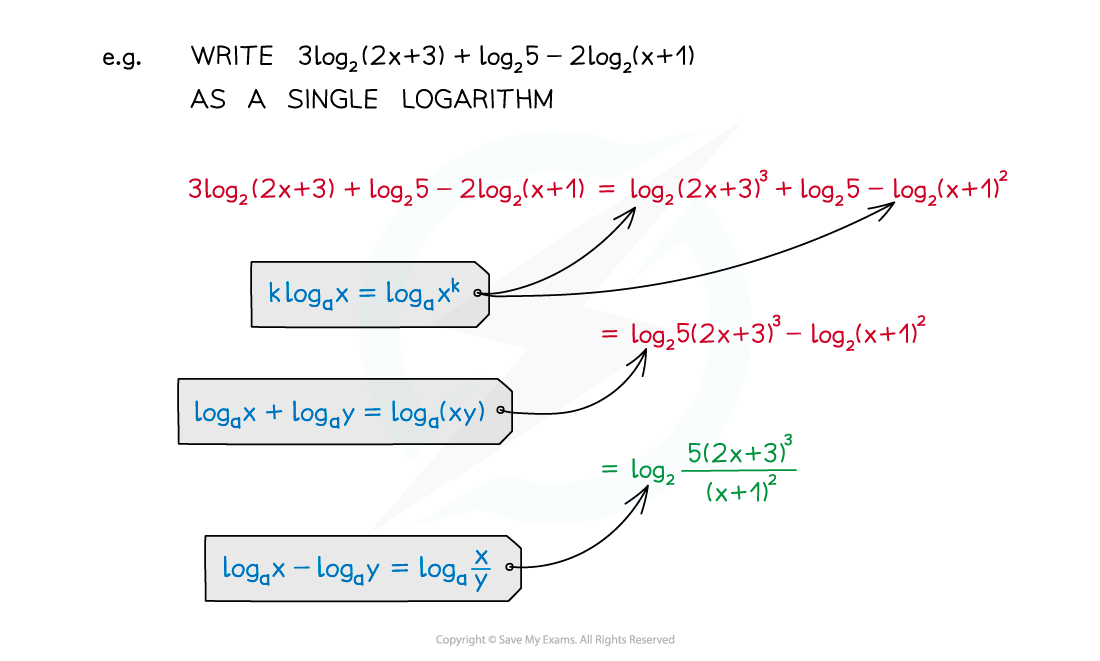
Let's watch a quick demonstration of condensing an expression that includes a constant term.
Logarithms Part 3: Properties of Logs, Expanding Logarithmic Expressions
The same video from 'Professor Dave Explains' also shows how to condense an expression. Pay close attention to how the constant '2' is converted into a logarithm so it can be combined with the other terms.
Watch from 04:59 to 06:01.
The key trick here was converting the number 2 into so it could be combined with the other log terms. This uses the fundamental definition of a logarithm in reverse.
Test your understanding!
Condense the following expression into a single logarithm:
Show answer
- Apply the Power Rule first:
You can also write as . - Apply the Product and Quotient Rules:
The terms being added ( and ) are multiplied in the numerator.
The term being subtracted () goes in the denominator.
Conclusion
In this lesson, we connected the laws of indices to the laws of logarithms and learned how to use these properties to manipulate expressions.
Key Takeaways:
- Product Rule:
- Quotient Rule:
- Power Rule:
- Expanding involves breaking one logarithm into many.
- Condensing involves combining many logarithms (of the same base) into one.
- The order of operations for condensing is Power Rule first, then Product/Quotient Rules.
Preview of the Next Lesson:
These laws are not just for simplifying expressions; they are crucial tools for solving equations. In our next lesson, we will solve exponential equations using logarithms. You will see how the Power Rule, in particular, becomes incredibly useful for isolating variables that are stuck in an exponent.