Hello! In our last lesson, we focused on evaluating functions, including piecewise functions, at specific input values. This skill of substituting an input to find an output is fundamental.
Today, we'll build on that by exploring how to combine entire functions. Just as you can perform arithmetic with numbers, you can also add, subtract, multiply, and divide functions to create new, more complex ones. This lesson will teach you how to perform these arithmetic operations on functions.
From your IT perspective, you can think of this as creating a new, more powerful function by combining the outputs of two existing functions. For example, if you have a function to calculate revenue and another to calculate costs, you could subtract them to create a new function that directly calculates profit.
1. Notation for Function Operations
First, let's establish the notation. When we combine two functions, say and , using arithmetic, we use a clear and intuitive notation.
- Sum:
- Difference:
- Product:
- Quotient: , where
The process is exactly what the notation implies: you simply take the expressions for the two functions and add, subtract, multiply, or divide them.
For a quick confirmation of this notation, you can review the resource below.
This page from Purplemath, titled 'Operations on Functions', clearly lays out the standard notation for each of the four arithmetic operations.
Read the short section 'What is the notation for function operations?'. It provides a concise summary of the formulas we will be using.
2. Performing the Operations: Addition, Subtraction, and Multiplication
Performing these operations involves the algebraic skills you already have, like combining like terms and expanding brackets (parentheses).
Let's watch a video that demonstrates the process with some clear examples.
This video, 'Function Operations' by The Organic Chemistry Tutor, provides a straightforward walkthrough of adding, subtracting, and multiplying two functions.
Watch the video from the beginning up to 02:00. Notice how adding and subtracting involves combining like terms, while multiplication uses the FOIL method to expand the brackets.
Let's work through an example together.
Let and .
-
Sum:
Now, combine like terms: -
Difference:
Be careful to distribute the negative sign to every term in : -
Product:
Expand the brackets (using FOIL or distributive method):
Combine like terms:
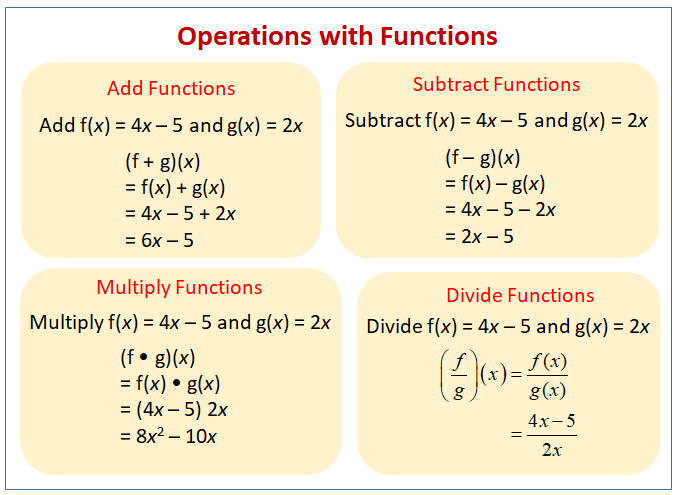
This image provides another clean, visual summary of the four operations.
3. Division and the Crucial Role of Domain
Division follows the same pattern, but it introduces a critical consideration: the domain of the new function. As you know from our first lesson on functions, the domain is the set of all valid inputs. When combining functions, the domain of the new function is constrained by the domains of the original functions.
This video introduces the key idea: domain restrictions from the original functions are like "skeletons in the closet"—they follow you, even if they seem to disappear after simplification.
Operations of Functions (Precalculus - College Algebra 5)
In this introduction from 'Operations of Functions', Professor Leonard explains why the domain of the original functions is so important when creating new ones.
Watch the first 1 minute and 40 seconds of the video. Focus on the core message: domain issues from the original functions persist in the combined function.
Let's formalise this concept.
Combining Functions: Definition, Example & Arithmetic
The article 'Combining Functions' explains the rule for the domain of a combined function using the idea of an intersection.
Read the section titled 'Combining Functions: A Note on Domain'. This section explains that the domain of a sum, difference, or product is the intersection of the individual domains. It also introduces the extra rule for division.
Rule for Domains of Combined Functions:
- For Addition, Subtraction, and Multiplication: The domain of the combined function , , or is the intersection of the domains of and . This means the input must be valid for both original functions.
- For Division: The domain of is the intersection of the domains of and , with one additional restriction: we must exclude any values for which , because division by zero is undefined.
Let's see this in action with division.

Example:
Let (Domain: all real numbers) and (Domain: all real numbers).
Find and its domain.
First, we write the division:
It's tempting to simplify this by factorising the numerator:
The simplified function is just , which looks like its domain should be all real numbers. But this is incorrect. We must honour the original domain restrictions. The function is in the denominator. We must find where :
So, is not allowed in the domain of the combined function , even though it appears to be valid in the simplified version.
The correct domain is all real numbers except 3. In interval notation, this is .
Test your understanding!
Let and .
- What is the domain of ? What is the domain of ?
- Find the function and determine its domain.
- Find the function and determine its domain.
Show answer
-
The domain of is all non-negative numbers, or , since you cannot take the square root of a negative number. The domain of is all real numbers, .
-
. The domain is the intersection of the domains of and . The intersection of and is . So, the domain of the product is .
-
. The domain is the intersection of the original domains, , but we must also exclude values where the denominator is zero. when . So, we must exclude . The domain is therefore .
4. Evaluating Combined Functions at a Point
What if you need to find the value of a combined function at a single point, like ? As you saw in the last lesson, this involves finding the output for a specific input. There are two ways to do this:
- Combine, then Evaluate: Find the general formula for first, and then substitute into the new formula.
- Evaluate, then Combine: Find and separately, and then add the resulting numbers.
Method 2 is often faster and less prone to algebraic mistakes. Let's see a demonstration.
Let's return to the 'Function Operations' video. This final clip shows how to evaluate combined functions at a specific numerical input, comparing the two methods.
Watch from 04:55 to the end (07:10). The video demonstrates the 'evaluate, then combine' method, which is usually more direct.
Example:
Using and , let's find .
-
Method 1 (Combine, then Evaluate):
From before, we know .
Now substitute :
. -
Method 2 (Evaluate, then Combine):
First, find and :
Now, perform the operation:
.
Both methods give the same result, but you can see how the second might be simpler.
Conclusion
In this lesson, you've learned how to create new functions from old ones using basic arithmetic.
Key Takeaways:
- Functions can be added, subtracted, multiplied, and divided just like numbers.
- The notation, such as , directly tells you which operation to perform on the functions' expressions.
- The domain of a combined function is the intersection of the domains of the original functions.
- For division, you must add a restriction: the denominator function cannot be equal to zero. This restriction holds even if simplification makes it seem like the issue has vanished.
- To evaluate a combined function at a point, it's often easiest to evaluate each function at that point first and then perform the arithmetic.
Preview of the Next Lesson:
We've just combined functions using arithmetic. Next, we will learn a completely different and powerful way to combine them called function composition. Instead of operating on the outputs, we will be feeding the output of one function directly into the input of another.