Hello!
In our recent lessons, we've focused on understanding the properties and graphs of linear and quadratic functions. We learned to identify key features like the gradient (slope), y-intercept, vertex, and roots (x-intercepts) to sketch their graphs efficiently.
Today, we will put that knowledge to work in a very practical way. Our goal is to translate word problems into mathematical models using linear and quadratic functions. This is one of the most important skills in mathematics, as it allows us to take a real-world scenario, represent it with an equation, and use that equation to make predictions and solve problems. This process of translation and analysis is a cornerstone of problem-solving in many fields, including technology and finance.
1. Modelling with Linear Functions
Linear models are used for situations where a quantity changes at a constant rate. Think of a monthly subscription, a car travelling at a steady speed, or a salary that includes a fixed amount plus a commission per sale.
The key is to translate the words of the problem into the components of the linear equation you already know: y = mx + b.
b(the y-intercept): This is the starting value or fixed amount. Look for phrases like "initial fee," "flat rate," or a base amount that doesn't change. It's the value ofywhenxis zero.m(the gradient or slope): This is the rate of change. It's the amount the dependent variable (y) changes for every one-unit increase in the independent variable (x). Look for keywords like "per," "each," or "for every."
A Step-by-Step Approach
A systematic approach can make these problems much more manageable. Let's explore a detailed example of a car salesman's income. The following video breaks down the process of turning a word problem into a linear function.
Modeling Word Problems with Linear Functions Part 1
The video 'Modeling Word Problems with Linear Functions Part 1' by ProfRobBob provides an excellent, methodical walkthrough of a linear word problem. We'll watch it in a few segments to focus on the key steps.
First, watch from the beginning to 06:50. The presenter introduces the problem and discusses the first crucial step: identifying the independent and dependent variables and their units. This step sets up the entire problem.
As you saw in the video, the first steps are:
- Read and Understand: What is the problem about? Here, it's about income based on salary and car sales.
- Identify Variables: What two quantities are related? In this case, it's the number of cars sold and the total pay.
- Assign Independent and Dependent: Which variable controls the other? The number of cars sold influences the pay. So:
- Independent variable (x): Number of cars sold.
- Dependent variable (y): Total pay.
Once the variables are set, the next step is to build the equation. A powerful technique, especially if the equation isn't immediately obvious, is to calculate a few values and find the pattern.
Modeling Word Problems with Linear Functions Part 1
Now, let's continue with the same video to see how to build the equation from the pattern.
Please watch from 06:50 to 11:12. Pay close attention to how the presenter uses a table to calculate the pay for 0, 1, 2, and 3 cars. This process reveals the underlying structure of the linear equation.
The video demonstrates how the calculation always involves the fixed salary ($1000) plus a repeated amount ($200) for each car. This leads directly to the model:
Pay = $1000 + $200 × (Number of Cars)
Or, using our standard variables:y = 200x + 1000
Here, the rate of change m is $200 per car, and the initial value b is the $1000 base salary.
The final step is to use this model to answer questions.
Modeling Word Problems with Linear Functions Part 1
Let's watch one last clip from the video to see how the created model is used to solve a specific problem.
Watch from 21:17 to 24:15. This section shows how to use the equation to find out how many cars must be sold to earn a target income of $3100.
This last step highlights the power of creating a mathematical model. Once you have the equation, you can solve for any unknown value without having to manually calculate every scenario.
2. Modelling with Quadratic Functions
Quadratic models, which graph as parabolas, appear in different kinds of real-world situations. Common examples include:
- Projectile Motion: The path of an object thrown or launched into the air (e.g., a ball, a flare, a rocket). The height of the object over time is a quadratic relationship.
- Area Problems: Finding the maximum or minimum area of a shape, like a rectangular garden, given constraints on its perimeter.
- Revenue and Profit: Modelling the revenue or profit based on the price of an item. Often, raising the price increases revenue for a while, but then it starts to decrease as fewer people buy the item, creating a parabolic shape.

A Step-by-Step Approach
When faced with a quadratic word problem, your strategy will depend on the information given.
-
Identify Key Information: Read the problem and look for:
- A maximum or minimum value (e.g., "maximum height," "lowest point"). This corresponds to the vertex
(h, k). - Points where the value is zero (e.g., "hits the ground," "starts and ends on the ground"). These are the roots (x-intercepts)
pandq. - A starting value (e.g., "thrown from a height of..."). This is the y-intercept.
- Any other points
(x, y)on the path.
- A maximum or minimum value (e.g., "maximum height," "lowest point"). This corresponds to the vertex
-
Choose the Right Form:
- If you know the vertex, use vertex form:
y = a(x - h)² + k. - If you know the roots (x-intercepts), use intercept form:
y = a(x - p)(x - q). - If you are given three points or the equation is provided in standard form, use
y = ax² + bx + c.
- If you know the vertex, use vertex form:
-
Build and Solve the Model: Let's see this in action with a projectile motion problem.
Graphing Quadratic Functions in Vertex & Standard Form - Axis of Symmetry - Word Problems
The video 'Graphing Quadratic Functions... - Word Problems' by The Organic Chemistry Tutor has an excellent example of modelling the path of a thrown ball. This will show you how to apply the standard form and the vertex formula.
Please watch from 29:50 to 37:55. The problem gives the height function in standard form. Observe how the presenter uses the formula t = -b/(2a) to find the time to reach maximum height (the x-coordinate of the vertex) and then calculates the maximum height (the y-coordinate). Also, notice how the quadratic formula is used to find when the ball hits the ground (the positive root).
A Different Type of Quadratic Problem: Area
Quadratic models aren't limited to things flying through the air. They are also very useful for optimisation problems, like finding the maximum possible area of a rectangular space.
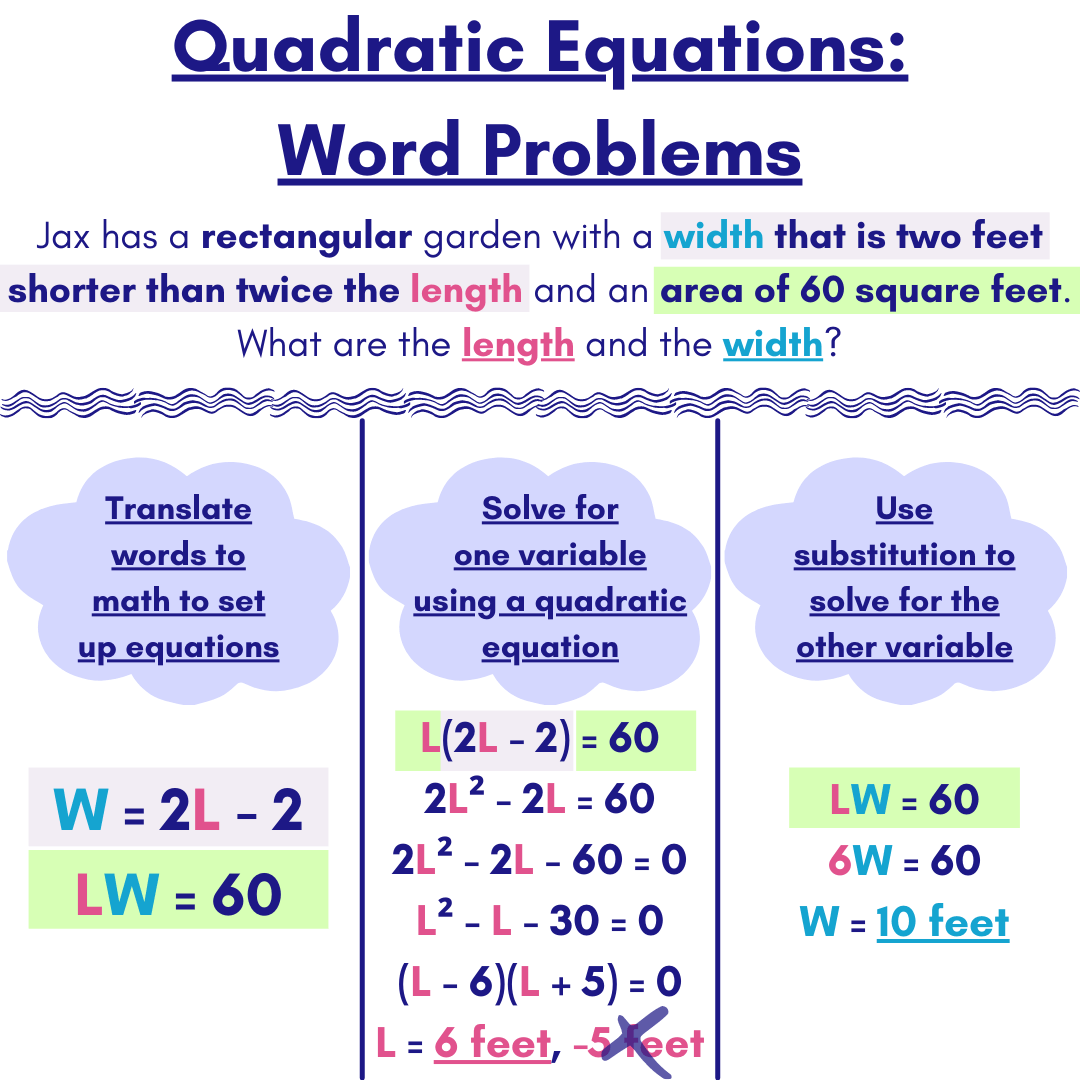
Let's break down the logic in this image:
- Define Variables:
Lfor length,Wfor width. - Translate the Words into Equations:
- "The length is 5 less than twice the width" becomes
L = 2W - 5. - "The area is 75" becomes
A = L × W = 75.
- "The length is 5 less than twice the width" becomes
- Create a Single Quadratic Equation: Substitute the expression for
Linto the area formula:
(2W - 5) × W = 75
2W² - 5W = 75
2W² - 5W - 75 = 0 - Solve the Quadratic Equation: The image shows one method: factorising (factoring). You could also use the quadratic formula. The solutions are
W = 7.5andW = -5. - Interpret the Solution in Context: Since width cannot be negative, we discard
W = -5. The only valid solution isW = 7.5. - Find the Other Dimension: Use the width to find the length:
L = 2(7.5) - 5 = 15 - 5 = 10.
This example shows how a completely different scenario can also lead to a quadratic model. The key is to set up the relationships between the variables correctly.
Test your understanding!
Let's try applying these modelling skills. For each problem, identify the type of function (linear or quadratic), write the equation, and solve the problem.
Problem 1 (Linear):
A banquet hall charges £550 for room rental, plus £18 for each person served.
a) Write a function C(p) for the total cost of a banquet for p people.
b) What is the total cost for 70 people?
Problem 2 (Quadratic):
A football is thrown. Its height, h(t) in metres, after t seconds is modelled by the function h(t) = -4.9t² + 14.7t + 1.
a) What was the maximum height of the football? (Hint: Find the vertex).
b) How long does it take for the ball to hit the ground? (Hint: Find the positive root when h(t)=0).
Show answer
Problem 1 (Linear):
a) This is a linear relationship. The fixed cost (y-intercept) is £550, and the rate of change (gradient) is £18 per person.
The function is C(p) = 18p + 550.
b) To find the cost for 70 people, we evaluate C(70):C(70) = 18(70) + 550 = 1260 + 550 = 1810.
The total cost is £1810.
Problem 2 (Quadratic):
The function is h(t) = -4.9t² + 14.7t + 1, with a = -4.9, b = 14.7, c = 1.
a) The maximum height occurs at the vertex. The time to reach the vertex is:t = -b / (2a) = -14.7 / (2 * -4.9) = -14.7 / -9.8 = 1.5 seconds.
Now, find the height at t = 1.5:h(1.5) = -4.9(1.5)² + 14.7(1.5) + 1 = -4.9(2.25) + 22.05 + 1 = -11.025 + 22.05 + 1 = 12.025.
The maximum height is 12.025 metres.
b) The ball hits the ground when h(t) = 0. We use the quadratic formula to solve -4.9t² + 14.7t + 1 = 0:
This gives two solutions:t₁ = (-14.7 + 15.35) / -9.8 ≈ 0.65 / -9.8 ≈ -0.066t₂ = (-14.7 - 15.35) / -9.8 = -30.05 / -9.8 ≈ 3.066
Since time cannot be negative, the ball hits the ground after approximately 3.07 seconds.
Conclusion
Today, we've taken a significant step from theory to practice by learning how to model real-world problems with linear and quadratic functions. This skill of translating a situation into a mathematical equation is fundamental to applying mathematics.
Key Takeaways:
- Linear models (
y = mx + b) are used for situations with a constant rate of change (m) and a starting or fixed value (b). - Quadratic models describe phenomena that increase to a maximum and then decrease (or vice versa), like projectile motion or certain optimisation problems involving area or revenue.
- To build a quadratic model, identify key features from the problem—such as the vertex, roots (intercepts), or other points—to determine the parameters of the equation in its most convenient form (vertex, intercept, or standard).
- Once a model is created, it can be used to answer questions and make predictions by solving for unknown variables.
Preview of the Next Lesson:
We've spent a lot of time with linear and quadratic functions. In our next module, "Advanced Function Families," we'll begin to explore functions of higher degrees. The first lesson will focus on finding the roots of more complex polynomial functions, extending the factorising and formula-based techniques you learned for quadratics.