Welcome to our next lesson. In our last session, we established the importance of splitting data into training, validation, and test sets to get a reliable estimate of model performance. However, we ended with a critical question: what if our single validation set was just a "lucky" or "unlucky" draw of data points? A single split can give us a performance score that's either too optimistic or too pessimistic by pure chance.
Today, we will solve that problem. Your goal is to learn how to apply k-fold cross-validation to get robust estimates of model performance. This technique is the industry standard for evaluating models reliably. It moves beyond a single validation set by systematically creating and testing on multiple validation sets from our training data, giving us a much more trustworthy picture of how our model will perform in the real world.
1. The "Lucky Split" Problem
The core issue with a single train-validation split is its instability. Depending on the random_state you choose, the samples that land in your validation set change, and so does your model's performance score. On smaller datasets, this swing can be dramatic, making it hard to trust your evaluation.
This phenomenon is often called the "lucky split problem." To understand it more deeply, let's start with a short article that frames the issue perfectly.
Cross-Validation vs Train-Test Split: Trust Your Model | Let's Data ...
This article from Let's Data Science introduces the core problem that cross-validation solves.
Read the introduction and the section "The Lucky Split Problem". Pay close attention to the example where changing random_state causes an 11-point swing in accuracy. The key insight is that a single split gives you a point estimate, while cross-validation gives you a distribution of performance.
To reinforce this intuition, this short segment from StatQuest explains why relying on a single, arbitrary split is a flawed approach.
Machine Learning Fundamentals: Cross Validation
This segment from StatQuest's "Machine Learning Fundamentals: Cross Validation" visually demonstrates the pitfalls of a fixed data split.
Watch the part from the explanation where Josh Starmer discusses why simply splitting data into training and testing portions isn't enough, highlighting the arbitrariness of any single split.
2. K-Fold Cross-Validation: The Solution
Instead of committing to one validation set, k-fold cross-validation allows us to use our data more effectively. The process is straightforward:
- Split: We divide our training dataset into k equal-sized parts, or "folds". A common choice for k is 5 or 10.
- Iterate: We then run k rounds of training and evaluation. In each round:
- One fold is held out as the validation set.
- The remaining k-1 folds are used to train the model.
- Average: After k rounds, we have k different performance scores. We average these scores to get a single, more robust estimate of our model's performance.
This animation from StatQuest provides an excellent visual walkthrough of this process.
Machine Learning Fundamentals: Cross Validation
This part of the StatQuest video explains the mechanics of k-fold cross-validation.
Watch from the core concept. Notice how each fold gets a turn to be the test (validation) set, ensuring that every data point is used for validation exactly once.
The diagram below illustrates this process for a 5-fold cross-validation scenario. The full dataset is first split into training and a final test set. The cross-validation procedure then happens only on the training data.
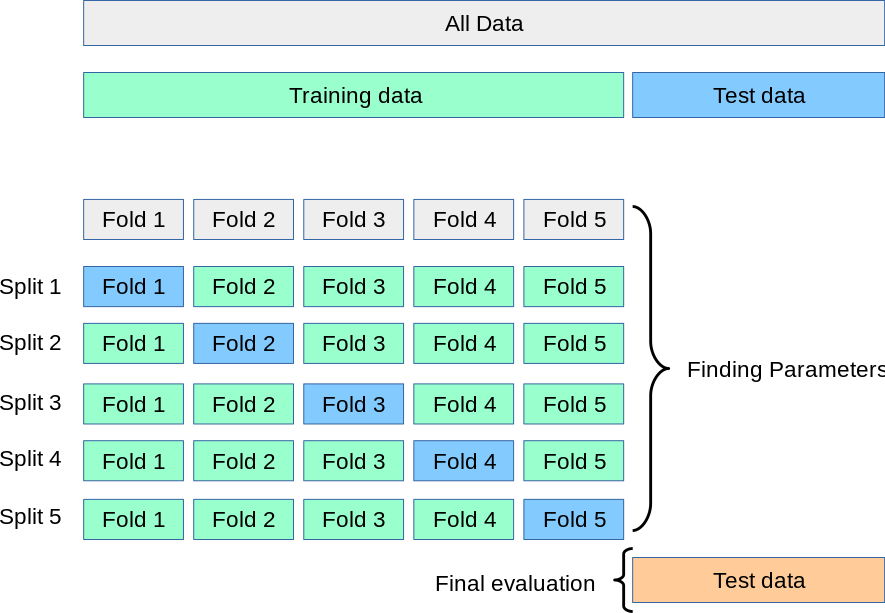
3. Implementing Cross-Validation in Scikit-Learn
While you could write a for loop to implement this logic manually, scikit-learn provides a much simpler and optimized function: cross_val_score. This function handles the entire k-fold process in a single line of code.
Let's watch a practical demonstration of how to use it. The video first shows the manual process to build your intuition, then introduces the convenient cross_val_score function.
Machine Learning Tutorial Python 12 - K Fold Cross Validation
This video from the codebasics channel provides a hands-on guide to implementing k-fold cross-validation in Python.
First, watch how KFold can be used in a loop to generate training and testing indices (manual splits). This helps you understand what's happening under the hood. Then, watch the section on the more direct method using cross_val_score (using cross_val_score). This is the standard way you'll apply cross-validation in practice.
Here is how you would use it in your code:
from sklearn.model_selection import cross_val_score
from sklearn.linear_model import LogisticRegression


# Assume X and y are your full feature and target arrays
# We create an instance of the model we want to evaluate
model = LogisticRegression()


# We call cross_val_score
# cv=5 means we are performing 5-fold cross-validation
scores = cross_val_score(model, X, y, cv=5, scoring='accuracy')

print("Scores for each fold:", scores)


# Example output: [0.98, 0.95, 0.96, 0.92, 0.99]

print("Mean accuracy:", scores.mean())


# Example output: 0.96

print("Standard deviation:", scores.std())


# Example output: 0.024
The output of cross_val_score is an array of scores, one for each fold. The most important step is to report both the mean and the standard deviation.
- The mean gives you the overall performance estimate.
- The standard deviation tells you how much the performance varied between folds. A low standard deviation means your model's performance is stable across different subsets of data, which builds confidence in the mean score.
4. Important Considerations and Variations
While standard K-Fold is powerful, there are variations designed for specific situations. Understanding these will be crucial for your projects and for technical interviews.
Stratified K-Fold
For classification problems, especially with imbalanced classes, you should use Stratified K-Fold. This variant ensures that the proportion of classes in each fold is the same as in the original dataset. For example, if your dataset is 80% class A and 20% class B, stratified k-fold ensures each fold maintains this 80/20 split. This prevents situations where a fold might, by chance, contain no samples from the minority class.

The good news is that scikit-learn's cross_val_score is smart: when used with a classifier, it automatically uses StratifiedKFold by default.
Choosing K
The number of folds, K, is a parameter you choose.
- K=5 or K=10 are the most common choices. They provide a good balance between computational cost and getting a reliable estimate.
- A higher
Kmeans training on more data in each fold, which is closer to how your final model will be trained (on all data). However, it's also more computationally expensive. - A lower
Kis faster but might give a less reliable estimate, as each model is trained on a smaller portion of the data.
The article from Let's Data Science has a helpful table and decision framework for choosing the right cross-validation strategy.
Cross-Validation vs Train-Test Split: Trust Your Model | Let's Data ...
This article provides deep, practical advice on choosing and using cross-validation methods.
Focus on these three sections: "Choosing the Right K": This gives you a clear trade-off table for selecting K. "Stratified K-Fold for Imbalanced Classes": This reinforces why stratification is so important for classification. "CV Strategy Selection Decision Framework": This is an excellent decision tree and table to help you choose the right CV method for different types of problems (e.g., regression vs. classification, grouped data, time series). This is valuable knowledge for an internship-seeker.
Self-Check
To prepare for technical interviews, it's crucial to be able to articulate these concepts clearly. Based on what you've learned, try to answer these questions for yourself.
- Why is a single train-test split considered unreliable for model evaluation?
- When should you use Stratified K-Fold instead of regular K-Fold?
- You run 5-fold cross-validation and get the scores
[0.91, 0.98, 0.89, 0.94, 0.93]. How would you report the model's performance to a stakeholder? - What is the main drawback of using cross-validation?
You can find excellent, concise answers to similar questions in the letsdatascience.com article under the "Interview Questions" section (resource LINK, section 12).
Conclusion
You have now learned how to use k-fold cross-validation to generate robust and reliable estimates of your model's performance. This technique is a significant step up from a single validation set and is a fundamental skill for any data scientist.
Key Takeaways:
- Cross-validation mitigates the "lucky split" problem by training and evaluating a model on multiple, systematic splits of the data.
- The
cross_val_scorefunction in scikit-learn is the standard tool for applying k-fold cross-validation. - Always report both the mean and standard deviation of the cross-validation scores to provide a complete picture of model performance and stability.
- For classification tasks,
StratifiedKFoldis essential to ensure class proportions are maintained across folds.
In our last lesson, we used a validation set for model tuning. Now we've seen how cross-validation is used for robust evaluation. In future lessons, we will combine these ideas and see how to use cross-validation to perform hyperparameter tuning, a process that finds the best settings for a model.