Welcome to the first lesson of our module on Feature Engineering! In the previous module, we established the theoretical foundations of machine learning, from evaluating models to understanding the probabilistic reasoning behind their predictions with Bayes' rule. Now, we transition from theory to the essential, hands-on craft of preparing data for these models.
Machine learning algorithms are powerful, but they operate on mathematics, not raw text. This lesson addresses a fundamental first step in data preparation: encoding categorical variables. Your goal is to learn how to convert non-numeric data, such as product categories or city names, into the numerical format that models require. We will cover three core techniques: one-hot, label, and target encoding, exploring not just how they work, but more importantly, when and why to use each one.
1. Why We Need to Encode Categorical Data
Before we dive into the techniques, let's establish why this step is non-negotiable. Most machine learning models, from linear regression to neural networks, are mathematical functions that perform operations like weighted sums and gradient calculations. These operations are only defined for numbers. Feeding a model a string like "Green" or "New York" will result in an error because the model simply doesn't know how to multiply or add text.
Categorical encoding is the process of converting these text-based categories into numerical values, enabling the model to do its job. However, the way we perform this conversion is critical, as a poor choice can introduce false information and harm your model's performance.
2. The Three Main Encoding Strategies: A Conceptual Overview
To get a strong intuitive grasp of the primary encoding methods, we'll turn to StatQuest. Josh Starmer provides clear, visual explanations that are perfect for building a conceptual foundation.
One-Hot, Label, Target and K-Fold Target Encoding, Clearly Explained!!!
The video "One-Hot, Label, Target and K-Fold Target Encoding, Clearly Explained!!!" offers an excellent high-level introduction to our key topics.
Watch the following segments to understand the core ideas: Why encode?: This reinforces the need to convert discrete features into numbers. One-Hot Encoding: Notice how it creates new columns to avoid creating an artificial order between categories. Pay attention to the discussion of its drawback: creating too many columns for high-cardinality features. Label Encoding: See how it maps categories to integers. Critically, understand the main pitfall: the arbitrary numbers can imply a false order that confuses some models. Target Encoding: This introduces the powerful idea of using the target variable itself to create the encoding.
3. A Deeper Dive into Encoding Techniques
Now that you have the high-level intuition, let's explore the nuances, common pitfalls, and best practices for each method.
The following article provides detailed explanations and addresses important practical considerations.
Categorical Encoding: One-Hot vs Label vs Target
This guide from letsdatascience.com provides clear examples and digs into the "gotchas" of each method.
Read the following sections: "Label and ordinal encoding": This section makes a crucial distinction. While Label Encoding assigns arbitrary integers, Ordinal Encoding should be used when your categories have a natural, meaningful order (e.g., low < medium < high). Scikit-learn has separate tools for this (OrdinalEncoder for features, LabelEncoder mainly for the target variable). "One-hot encoding": Focus on the "dummy variable trap." Dropping one category can be necessary for certain models (like linear regression) to avoid perfect multicollinearity. "Target encoding (mean encoding)": This is the most critical section. Pay close attention to the target leakage problem. This is a direct risk of using information from the target variable improperly.

Connecting Target Encoding to Conditional Probability
Let's pause on Target Encoding. Notice what it's actually calculating. When we replace a category c with the mean of a binary target variable Y for all instances of that category, we are calculating an estimate of the conditional probability .
This connects directly to our last lesson on Bayes' rule. You're using a direct probabilistic relationship from your data to create a powerful, predictive feature. But this power comes with the risk of target leakage. The video and article both mention solutions, which we'll summarize:
- Smoothing (or Regularization): For rare categories, the calculated mean can be very noisy and overfit to the few examples available. Smoothing mitigates this by blending the category's mean with the overall global mean of the target. This is a Bayesian idea—we "shrink" our estimate towards the prior (the global mean) when we have little data for a specific category.
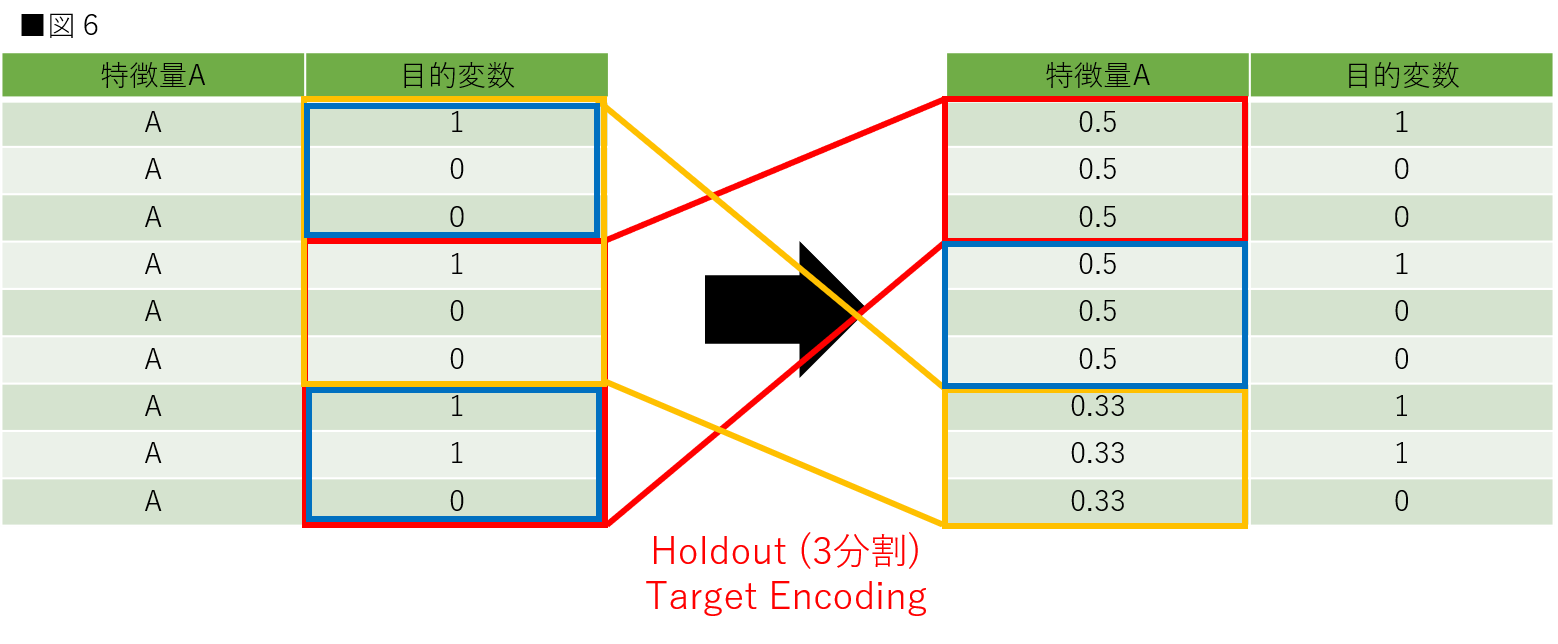
- Cross-Validation: To prevent a row's own target value from influencing its encoding, we can use a cross-validation scheme. For each fold, we compute the encodings using the data from the other folds.
4. Implementation with Scikit-learn Pipelines
Theory is essential, but practical implementation is your goal. A key skill for any data scientist is building robust, reproducible preprocessing workflows. The ColumnTransformer and Pipeline objects in scikit-learn are the industry-standard tools for this.
The following video demonstrates how to apply different preprocessing steps to different columns and chain them together with a model into a single pipeline. This is exactly how you'll handle encoding in your projects.
How do I encode categorical features using scikit-learn?
This video from Data School, "How do I encode categorical features using scikit-learn?", is a masterclass in modern scikit-learn preprocessing.
Watch these key segments: Using ColumnTransformer: This is the most important part. See how make_column_transformer is used to apply the OneHotEncoder to only the categorical columns (sex, embarked) while leaving the numerical column (pclass) untouched. Building the Pipeline: The instructor combines the ColumnTransformer with a LogisticRegression model inside a make_pipeline. This creates a single, elegant object that handles both preprocessing and modeling. Why this is better: The video concludes with four excellent reasons why using scikit-learn pipelines is superior to manually applying transformations with pandas (e.g., pd.get_dummies). These points are crucial for writing professional, production-ready code.
Scikit-learn TargetEncoder
For target encoding, the category_encoders library was historically the go-to. However, as of version 1.3, scikit-learn includes its own TargetEncoder. It's designed for safety and convenience. When you use .fit_transform() on your training data, it automatically uses an internal cross-validation strategy to prevent data leakage.
Here's how you might use it within a ColumnTransformer:
from sklearn.preprocessing import TargetEncoder
from sklearn.compose import ColumnTransformer


# Assume 'high_cardinality_feature' is a column with many categories
encoder = TargetEncoder(target_type='continuous') # 'binary' or 'continuous'

preprocessor = ColumnTransformer(
    transformers=[
        ('target_encoder', encoder, ['high_cardinality_feature'])
    ],
    remainder='passthrough' # Keep other columns
)


# You can now use 'preprocessor' in a pipeline
# pipeline = Pipeline(steps=[('preprocessor', preprocessor),
#                           ('regressor', RandomForestRegressor())])
# pipeline.fit(X_train, y_train)
5. Decision Framework: Choosing Your Encoder
You now have three tools in your belt. Which one should you reach for? The choice depends on the characteristics of your feature and the model you're using.
| Scenario | Recommended Encoding | Reason & Key Considerations |
|---|---|---|
Ordinal Feature (e.g., low, medium, high) |
Ordinal Encoding (OrdinalEncoder) |
Preserves the natural rank. The numerical distance between categories is meaningful. |
| Nominal Feature, Low Cardinality (<~15 categories) | One-Hot Encoding (OneHotEncoder) |
Safe default. No false ordering. Works well for linear models and NNs. For tree models, drop='first' isn't necessary. |
| Nominal Feature, High Cardinality (>~15 categories) | Target Encoding (TargetEncoder) |
Creates a single, powerful feature. Avoids dimensionality explosion. Must be done carefully to prevent leakage and overfitting. Best for tree-based models. |
Conclusion
In this lesson, you've learned how to transform categorical data into a model-friendly format. This is a foundational step in feature engineering and a skill you will use in every machine learning project.
Key Takeaways:
- Categorical Encoding is mandatory because models work with numbers, not text.
- Label/Ordinal Encoding is only for features with a natural order. Using it on nominal data creates a false, misleading relationship.
- One-Hot Encoding is the standard for low-cardinality nominal features. It avoids creating a false order but increases the number of features.
- Target Encoding is a powerful technique for high-cardinality features that directly encodes predictive information from the target variable. It carries a high risk of data leakage and must be implemented with safeguards like smoothing and cross-validation.
- Using
ColumnTransformerandPipelineis the professional standard for applying preprocessing steps in a clean, reproducible way.
Next, we'll turn our attention to the other main data type: numerical features. You'll learn why and how to scale numerical features using techniques like standardization and normalization, another crucial step in preparing your data for modeling.