Introduction
In our last lesson, we examined live migration, a technique for moving a single running virtual machine between physical hosts to ensure service continuity. This provided a close-up view of how cloud infrastructure offers flexibility for individual workloads.
Today, we will zoom out to look at the bigger picture. This lesson addresses the first learning outcome of Module 6: Define resource pooling and explain how it allows multiple tenants to securely share a common pool of physical resources.
We will break down this fundamental cloud concept, which is one of the five essential characteristics defined by NIST. For your exam preparation, we will focus on:
- A clear, precise definition of resource pooling.
- The relationship between resource pooling and multi-tenancy.
- The architectural components of resource pools (server, storage, and network).
- How logical isolation ensures tenants can share resources securely.
Understanding resource pooling is key to grasping how cloud providers achieve the massive economies of scale that make cloud computing so cost-effective.
1. Defining Resource Pooling and Multi-Tenancy
At its core, resource pooling is the model through which a cloud provider groups its computing resources to serve multiple customers, known as tenants. Instead of dedicating a physical server or storage device to a single customer, the provider creates a large "pool" of these resources. From this pool, resources are dynamically assigned and reassigned according to tenant demand.
This approach enables multi-tenancy, an architecture where a single instance of a software application or a single set of infrastructure serves multiple tenants simultaneously. Think of resource pooling as the provider's strategy and multi-tenancy as the resulting customer experience.
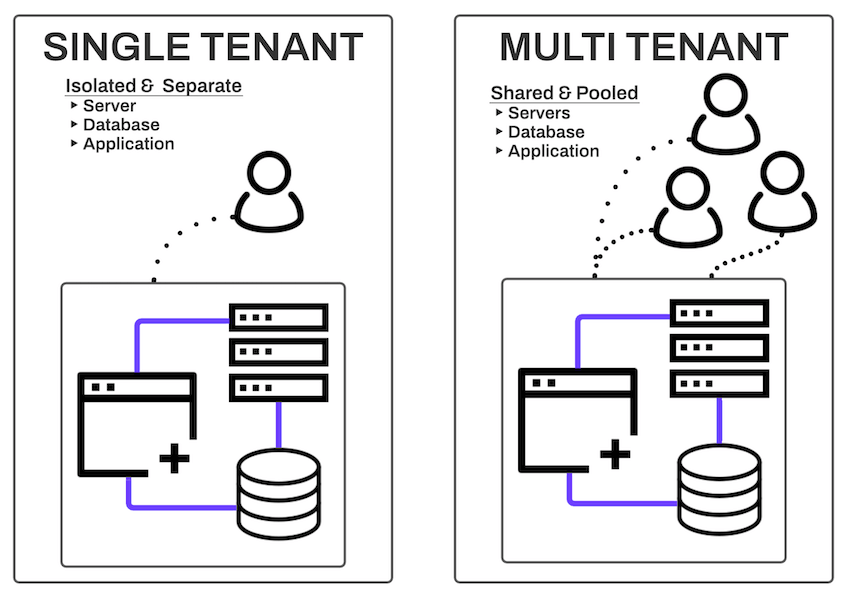
To build a strong intuition for this concept, let's start with a helpful analogy.
The video 'Multitenancy Explained' from IBM Technology uses a great analogy of an apartment building to explain how tenants can have private, secure spaces while sharing common infrastructure like water and electricity. This directly relates to how resource pooling and multi-tenancy work in the cloud.
Please watch the segment from 00:33 to 01:54. Focus on how the apartment building model explains shared resources (the building's utilities) versus private, secure spaces (individual apartments).
As the video explains, just as apartment dwellers share the building's main structure, plumbing, and electrical systems, cloud tenants share the provider's physical servers, storage systems, and network fabric. However, each tenant's data and virtual environment are isolated and invisible to other tenants, just as one apartment is private and secure from another.
For your exam, a good definition is:
Resource Pooling is a cloud computing characteristic where a provider's resources, such as compute, storage, and networking, are grouped together to serve multiple customers using a multi-tenant model. These resources are dynamically assigned based on demand, and tenants are generally unaware of the exact physical location of their resources.
2. The Architecture of Resource Pools
To ensure you can provide a detailed answer in your exam, it's important to understand that a "resource pool" isn't just one monolithic block. It's a structured architecture composed of several distinct types of pools.
Let's explore the three main categories of resource pools.
What Is Resource Pooling in Cloud Computing? Key Concepts ...
The article 'What Is Resource Pooling in Cloud Computing?' provides an excellent breakdown of the architecture. We will use it to understand the individual components that make up the overall resource pool.
Please read the section titled 'Cloud Resource Pooling Architecture' and the subsections on 'Server Pool,' 'Storage Pool,' and 'Network Pool.' Focus on what each pool consists of and how it is virtualized for tenants.
Based on your reading, we can structure the architecture as follows:
a) Server Pool
- Composition: A collection of physical servers. These servers provide the raw processing power (CPU) and memory (RAM) for the entire cloud environment.
- Virtualization: Virtual machines (VMs) are created on these physical servers. These VMs are then grouped into virtual server pools, from which they can be assigned to tenants.
- Specialized Pools: Within the server pool, there can be even more granular pools, such as a processor pool (a collection of CPUs) and a memory pool (a collection of RAM modules). This allows for very flexible and dynamic allocation—for instance, assigning more CPU cores to a VM that needs more processing power.
b) Storage Pool
- Composition: A collection of physical storage devices. This can include Hard Disk Drives (HDDs) and Solid-State Drives (SSDs) arranged in large-scale systems like Storage Area Networks (SANs) or Network Attached Storage (NAS).
- Virtualization: The physical storage is abstracted into virtual disks or volumes that can be attached to VMs.
- Types of Storage: As the article notes, storage pools can be organized to provide different types of storage services, each suited for different tasks:
- File-Based Storage: For shared file access, like a network drive.
- Block-Based Storage: For high-performance needs, like databases, where it functions like a raw hard drive for a VM.
- Object-Based Storage: For massive scalability and storing unstructured data, like media files or backups.
c) Network Pool
- Composition: A collection of physical networking hardware, including switches, routers, and gateways.
- Virtualization: This hardware is used to create virtualized network constructs for tenants. This includes:
- Virtual Networks: Such as a Virtual Private Cloud (VPC) or Virtual LANs (VLANs), which give a tenant their own isolated network space.
- Other Network Functions: Such as virtual load balancers and firewalls, which can be provisioned on-demand from the pool.
This layered architecture of pools is what allows a cloud provider to efficiently manage and allocate a massive amount of hardware to thousands of tenants.
3. Secure Sharing: Isolation in a Multi-Tenant Environment
The most critical challenge in resource pooling is ensuring that one tenant cannot access another tenant's data or affect the performance of their applications. This is the "securely share" part of our learning outcome. The key principle is isolation. While the physical resources are shared, tenants must be kept in logically separate, secure containers.
Virtualization, which we've studied extensively, is the first line of defense. The hypervisor enforces strong isolation between VMs running on the same physical host.
However, different applications and tenants have different security and performance needs. To accommodate this, there are several implementation models for multi-tenancy, which essentially offer different trade-offs between isolation and resource efficiency. For a top-grade exam answer, you should be able to describe these models.
Multi-tenancy: Deep dive on how cloud platforms serve many users ...
The research paper 'Multi-tenancy: Deep dive...' provides a clear, academic classification of the three main multi-tenancy models. Understanding these will give you a sophisticated perspective on how secure sharing is implemented in practice.
Please read the sections '2.4. Multi-Tenancy Implementation Models and Design Patterns', '3.5. Silo Model', '3.6. Bridge Model', and '3.7. Pool Model'. Focus on the description of each model and the trade-offs between isolation and efficiency. Pay special attention to Table 2, which summarizes the models.
Based on the paper, here is a comparative summary of the three multi-tenancy models, which is an ideal format for an exam question.
| Feature | Silo Model | Bridge Model | Pool Model |
|---|---|---|---|
| Isolation | Maximum. Each tenant gets a completely isolated stack of resources (VMs, database, etc.). | Moderate. A hybrid approach. Some resources are shared (e.g., application servers), while others are dedicated (e.g., database). | Minimal. Tenants share everything, including the application and database instance. Isolation is logical, enforced at the application level. |
| Resource Efficiency | Low. No resource sharing means significant underutilization of hardware. Highest cost. | Moderate. Better efficiency than the silo model due to partial sharing. | High. Maximum resource utilization by sharing everything. Lowest cost. |
| Operational Complexity | High. Each tenant's stack must be managed and maintained separately. | Moderate. A balance between managing shared and dedicated components. | Low. Only a single, shared stack needs to be managed and maintained for all tenants. |
| Best Use Case | Highly regulated industries with strict compliance needs (e.g., finance, government) where data separation is mandatory. | Enterprise SaaS applications that need a balance of security and cost-effectiveness. | Consumer-facing applications where cost-efficiency is paramount and data sensitivity is lower (e.g., social media, project management tools). |
This demonstrates that "secure sharing" is not a one-size-fits-all concept. The level of isolation is an architectural choice that depends on the tenants' requirements for security, performance, and cost.
Conclusion
In this lesson, we established the central role of resource pooling and multi-tenancy in cloud computing.
Key Takeaways:
- Resource Pooling: The practice of grouping a cloud provider's physical compute, storage, and network resources to serve multiple customers.
- Multi-Tenancy: The architectural result of resource pooling, where multiple tenants share a single infrastructure while their data and operations are logically isolated.
- Pool Architecture: Resources are organized into server, storage, and network pools, which are then virtualized and allocated to tenants.
- Secure Sharing: Security is achieved through logical isolation. The primary mechanism is the hypervisor, but the degree of sharing and isolation can be adjusted using different tenancy models (Silo, Bridge, and Pool) to balance security with cost.
Preview of the Next Lesson:
Now that we understand how resources are shared, we must consider what happens when the isolation mechanisms are compromised. In our next lesson, we will delve into virtualization security threats. We will identify and explain specific risks like VM sprawl, VM escape, and hyperjacking, and discuss the countermeasures used to defend against them.