Introduction
Welcome to our third lesson. In our previous sessions, we defined cloud computing, its core components, and the essential IaaS, PaaS, and SaaS service models. We now have a clear picture of what modern cloud computing is. This lesson will focus on how it came to be.
Your syllabus requires you to understand the historical context of the cloud, specifically its relationship with older computing paradigms. Today's learning outcome is to trace the evolution of cloud computing from grid computing and virtualization. Understanding this evolution is not just a history lesson; it helps clarify what makes the cloud unique and is a frequent topic in university examinations.
We will follow the chronological journey of key technologies, focusing on how each step solved a problem and paved the way for the next, culminating in the cloud services we use today.
The Evolutionary Path to Cloud Computing
Cloud computing didn't appear overnight. It is the result of decades of evolution in computing. Several key technologies and computing models served as stepping stones, each contributing a crucial piece of the puzzle.
To get a comprehensive overview of this journey, let's start with your college notes, which provide an excellent summary of the historical progression.
[PDF] UNIT -1 CLOUD COMPUTING - Vardhaman College of Engineering
Your college notes outline the key computing paradigms that led to the cloud. This reading will establish the timeline we will be discussing.
Please find and read the section titled 'Evolution of Cloud Computing', starting on page 10. Focus on the progression from Distributed Systems through Mainframe, Cluster, and Grid computing. Also, note the roles of Virtualization, Web 2.0, Service orientation, and Utility computing.
The evolution you just read about can be visualized as a series of steps, with each new paradigm building upon the last.
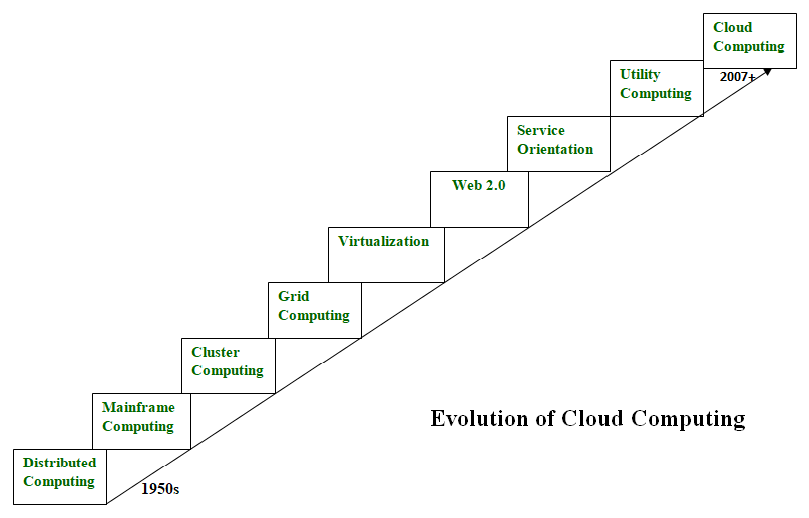
Let's summarize the key stages in this evolution to build a clear narrative for your exam preparation:
-
Mainframe Computing (1950s-1970s): The story begins with massive, powerful, and highly reliable centralized computers called mainframes. They could handle huge amounts of data processing but were incredibly expensive and accessible to only the largest organizations.
-
Cluster Computing (1980s): To overcome the high cost of mainframes, cluster computing was developed. This approach involved connecting many low-cost commodity computers with a high-speed local network to work as a single, more powerful machine.
- Problem Solved: High cost of computing.
- Limitation: All machines had to be in the same physical location (geographically constrained).
-
Grid Computing (1990s): Grid computing was the next logical step. It aimed to solve the geographical limitation of clusters by connecting heterogeneous computers (from different organizations, with different hardware/software) over the internet. The goal was to create a massive, distributed "grid" of computing power, much like an electrical power grid, for large-scale scientific and academic problems.
- Problem Solved: Geographical constraints.
- Limitation: Grids were complex to manage, often had inconsistent security, and were hampered by low-bandwidth internet connections. They were project-based, not service-based.
Cloud computing is often called the "successor of grid computing" because it inherits the idea of large-scale, distributed resource sharing. However, it refines this idea with a different architecture and business model, which was made possible by a key technology: virtualization.
The Key Enablers: Virtualization and Utility Computing
While grid computing provided the vision, two other developments were critical in making modern cloud computing a practical reality.
Virtualization: The Technological Catalyst
As your syllabus and the learning outcome highlight, virtualization is a foundational element of the cloud. It is the technology that decouples software (like an operating system) from the underlying physical hardware.
[PDF] UNIT -1 CLOUD COMPUTING - Vardhaman College of Engineering
As the previous reading mentioned, virtualization is the main enabling technology for the cloud. Let's revisit your notes for a more focused look at why it's so critical.
Read the section 'Virtualization and Cloud Computing' on page 12. Pay close attention to how it defines virtualization as 'the main enabling technology' and how it 'decouples the software from the hardware'.
Here’s why virtualization was the game-changer:
- Resource Pooling: It allows a single physical server to be partitioned into multiple, isolated Virtual Machines (VMs). This enables multiple users (tenants) to share the same hardware securely.
- Abstraction: It hides the complexity of the physical hardware from the user. Users request a VM with specific resources (e.g., 2 CPUs, 8 GB RAM) without needing to know anything about the physical server it runs on.
- Elasticity: VMs can be created, destroyed, and moved between physical machines quickly, providing the rapid scalability that is a hallmark of the cloud.
In essence, grid computing tried to connect many distinct physical machines. Cloud computing, powered by virtualization, creates a pool of virtual resources from those machines, which is far more flexible and efficient to manage.
Other Key Influences
- Utility Computing: This provided the business model for the cloud. Like a utility such as electricity, you pay only for the computing resources you consume. This "pay-per-use" model made computing accessible without large upfront investments.
- Service-Oriented Architecture (SOA): This provided the "as-a-service" mindset. It promotes building applications by combining loosely-coupled, interoperable services (like IaaS, PaaS, and SaaS).
- Web 2.0: This provided the user-friendly, interactive web-based interfaces (like the AWS console or Google Drive) through which users access cloud services.
Grid vs. Cloud Computing: An Evolutionary Comparison
To fully trace the evolution from grid to cloud, it's crucial to compare them directly. This highlights the specific advancements that cloud computing introduced.
[PDF] UNIT -1 CLOUD COMPUTING - Vardhaman College of Engineering
To clearly understand how cloud computing evolved from grid computing, it's essential to compare them directly. Your notes provide a concise table that is perfect for exam answers.
Find the section 'Grid Computing Vs Cloud Computing' on page 21. Study the table comparing the two models. Focus on the differences in their core purpose (service provider vs. common goal) and architecture (centralized vs. decentralized).
Based on that reading and other sources, here is a summary of the key distinctions that demonstrate the evolution:
| Feature | Grid Computing | Cloud Computing |
|---|---|---|
| Primary Goal | Distributed computing for a common goal (e.g., a scientific experiment). Project-oriented. | Providing services on-demand (IaaS, PaaS, SaaS). Service-oriented. |
| Architecture | Decentralized and heterogeneous. Resources are owned and managed by multiple organizations. | Centralized (in a logical sense). Resources are owned and managed by a single cloud provider. |
| Business Model | No standardized business model. Resource sharing is based on collaboration. | Pay-per-use (Utility model). Clear pricing for services. |
| Virtualization | Optional. Often uses bare-metal machines. | Essential. Virtualization is the core enabling technology for resource pooling and elasticity. |
| Resource Management | Complex, with scheduling managed by grid middleware across different administrative domains. | Simplified through a unified management interface (e.g., cloud provider's console/API). |
| Standardization | Low. Highly diverse and custom environments. | High. Standardized APIs and virtual hardware configurations. |
This comparison makes it clear: cloud computing took the grid's vision of large-scale resource sharing and made it commercially viable, flexible, and easy to use by integrating virtualization and a service-based, utility pricing model.
Conclusion
In this lesson, we traced the evolutionary path that led to modern cloud computing. We saw how the limitations of one paradigm spurred the development of the next.
Key Takeaways:
- The evolution progressed from Mainframes (expensive) to Clusters (cheaper but local) to Grids (distributed but complex).
- Grid Computing was a direct ideological predecessor, introducing the concept of large-scale distributed resource sharing over the internet.
- Virtualization was the key technological catalyst. It enabled the resource pooling, abstraction, and elasticity that are fundamental to the cloud, solving many of the problems that held back grid computing.
- Cloud computing combines the vision of the grid with the technology of virtualization and a pay-per-use utility business model, all delivered through user-friendly web interfaces.
In our next lesson, we will continue this thread by creating a formal, detailed comparison of cluster, grid, and cloud computing. This will expand on the comparisons made today and prepare you for specific exam questions that ask you to differentiate between these three important computing models.