Introduction
Welcome to your sixth lesson. In our previous session, we detailed the compelling benefits of cloud computing, such as cost savings through the CAPEX to OPEX shift, scalability, and high reliability guaranteed by SLAs. You are now well-equipped to articulate why organizations adopt the cloud.
However, for a complete and high-scoring answer in your exam, you must also understand the drawbacks. This lesson addresses the learning outcome: to list and explain the primary challenges of cloud computing, including security, vendor lock-in, and internet dependency. We will systematically break down these hurdles and others, providing the definitions, keywords, and explanations needed to demonstrate a balanced and expert understanding of the topic.
An Overview of Cloud Computing Challenges
While cloud adoption is widespread, it introduces a new set of challenges that organizations must navigate. Before we dive into specifics, the following diagram provides a quick visual summary of the common obstacles companies face when moving to or operating in the cloud.

Now, let's dissect the most significant challenges, starting with the one most frequently cited: security.
1. Security and Privacy Concerns
Security is arguably the most significant barrier to cloud adoption. When an organization moves its data and applications off-premise, it cedes direct control over the physical infrastructure, introducing new security and privacy risks.
The Future of Cloud Computing & Pros and Cons of Cloud Computing
To understand these risks in detail, we will consult two resources. The first is a research paper that frames security as a primary barrier, and the second is a blog post that provides some useful statistics.
From the resource '[PDF] The Future of Cloud Computing...', please read section 3.1 Security and Privacy Concerns. Focus on how storing data in the cloud makes companies vulnerable to cyber threats and the importance of encryption and authentication.
What are the Pros and Cons of Cloud Computing
Next, let's look at a more concise list of security issues.
From the resource 'What are the Pros and Cons of Cloud Computing', please read the section titled '1. Security and Privacy Concerns with Data Breaches'. Note the point about misconfigurations being a major cause of security incidents.
Based on these readings, here are the key points to remember for your exam:
- Data Breaches: The unauthorized access and exfiltration of sensitive data (e.g., customer information, intellectual property) by malicious actors. In a multi-tenant cloud environment, a single vulnerability could potentially affect multiple customers.
- Unauthorized Access: Often caused by misconfigurations, such as improperly configured security groups, weak credentials, or giving excessive permissions. According to Gartner, a vast majority of cloud security failures are due to customer error, not provider vulnerability.
- Shared Responsibility Model: A key concept where the cloud provider is responsible for the security of the cloud (infrastructure, hardware), while the customer is responsible for security in the cloud (data, access policies, configurations). A misunderstanding of this model can lead to security gaps.
- Privacy and Compliance: Concerns about who can access data, including provider employees or government agencies. This is closely tied to data sovereignty—the legal requirement that data be kept within the borders of a specific country.
Potential Solutions: Strong encryption for data at rest and in transit, multi-factor authentication (MFA), Identity and Access Management (IAM) policies, and adopting a Zero Trust Architecture, which assumes no user or device is trusted by default.
2. Vendor Lock-In
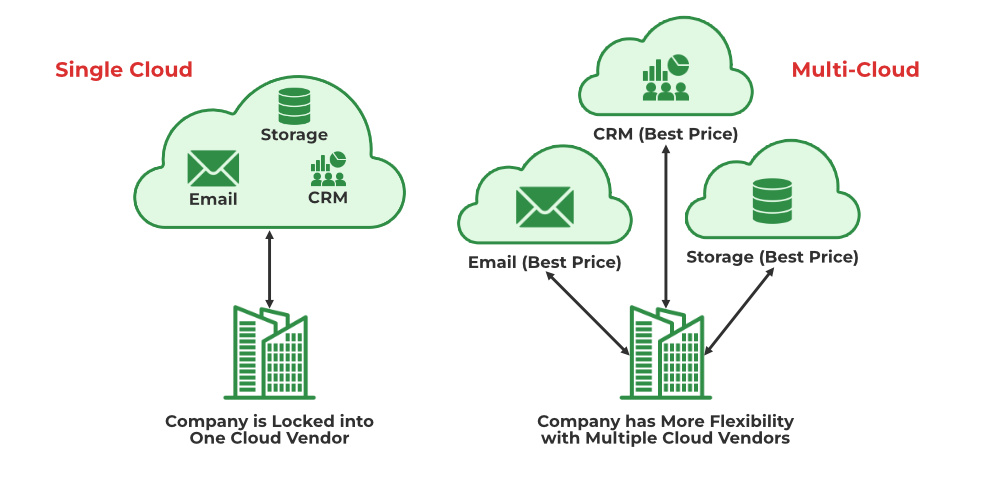
Vendor lock-in is a significant business and technical risk where a customer becomes so dependent on a single cloud provider's unique services that switching to another provider becomes prohibitively expensive and complex.
[PDF] The Future of Cloud Computing...
The research paper 'The Future of Cloud Computing...' provides an excellent explanation of vendor lock-in and its consequences.
Please read section 3.3 Vendor Lock-In and Limited Flexibility. Pay close attention to why migrating between providers like AWS and Azure is difficult and how multi-cloud strategies and containerization can be used as solutions.
Key points on vendor lock-in are:
- Proprietary APIs and Services: Cloud providers offer unique services (e.g., specialized databases, AI/ML platforms) with proprietary APIs. Applications built using these services are not easily portable to another cloud.
- High Migration Costs: Migrating large datasets and complex applications from one cloud to another requires significant time, effort, and financial investment. This includes data transfer fees (known as egress fees), retraining staff, and re-architecting applications.
- Reduced Negotiating Power: Once locked in, a customer has less leverage to negotiate pricing and contract terms with the provider.
The following diagram clearly illustrates the difference between being locked into a single provider versus having the flexibility of a multi-cloud approach.
Potential Solutions:
- Multi-Cloud Strategy: Distributing workloads across multiple cloud providers.
- Containerization: Using technologies like Docker and Kubernetes to build portable applications that can run on any cloud platform. We will cover this in detail in Module 3.
- Using Open-Source Solutions: Preferring open-source software and standards over proprietary ones where possible.
3. Internet Dependency and Performance
Cloud computing, by its very nature, relies on the internet. This dependency creates a critical point of failure and can introduce performance issues.
The Future of Cloud Computing & Pros and Cons of Cloud Computing
Let's review two short sections that describe this challenge.
From '[PDF] The Future of Cloud Computing...', read section 3.4 Performance and Latency Issues. Focus on how network delays impact real-time applications and how physical distance to a data center is a factor.
What are the Pros and Cons of Cloud Computing
The 'Pros and Cons' article provides a direct summary of this issue.
Now, read section '2. Internet Dependency and Connectivity Issues' from the 'Pros and Cons' article. Note the points about what happens during an outage and the impact of slow speeds.
Here's a summary for your exam answer:
- Requirement for Constant Connectivity: Cloud services are accessed over the internet. If the internet connection fails, employees cannot access their applications and data, leading to a complete halt in productivity.
- Performance and Latency: The speed and quality of the internet connection directly impact application performance.
- Latency: This is the delay between a user's action and the application's response. For real-time applications like online gaming, video conferencing, or financial trading, high latency can render them unusable.
- Bandwidth: Transferring large files to and from the cloud can be slow and costly, especially for businesses in areas with poor internet infrastructure.
- Data Center Location: The physical distance between the user and the cloud data center also contributes to latency.
Potential Solutions: Using Content Delivery Networks (CDNs) to cache content closer to users, choosing cloud regions geographically near the user base, and employing Edge Computing to process data locally before sending it to the cloud.
4. Other Significant Challenges
To provide a comprehensive answer, it's wise to be aware of other major challenges. The following are frequently discussed and are excellent points to include.
| Challenge | Description | Potential Solutions |
|---|---|---|
| Cost Management | While the cloud can save money, its pay-as-you-go model and complex pricing can lead to unexpected expenses from data transfer fees, idle resources, and inefficient use. | AI-based cost monitoring tools, setting budgets and alerts, using auto-scaling, and purchasing reserved instances. |
| Regulatory Compliance | Industries like finance and healthcare must adhere to strict regulations (e.g., GDPR, HIPAA). This includes rules about data location, privacy, and auditability. | Using compliance automation tools, conducting regular audits, and selecting cloud providers that meet specific compliance standards. |
| Limited Control | Customers lose physical control over their infrastructure. They depend on the provider for hardware maintenance, physical security, and disaster recovery. | Clear SLAs, understanding the shared responsibility model, and having a robust multi-region or multi-cloud disaster recovery plan. |
This summary is based on the challenges discussed in both the "[PDF] The Future of Cloud Computing..." (Table 2) and the "What are the Pros and Cons of Cloud Computing" resources.
Conclusion
In this lesson, we have balanced our perspective on cloud computing by examining its primary challenges. While the benefits are transformative, a successful cloud strategy requires careful management of these risks.
Key Takeaways:
- Security & Privacy: This remains the top concern, stemming from data breaches, misconfigurations, and privacy issues in a shared environment.
- Vendor Lock-In: A major strategic risk where dependency on a provider's proprietary services makes migration difficult and costly.
- Internet Dependency: The reliance on a stable internet connection creates a single point of failure and can lead to performance and latency issues.
- Other Key Challenges: Effective Cost Management is crucial to avoid bill shock, and adherence to Regulatory Compliance is non-negotiable for many industries.
Preview of the Next Lesson:
Now that we have explored both the benefits (Lesson 5) and challenges (this lesson), we are perfectly positioned for our next topic. In the next lesson, we will synthesize this knowledge to compare traditional on-premise computing with cloud computing across cost, scalability, maintenance, and deployment speed in a tabular format, giving you a powerful tool for comparative exam questions.