Introduction
Welcome to your lesson on cloud security. In our previous discussion, we defined Identity and Access Management (IAM) and its four pillars: Administration, Authentication, Authorization, and Audit. We established that Authorization answers the critical question, "What is an authenticated user allowed to do?"
Today, we will dive deep into this pillar. This lesson directly addresses how different systems implement authorization by comparing the primary access control mechanisms. This is a fundamental topic in security and a frequent question in university exams.
Our learning outcome is to: Compare access control mechanisms (DAC, MAC, RBAC, ABAC) in a tabular format with examples.
We will define each model, understand its core logic, and then organize this knowledge into the clear, tabular format your exam requires.
Understanding the Four Main Access Control Models
To begin, let's get a clear overview of the four models. These models represent an evolution in thinking about security, from flexible but risky approaches to highly dynamic and secure ones.
The following video provides an excellent, structured explanation of each model with clear examples. We will work through it section by section.
Access Control Models Explained | DAC MAC RBAC ABAC | Cybersecurity Fundamentals - Infosec Guardians
This video from InfoSec Guardians explains the four primary access control models. It is well-structured and uses simple analogies to clarify each concept, which will be very helpful for building our comparison.
First, watch the introduction from 00:00 to 04:21. This segment will define the core components of access control (subject, object, action, policy) and introduce the four models: DAC, MAC, RBAC, and ABAC.
Now, let's examine each model individually.
1. Discretionary Access Control (DAC)
DAC is the most straightforward model. The key principle to remember is that the owner of a resource has the discretion to decide who can access it.
- Core Idea: Control is decentralized and managed by individual resource owners.
- Implementation: Typically uses an Access Control List (ACL), which is a list of users and their specific permissions (e.g., read, write, execute) attached to a file or object.
- Example: A user creating a document in Google Drive and then sharing it with specific colleagues by granting them "Viewer" or "Editor" rights. The user owns the document and controls its access.
Access Control Models Explained | DAC MAC RBAC ABAC | Cybersecurity Fundamentals - Infosec Guardians
Now, let's focus on DAC. This part of the video explains how owner-based permissions work.
Watch the segment from 04:21 to 06:19. Pay close attention to the concept of 'owner discretion' and the example provided.
2. Mandatory Access Control (MAC)
MAC is the opposite of DAC in terms of flexibility and control. Access is not determined by owners but is mandated by a central system-wide policy.
- Core Idea: Control is centralized and based on security labels (or classifications). Every subject (user) and object (resource) is assigned a security label (e.g., Top Secret, Secret, Confidential).
- Implementation: The system enforces a strict rule: a user can only access a resource if their security clearance level is equal to or higher than the resource's classification. Users cannot change these permissions.
- Example: Military and government systems where access to a "Secret" document is only granted to personnel with "Secret" or "Top Secret" clearance.
Access Control Models Explained | DAC MAC RBAC ABAC | Cybersecurity Fundamentals - Infosec Guardians
Next, let's explore the highly structured MAC model.
Watch from 06:19 to 08:37. Focus on understanding how security labels and clearance levels are used to enforce access.
3. Role-Based Access Control (RBAC)
RBAC is the most common model used in corporate and cloud environments. It simplifies management by assigning permissions to roles instead of individual users.
- Core Idea: Access is determined by the user's job function or role within the organization.
- Implementation: An administrator defines roles (e.g., "HR Manager," "System Administrator," "Finance Analyst") and assigns a set of permissions to each role. Users are then assigned to these roles and inherit the associated permissions.
- Example: In a company, all employees assigned to the "Accountant" role automatically get read/write access to the financial software, while those in the "Sales" role get access to the CRM system. When an employee changes jobs, an administrator simply changes their role, and their permissions are updated automatically. This enforces the Principle of Least Privilege.
Access Control Models Explained | DAC MAC RBAC ABAC | Cybersecurity Fundamentals - Infosec Guardians
Now for RBAC, the most widely adopted model in business settings.
Watch from 08:37 to 10:52. Note how tying permissions to roles, not individuals, makes administration scalable and efficient.
4. Attribute-Based Access Control (ABAC)
ABAC is the most modern, dynamic, and fine-grained access control model. It makes decisions based on a wide range of attributes (or characteristics).
- Core Idea: Access is granted or denied based on policies that evaluate attributes of the user, the resource, and the environment.
- Implementation: It uses logical rules (e.g., IF-THEN statements). For example:
IFthe user is a "Doctor"ANDthe time is between 9 AM-5 PMANDthe access location is from a hospital-issued device,THENgrant access to patient records. - Example: A policy that allows a financial controller to access sensitive quarterly reports only during business hours and from within the corporate network, but denies access if they try to log in from a public Wi-Fi network at midnight.
Access Control Models Explained | DAC MAC RBAC ABAC | Cybersecurity Fundamentals - Infosec Guardians
Finally, let's look at the most dynamic model, ABAC.
Watch from 10:52 to 13:24. Focus on how ABAC uses context (user, resource, environment attributes) to make real-time access decisions.
Tabular Comparison of Access Control Models
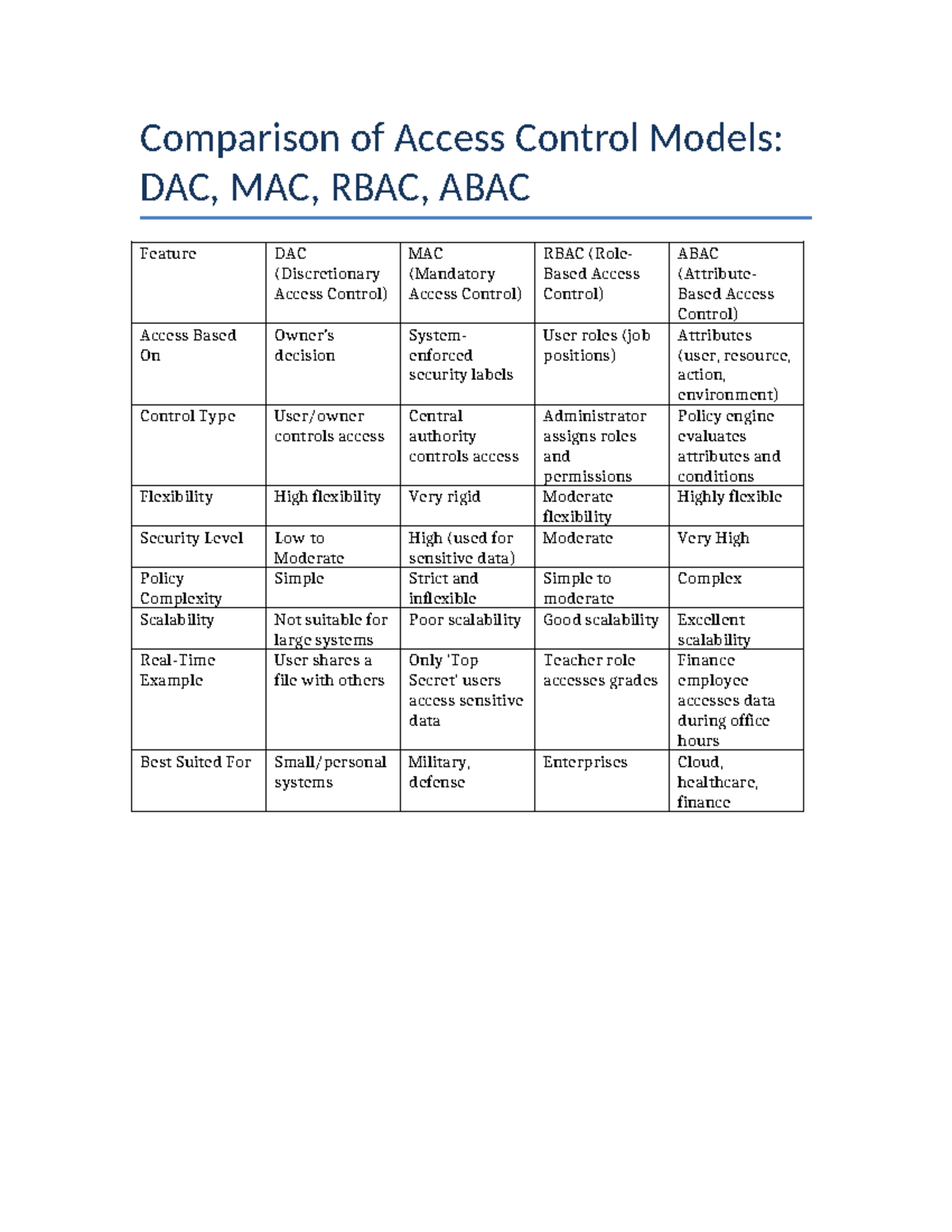
For your exam, presenting a clear comparison in a table is crucial for earning full marks. The table below synthesizes the key characteristics of each model.
| Feature | Discretionary Access Control (DAC) | Mandatory Access Control (MAC) | Role-Based Access Control (RBAC) | Attribute-Based Access Control (ABAC) |
|---|---|---|---|---|
| Basis of Control | Resource Owner | System-wide Security Labels & Classifications | User's Job Role | Policies evaluating User, Resource, & Environment Attributes |
| Control Type | Decentralized | Centralized | Centralized | Centralized (Policy Engine) |
| Flexibility | Very High | Very Low (Rigid) | Medium | Very High (Dynamic) |
| Security Level | Low (Prone to error) | Highest (Strictly enforced) | High | Very High (Context-aware) |
| Primary Use Case | Personal file sharing, academic projects (e.g., Google Drive, local file permissions) | Military, government, high-security environments | Enterprise applications, cloud IAM (e.g., AWS IAM Roles) | Zero Trust architectures, IoT, complex cloud environments |
| Example | You give a friend "edit" access to your holiday photos folder. | A user with "Secret" clearance cannot view a "Top Secret" file. | An "HR Manager" can access payroll, but a "Sales Rep" cannot. | A doctor can access patient data only from a hospital IP during work hours. |
| Complexity | Low | High | Medium | Very High |
This image provides another excellent summary of the key differences, which is perfect for quick revision.
For further reading and to see a similar tabular comparison, you can review the following article.
4 Types of Access Control in Security | Tech Prescient
The article '4 Types of Access Control in Security' from Tech Prescient offers concise definitions and a very clear comparison table.
Read the sections '1. Discretionary Access Control (DAC)', '2. Mandatory Access Control (MAC)', '3. Role-Based Access Control (RBAC)', and '4. Attribute-Based Access Control (ABAC)'. Then, carefully study the comparison table that follows. This table reinforces the one provided above.
Conclusion
In this lesson, we dissected the four primary access control models that form the backbone of authorization in IT and cloud security. Understanding their differences is key to explaining how security policies are enforced.
Key Takeaways:
- DAC (Discretionary): Control is in the hands of the resource owner. It's flexible but less secure.
- MAC (Mandatory): Control is mandated by the system using security labels. It's rigid but offers the highest level of security.
- RBAC (Role-Based): Control is based on the user's job role. It's scalable and the most common model in enterprises.
- ABAC (Attribute-Based): Control is based on dynamic policies that evaluate attributes. It's the most flexible and context-aware model, ideal for modern Zero Trust security.
The best choice of model depends on the specific needs of an organization, balancing security requirements with operational flexibility.
Preview of the Next Lesson:
Now that we understand the mechanisms for controlling access, our next lesson will focus on the philosophies that guide their implementation. We will explore core cloud security design principles like the Principle of Least Privilege and Defense in Depth, which you have already seen mentioned in the context of RBAC. These principles are essential for designing a robust and resilient cloud security posture.