Introduction
Welcome to your next lesson on cloud security. In our previous session, we established that under the Shared Responsibility Model, the customer is always responsible for managing their data, user identities, and access, regardless of whether they use IaaS, PaaS, or SaaS. This logically brings us to the "how": How do organizations manage this critical responsibility in the cloud?
This lesson addresses that question directly. Our learning outcome is to: Define Identity and Access Management (IAM) and explain its importance in cloud security.
IAM is one of the most fundamental security domains in cloud computing. Mastering its definition, components, and importance is essential for a comprehensive exam answer. We will focus on a clear, memorable framework, key definitions, and the benefits of a robust IAM strategy.
The New Security Perimeter: Identity
In traditional IT, security was often focused on building a strong perimeter around the corporate network with firewalls. The assumption was simple: "good guys" are inside, and "bad guys" are outside. However, cloud computing, remote work, and mobile devices have made this model obsolete. Your applications and data are no longer behind a single wall; they are distributed.
So, where is the new line of defense? It has shifted from the network edge to the individual user's identity. This is the foundational idea behind modern cloud security.
To see this shift explained, watch the first minute of the following video.
Identity & Access Management (IAM)
This video from IBM Technology introduces the core concept of IAM by explaining why the security focus has moved from the network perimeter to the end-user.
Watch the video from the beginning (00:00) to 01:06. Focus on understanding the transition from a network-centric security model to an identity-centric one.
Defining Identity and Access Management (IAM)
Now that we understand why identity is so important, let's establish a formal definition for your exams.
Identity and Access Management (IAM) is the security framework and set of business processes that ensures the right entities (users or devices) have access to the right resources (applications or data), at the right times, and for the right reasons.
Let's break this down further by reading a concise definition.
What is identity & access management (IAM)? A guide to IAM
This article from SailPoint provides a clear, formal definition of IAM and its core components.
Read the section titled 'Definition of identity and access management'. This provides a perfect, quotable definition for an exam answer.
The Four Pillars of IAM: A Framework for Your Exam
To structure your understanding of IAM's functions, a helpful mnemonic is the "Four A's" or the four pillars of IAM.
- Administration (Identity Management): The entire lifecycle of a digital identity. This includes creating accounts (provisioning), updating them as roles change, and deleting them when a user leaves (de-provisioning).
- Authentication: The process of verifying an identity claim. It answers the question, "Are you really who you say you are?"
- Authorization: The process of determining what an authenticated user is allowed to do. It answers the question, "What are you allowed to do?"
- Audit: The process of logging and reviewing access activities to ensure compliance and detect anomalies. It answers the question, "What did you do?"
The following video provides a quick overview of this framework.
Identity & Access Management (IAM)
Continuing with the same IBM Technology video, this segment quickly introduces the 'four A's' of IAM, giving you a simple and effective structure to remember.
Watch from 01:10 to 03:20 to get a clear definition of Administration, Authentication, Authorization, and Audit.
While the terms are sometimes used interchangeably, it is important for an exam to distinguish between Identity Management and Access Management.
| Identity Management | Access Management (part of IAM) |
|---|---|
| Deals primarily with the lifecycle of digital identities. | Integrates identity information to enforce access policies. |
| Core Functions: Creating, updating, and deleting user accounts; managing identity attributes. | Core Functions: Granting or denying access to resources based on policies (Authorization); requiring proof of identity (Authentication). |
This distinction clarifies that IAM is the broader framework that encompasses both managing who users are and what they can do.
The Importance of IAM in Cloud Security
Understanding what IAM is only half the battle. For a complete answer, you must explain why it is a cornerstone of cloud security. In essence, IAM is the primary mechanism for enforcing security policies in the cloud.
The following resource clearly outlines the key reasons why IAM is indispensable.
Architecture of Identity Access Management in Cloud Computing
This article from GeeksforGeeks provides a straightforward, exam-friendly explanation of IAM's importance.
Read the section titled 'Why is it important to understand IAM Architecture?'. Pay attention to the five key points: keeping data safe, controlling access, following rules, saving time, and scaling easily.
Key Benefits of a Robust IAM System
A well-implemented IAM system provides numerous benefits that enhance an organization's security posture, operational efficiency, and compliance. The image below summarizes the key advantages.
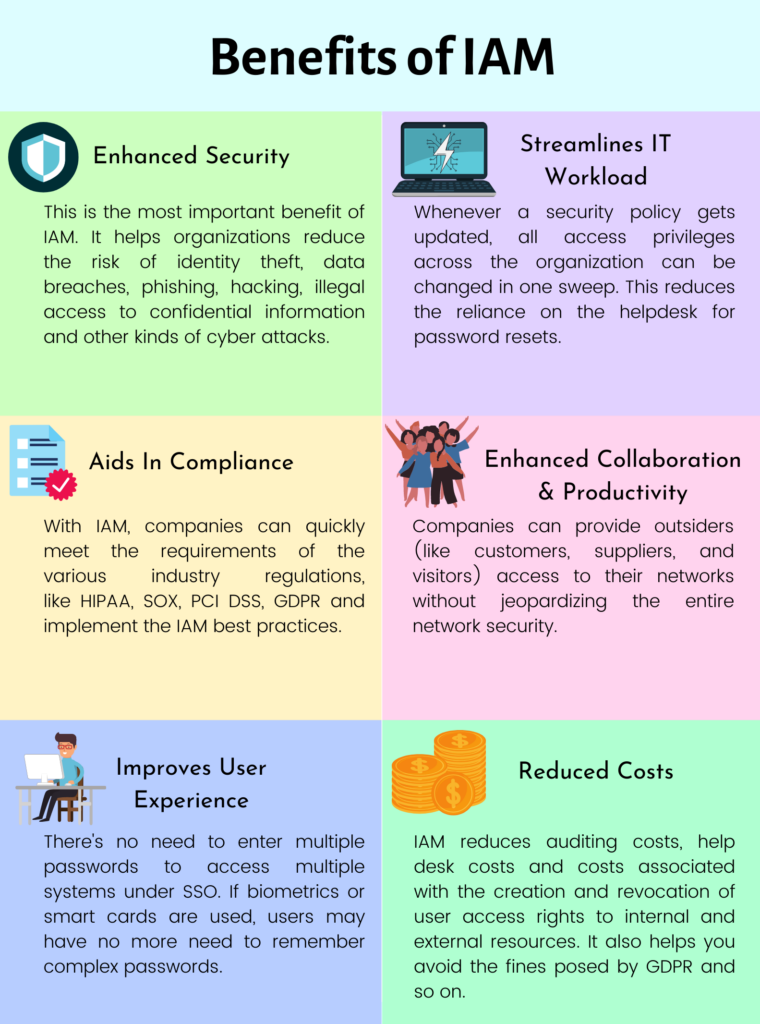
To expand on these points for your exam answer, here are the primary benefits of IAM:
- Enforces the Principle of Least Privilege: IAM allows you to grant users the minimum level of access—or permissions—necessary to perform their job functions. This drastically reduces the potential damage from a compromised account.
- Mitigates Security Threats: By controlling access and requiring strong authentication (like Multi-Factor Authentication or MFA), IAM helps prevent unauthorized access, data breaches, and insider threats.
- Improves Regulatory Compliance: Many regulations (like GDPR, HIPAA) have strict data protection requirements. IAM provides the tools to enforce policies and the audit trails to prove that they are being followed.
- Increases Operational Efficiency: IAM systems automate the user lifecycle, from onboarding to offboarding. This saves significant time for IT administrators and reduces the risk of human error, such as forgetting to revoke access for a former employee.
- Enhances User Experience: Features like Single Sign-On (SSO) allow users to log in once with a single set of credentials to access multiple applications. This improves productivity and reduces "password fatigue."
- Enables Centralized Control and Visibility: IAM provides a central point to manage all identities and their access rights across the entire cloud environment, offering a unified view of "who has access to what."
A Deeper Look: Privileged Access Management (PAM)
For a top-tier exam answer, it's useful to mention a specialized subset of IAM: Privileged Access Management (PAM).
Privileged accounts are those with elevated permissions, such as root on a Linux server or Administrator on Windows. If these accounts are compromised, an attacker gains "the keys to the kingdom." PAM focuses on applying much stricter security controls to these high-risk accounts.
Key features of PAM include:
- Credential Vaulting: Storing privileged passwords in a secure, encrypted vault.
- Session Monitoring: Recording what a privileged user does during their session.
- Just-in-Time Access: Granting privileged access for a limited time only, just long enough to complete a specific task.
- Password Rotation: Automatically changing the passwords for privileged accounts after each use.
Mentioning PAM demonstrates a more nuanced understanding of IAM's role in mitigating the most critical security risks.
Conclusion
In this lesson, we have defined Identity and Access Management and established its critical role in cloud security. We saw that as the network perimeter dissolves, identity has become the new control plane.
Key Takeaways:
- Definition: IAM is a framework that manages digital identities and enforces policies to control their access to resources.
- Core Functions (The 4 A's): IAM is built on four pillars: Administration (provisioning/de-provisioning), Authentication (verifying identity), Authorization (granting permissions), and Audit (monitoring activity).
- Importance: IAM is crucial for security (enforcing least privilege), meeting compliance requirements, and improving operational efficiency through automation and centralized control.
- Key Technologies: Core IAM-related technologies you should know include Multi-Factor Authentication (MFA) and Single Sign-On (SSO).
Preview of the Next Lesson:
We have established that Authorization—determining what a user can do—is a key pillar of IAM. In the next lesson, we will dive deeper into this concept by exploring different access control mechanisms. We will compare methods like Discretionary Access Control (DAC), Mandatory Access Control (MAC), and the widely used Role-Based Access Control (RBAC) in a tabular format perfect for your exams.