Introduction
Welcome to the next lesson in our cloud computing series. In our previous sessions, we explored the core services of AWS and Azure. You learned about Azure's IaaS offering, Virtual Machines, its PaaS solution, App Service, and its relational database service, Azure SQL Database, drawing direct comparisons to their AWS counterparts.
This lesson completes our tour of the "big three" public cloud providers by focusing on Google Cloud Platform (GCP). Our objective is to describe the key services offered by GCP, specifically Compute Engine, App Engine, and BigQuery. We will continue the comparative approach from previous lessons to build a comprehensive understanding of how these platforms align and differ, providing you with the structured knowledge essential for your exams.
1. Google Cloud Platform (GCP): An Overview
Google Cloud Platform (GCP) is a suite of cloud services that runs on the same powerful infrastructure Google uses for its end-user products like Google Search and YouTube. It is particularly well-regarded for its strengths in data analytics, machine learning, container orchestration (with Kubernetes, which it originally developed), and open-source-friendly technologies.
Let's begin with a video that provides a high-level introduction to GCP's core services.
Google Cloud Platform Tutorial | Google Cloud Platform Fundamentals | GCP Training | Edureka
This tutorial from Edureka offers a clear overview of GCP, its key features, and its main service categories. It will set the stage for our detailed look at specific services.
Please watch the following segments: GCP Service Overview (06:58 - 07:50): This gives a quick rundown of the service categories available on the platform. GCP Compute Services (09:58 - 11:49): Pay close attention to the explanations of Compute Engine and App Engine. Note how one provides virtual machines (IaaS) and the other is a platform for applications (PaaS).
Now, let's break down GCP's compute and data services in more detail, focusing on exam-relevant definitions and comparisons. For a deeper dive, the following article provides excellent, structured explanations.
Top Google Cloud Platform (GCP) Services Explained with Use Cases
The blog post 'Top Google Cloud Platform (GCP) Services Explained with Use Cases' from eG Innovations provides clear, in-depth descriptions of the services we're covering. It is well-structured for study and revision.
Please read the following three sections from the article: Google Compute Engine (GCE): Read this section to understand GCP's core IaaS offering and its typical use cases. Google Cloud App Engine: Read this section on GCP's PaaS for hosting web applications. Google Cloud Analytics: Read the introduction and the subsection on BigQuery to understand its role as a data warehouse.
2. GCP Compute Services: Compute Engine vs. App Engine
Like its competitors, GCP offers distinct services for running code, primarily split between Infrastructure as a Service (IaaS) and Platform as a Service (PaaS).
A. Google Compute Engine (GCE)
Definition: Google Compute Engine (GCE) is GCP's Infrastructure as a Service (IaaS) offering that allows users to create and run virtual machines (VMs) on Google's infrastructure. It provides users with high levels of control over the OS, configuration, and software environment.
Key Exam Points:
- Service Model: IaaS.
- Core Function: Provides scalable, high-performance virtual machines.
- Control: Users manage everything from the guest operating system upwards (OS patches, software installation, security). Google manages the physical hardware and virtualization layer.
- Use Cases:
- Lift-and-shift migrations: Moving on-premises applications to the cloud with minimal changes.
- Custom applications: Running software that requires a specific OS or configuration.
- High-performance computing: Leveraging specialized machine types with GPUs or TPUs for intensive workloads.
- Equivalents: Amazon EC2 and Azure Virtual Machines.
B. Google App Engine (GAE)
Definition: Google App Engine (GAE) is a fully managed, serverless Platform as a Service (PaaS) for building and hosting web applications and mobile backends. It abstracts away all infrastructure management, allowing developers to focus only on their code.
Key Exam Points:
- Service Model: PaaS.
- Core Function: Provides a platform to run code without managing servers.
- Control: Developers manage only their application code and data. Google manages the OS, patching, scaling, and server maintenance.
- Key Features:
- Automatic scaling based on traffic.
- Support for multiple programming languages (Python, Java, Node.js, Go, etc.).
- Built-in versioning to easily switch between different versions of your application.
- Use Cases:
- Developing and deploying scalable web applications and APIs.
- Mobile application backends.
- Microservices architectures.
- Equivalents: AWS Elastic Beanstalk and Azure App Service.
Visual Comparison: GCE vs. GAE
To solidify your understanding, a visual comparison is extremely helpful. The following diagram illustrates the architectural difference between the IaaS model of Compute Engine and the PaaS model of App Engine.

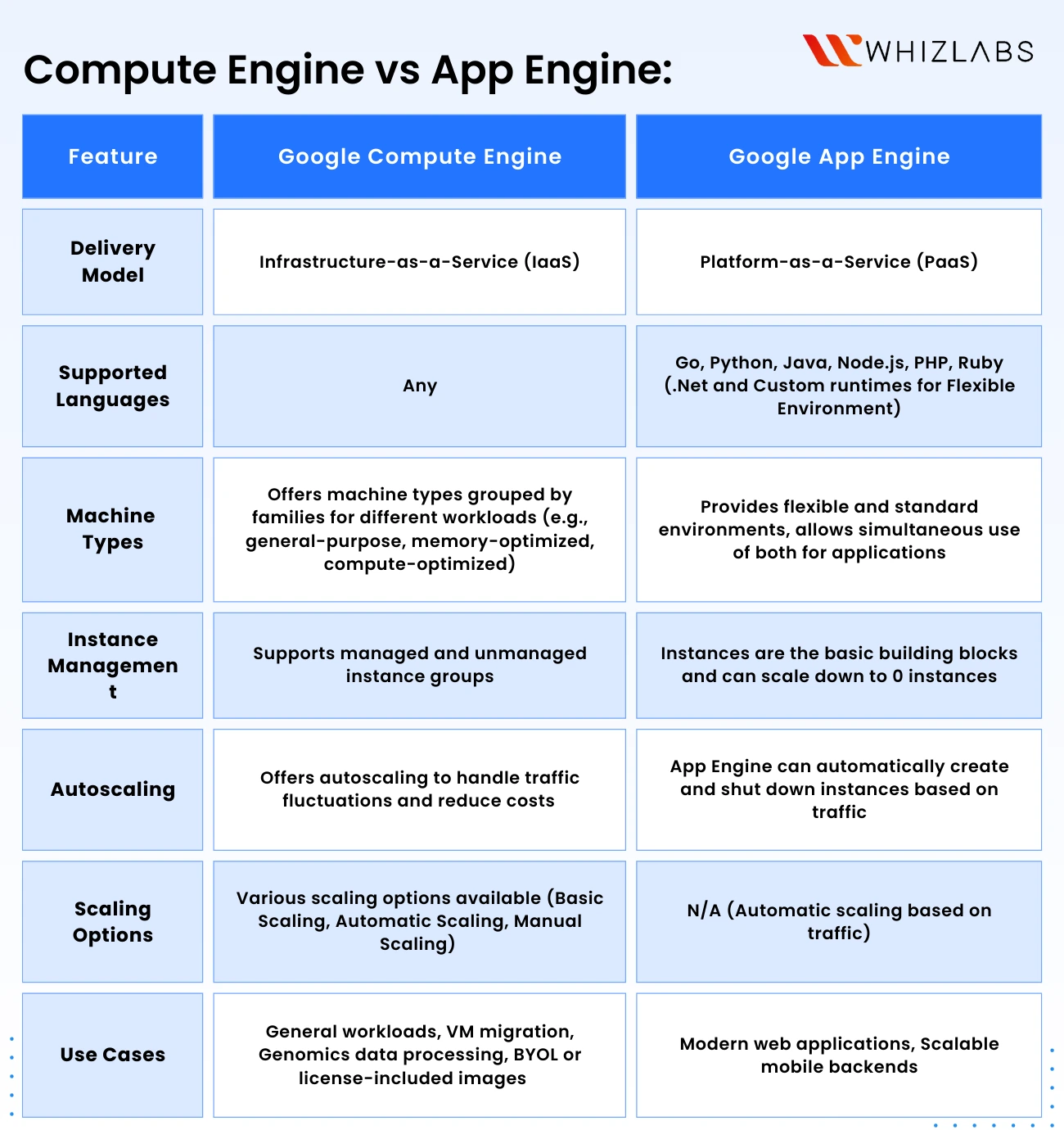
For exam preparation, a direct tabular comparison is invaluable. This table clearly summarizes the key differences between the two services.
3. GCP Data Services: Google BigQuery
While GCP offers a full range of database services (like Cloud SQL for relational databases), its most distinctive and well-known data service is BigQuery, which falls into the category of data analytics.
Definition: Google BigQuery is a fully managed, serverless, and highly scalable cloud data warehouse designed for analyzing petabyte-scale datasets. It enables extremely fast SQL queries using the processing power of Google's infrastructure.
Key Exam Points:
- Service Model: Serverless Data Warehouse / Analytics Platform.
- Core Function: Stores and analyzes massive amounts of data for business intelligence and data analytics.
- Key Features:
- Serverless: There are no servers to manage or provision.
- Decoupled Storage and Compute: Storage and compute resources are separated and can be scaled independently, which is highly efficient.
- Speed: Executes SQL queries across terabytes of data in seconds and petabytes in minutes.
- Built-in ML: Includes BigQuery ML, which allows users to create and execute machine learning models using standard SQL queries.
- Use Cases:
- Interactive, large-scale data analysis and reporting.
- Real-time analytics on streaming data.
- Powering business intelligence dashboards.
- Equivalents: Competes with services like Amazon Redshift and Azure Synapse Analytics.
Let's reinforce this with a short video segment that focuses specifically on BigQuery.
Google Cloud Platform Tutorial | Google Cloud Platform Fundamentals | GCP Training | Edureka
Let's return to the Edureka video for a focused look at GCP's big data capabilities, with a highlight on BigQuery.
Watch the segment on Big Data services (14:48 - 16:04). Pay close attention to the description of BigQuery as a 'fully managed, low-cost analytics data warehouse' that is serverless.
4. Summary for Exams: GCP in the Cloud Landscape
Now, let's place the GCP services you've learned into the broader context of the AWS and Azure services from previous lessons. This comparative table is a critical study tool for your exams.
| Feature / Service | AWS (Amazon Web Services) | Azure (Microsoft Azure) | GCP (Google Cloud Platform) |
|---|---|---|---|
| Compute (IaaS) | EC2 (Elastic Compute Cloud) | Virtual Machines (VMs) | Compute Engine (GCE) |
| Web Apps (PaaS) | Elastic Beanstalk | App Service | App Engine (GAE) |
| Relational DB (DBaaS) | RDS (Relational Database Service) | Azure SQL Database | Cloud SQL |
| Data Warehouse | Redshift | Azure Synapse Analytics | BigQuery |
| Object Storage | S3 (Simple Storage Service) | Blob Storage | Cloud Storage |
| Container Orchestration | EKS (Elastic Kubernetes Service) | AKS (Azure Kubernetes Service) | GKE (Google Kubernetes Engine) |
This table, which you can expand as you learn more, helps to map equivalent services across the top three cloud providers, a common topic in university exams.
Conclusion
In this lesson, we completed our high-level survey of the major public cloud platforms by examining Google Cloud Platform. You are now able to describe its key services and, crucially, understand where they fit in relation to their AWS and Azure counterparts.
Key Takeaways:
- Google Compute Engine (GCE) is GCP's IaaS offering, providing virtual machines with full user control, analogous to AWS EC2 and Azure VMs.
- Google App Engine (GAE) is GCP's fully managed PaaS for web applications, abstracting infrastructure and comparable to AWS Elastic Beanstalk and Azure App Service.
- Google BigQuery is a powerful, serverless data warehouse optimized for large-scale data analytics, competing with services like Amazon Redshift and Azure Synapse Analytics.
Preview of the Next Lesson:
Having reviewed the core services of AWS, Azure, and GCP, our next lesson will focus on a direct, formal comparison of these three providers. We will analyze them based on their core service offerings, pricing models, and primary market strengths, creating a comprehensive comparative summary perfect for exam revision.