Introduction
Welcome! In our previous lessons, you've built a foundational understanding of the core services offered by the three major public cloud providers: Amazon Web Services (AWS), Microsoft Azure, and Google Cloud Platform (GCP). We've looked at their individual IaaS, PaaS, and key data services.
This lesson synthesizes that knowledge to meet a critical objective for your exams: to compare AWS, Azure, and GCP in a tabular format across their core service offerings, pricing models, and primary strengths. Comparative analysis questions are very common, and mastering these distinctions will be essential for achieving a high score. We will construct a series of exam-focused comparison tables to structure this information clearly.
1. Market Position and Global Reach
Before diving into services, it's important to understand the market context. The "big three" are not equal in terms of market share, age, or global footprint. These factors influence their service maturity, customer base, and strategic focus.
To start, let's get a high-level video comparison of the three platforms.
AWS vs Azure vs GCP | Amazon Web Services vs Microsoft Azure vs Google Cloud Platform | Simplilearn
This video from Simplilearn provides a structured comparison of AWS, Azure, and GCP, covering their origins, market share, and service categories. It's a good primer for the detailed tables we will build.
Please watch the following segments to get a sense of the landscape: Comparison Parameters (02:12 - 02:38): Note the key areas that are used to compare the platforms. Origin (02:38 - 03:36): Understand when each platform was launched, which relates to their market maturity. Availability Zones (04:27 - 05:12): Pay attention to the differences in global infrastructure scale. Market Share & Pricing (08:51 - 09:23): Get a clear picture of who leads the market.
Based on the video and other industry data, here is a summary table of their market standing. This is prime material for an introductory question on an exam.
| Factor | Amazon Web Services (AWS) | Microsoft Azure | Google Cloud Platform (GCP) |
|---|---|---|---|
| Launch Year | 2006 | 2010 | 2008 |
| Market Share (Q1 2024) | ~31% | ~25% | ~11% |
| Global Regions | 33+ | 60+ | 40+ |
| Global Availability Zones | 105+ | 120+ (Estimated) | 121+ |
| Primary Identity | The market pioneer and leader, known for the broadest and deepest set of services. | The enterprise and hybrid cloud champion, with strong integration into the Microsoft ecosystem. | The data, AI, and open-source innovator, known for performance and competitive pricing. |
Note: The number of regions and AZs changes frequently. The figures above are approximate as of early 2024. The key takeaway is that all three have massive global footprints.
2. Core Service Offerings: A Comparative Map
For your exam, the most critical knowledge is mapping the equivalent services across platforms. While the names differ, the core functions are often similar.
The following image provides an excellent, detailed visual map of services across numerous categories. Spend a few moments studying it to appreciate the breadth of services and their counterparts.

To make this information more digestible, let's break it down into key domains using a series of targeted tables, which you can study in more detail from the provided reading.
AWS vs Azure vs Google Cloud: The Ultimate Comparison in 2025
The article 'AWS vs Azure vs Google Cloud: The Ultimate Comparison in 2025' from DynaTech Consultancy offers a series of excellent, exam-friendly tables that compare the services domain by domain.
Please read the sections titled 'Cloud Compute Services', 'Cloud Storage: Who Does It Best?', 'Databases in the Cloud', and 'Specialized Cloud Services Comparison'. Focus on the tables within these sections, as they directly compare the service names for each category.
Here are the key comparisons summarized from the resource, formatted for easy revision.
A. Compute Services
| Service Type | AWS | Azure | GCP |
|---|---|---|---|
| Virtual Machines (IaaS) | Amazon EC2 | Azure Virtual Machines | Google Compute Engine |
| Web Apps (PaaS) | Elastic Beanstalk | Azure App Service | Google App Engine |
| Containers (Orchestration) | EKS (Elastic Kubernetes Service) | AKS (Azure Kubernetes Service) | GKE (Google Kubernetes Engine) |
| Serverless Functions (FaaS) | AWS Lambda | Azure Functions | Google Cloud Functions |
B. Storage Services
| Storage Type | AWS | Azure | GCP |
|---|---|---|---|
| Object Storage | Amazon S3 | Azure Blob Storage | Google Cloud Storage |
| Block Storage | Amazon EBS | Azure Managed Disks | Google Persistent Disk |
| File Storage | Amazon EFS | Azure Files | Google Cloud Filestore |
| Archive / Cold Storage | Amazon S3 Glacier | Azure Archive Blob Storage | Google Cloud Coldline/Archive |
C. Database Services
| Database Type | AWS | Azure | GCP |
|---|---|---|---|
| Relational (SQL) | Amazon RDS | Azure SQL Database | Google Cloud SQL |
| NoSQL | Amazon DynamoDB | Azure Cosmos DB | Google Cloud Datastore / Firestore |
| Data Warehouse | Amazon Redshift | Azure Synapse Analytics | Google BigQuery |
3. Pricing Models and Cost Comparison
While all three providers use a pay-as-you-go model, they offer different ways to get discounts, which can be a key differentiator.
| Pricing Feature | AWS | Azure | GCP |
|---|---|---|---|
| Billing Granularity | Per-second (for EC2 Linux) or per-hour | Per-second | Per-second |
| Long-Term Discounts | Reserved Instances (RIs): 1-3 year commitment for up to 72% discount. | Reserved VM Instances (RIs): 1-3 year commitment for up to 72% discount. | Committed Use Discounts (CUDs): 1-3 year commitment for up to 70% discount. |
| Automatic Discounts | N/A | N/A | Sustained Use Discounts (SUDs): Automatic discounts applied for running GCE instances for a significant portion of the month. |
| Short-Term, Low-Cost | Spot Instances: Bid on spare capacity for up to 90% discount; can be terminated with short notice. | Spot Virtual Machines: Access spare capacity at a large discount; can be evicted. | Preemptible VM Instances: Low-cost, short-lived instances; terminated after 24 hours. |
| Special Discounts | Savings Plans (flexible compute commitment) | Azure Hybrid Benefit: Use existing on-premises Windows Server/SQL Server licenses on Azure. | N/A |
Numerical Example: Instance Cost
As requested, here is a simplified cost comparison for a general-purpose VM instance. Note that these prices are illustrative and change based on region, OS, and exact configuration.
AWS vs Azure vs GCP | Amazon Web Services vs Microsoft Azure vs Google Cloud Platform | Intellipaat
For a clear breakdown of instance pricing, this video from Intellipaat provides specific cost examples for small and large instances on each platform.
Watch the segment on Pricing and Billing Models (10:03 - 10:21). This part gives a direct monthly cost comparison for a basic instance with 2 vCPUs and 8 GB of RAM.
Here's a table summarizing those approximate costs for a basic instance (2 vCPUs, 8 GB RAM):
| Provider | Approximate Monthly Cost |
|---|---|
| AWS | ~$69 / month |
| Azure | ~$70 / month |
| GCP | ~$52 / month (often cited as cheaper for standard instances) |
Key Takeaway for Exams: GCP is often highlighted for its competitive and user-friendly pricing, particularly with automatic Sustained Use Discounts. Azure's key pricing advantage is the Hybrid Benefit for existing Microsoft customers. AWS has the most complex but also highly flexible discount options (Savings Plans, RIs).
4. Primary Strengths and Challenges
Finally, a top-level comparison of strengths and weaknesses is essential for "which to choose" style questions.
This image provides a concise, high-level summary of the platforms.
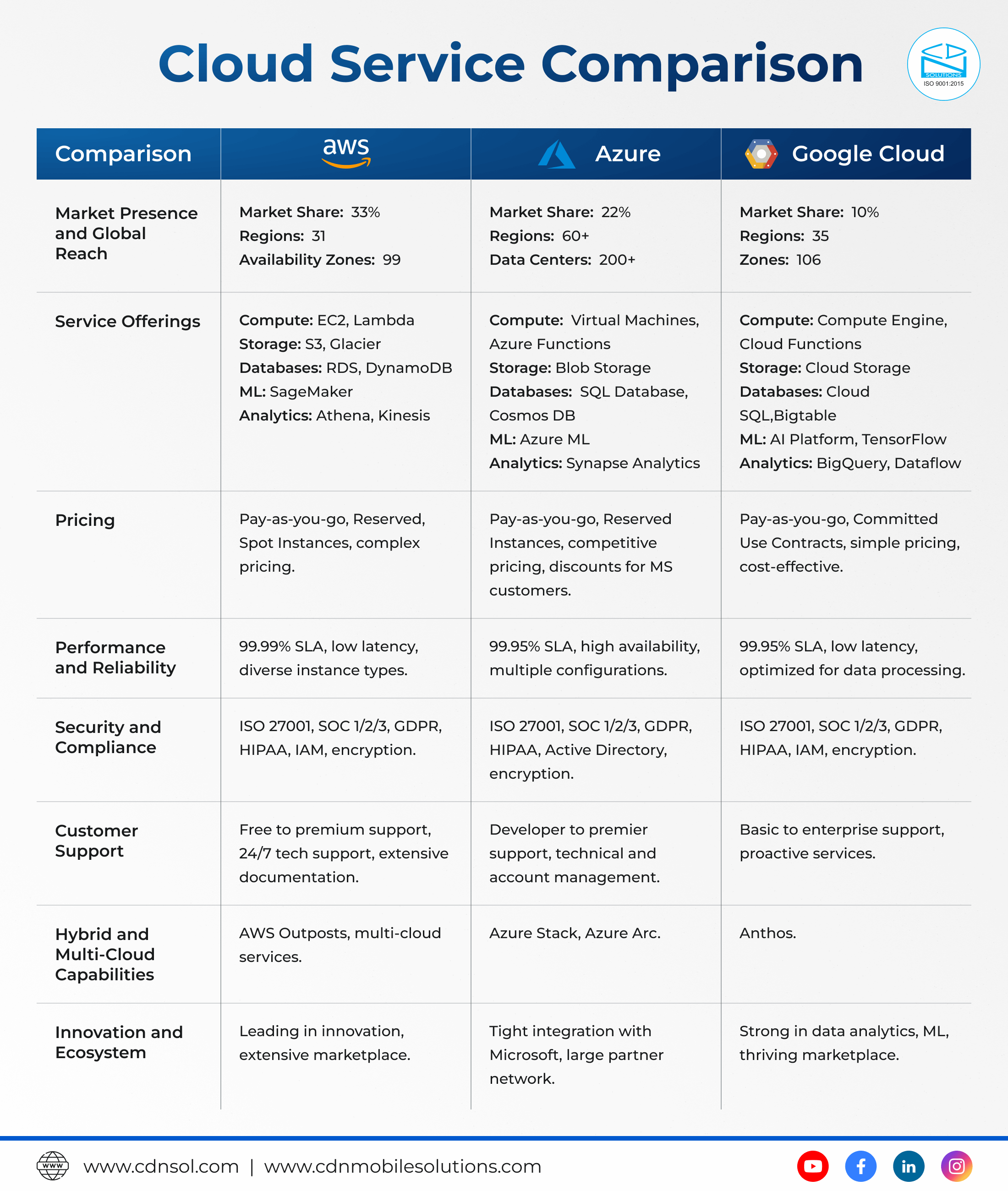
For a more detailed breakdown, the following table summarizes the primary pros and cons of each provider.
| AWS (Amazon Web Services) | Microsoft Azure | GCP (Google Cloud Platform) | |
|---|---|---|---|
| Primary Strengths | - Market Leader: Most mature platform with the largest customer base and community. - Broadest Service Portfolio: Most extensive range of services and features. - High Reliability: Proven track record of uptime and operational excellence. - Global Reach: Massive, well-established global infrastructure. |
- Enterprise Integration: Seamless integration with Microsoft tools (Office 365, Active Directory, Windows Server). - Hybrid Cloud Leader: Strong capabilities for hybrid environments (Azure Arc, Azure Stack). - PaaS and Developer Tools: Excellent Platform-as-a-Service offerings and developer tools. |
- Data & AI Excellence: Industry-leading services in Big Data (BigQuery) and Machine Learning (Vertex AI, TensorFlow). - Container Leadership: Expertise in containers and Kubernetes (GKE is considered a gold standard). - Competitive Pricing: Often cheaper, with flexible and automatic discounts. - High-Performance Network: Leverages Google's fast global network. |
| Primary Challenges | - Cost Complexity: Pricing can be very complex and difficult to manage without expertise. - Overwhelming Options: The sheer number of services can be difficult to navigate. - "Jack of all trades": May not be the absolute best in every single niche compared to focused competitors. |
- Perceived Complexity: Documentation and management portal can sometimes feel less intuitive than GCP's. - Less Flexible for Non-Microsoft Shops: While it supports open source, its main strengths lie in its own ecosystem. |
- Smaller Market Share: Less enterprise adoption and a smaller talent pool compared to AWS/Azure. - Fewer Services: Has a smaller overall service catalog than AWS. - Less Mature Enterprise Support: Historically perceived as having less enterprise-focused sales and support, though this is improving rapidly. |
Conclusion
In this lesson, we systematically compared AWS, Azure, and GCP, providing you with the structured, tabular information needed for your semester exams.
Key Takeaways:
- Market Position: AWS is the clear market leader, followed by Azure, with GCP as a strong and growing third player.
- Service Offerings: While most core services have direct equivalents (e.g., EC2/VMs/Compute Engine), each platform has areas of special strength.
- Pricing: All use a pay-as-you-go model, but differ in their discount structures. GCP is noted for automatic discounts, Azure for its Hybrid Benefit, and AWS for its flexible but complex options.
- Primary Strengths:
- AWS: Best for breadth of services and maturity.
- Azure: Best for enterprise and hybrid cloud, especially for Microsoft-centric organizations.
- GCP: Best for data analytics, machine learning, and container-based applications.
Preview of the Next Lesson:
Having established a firm understanding of the major cloud platforms, we will next explore emerging paradigms that build upon them. The upcoming lesson will introduce IoT and its relationship with cloud computing, as well as the concepts of Edge and Fog computing. We will also delve deeper into different cloud storage types, comparing object, file, and block storage in detail.