Introduction
Welcome to the first lesson in our module on "Cloud Monitoring and Financial Management." In the previous lesson, we concluded our discussion on cloud security by examining trust models. We learned that agreement-based trust, where trust is established through formal contracts, is a cornerstone of the customer-provider relationship.
Today, we will dissect the most critical document in agreement-based trust: the Service Level Agreement (SLA). Mastering SLAs is essential, as they form the contractual basis for service quality and are a frequent topic in university exams.
Your learning outcome for this lesson is to: Define a Service Level Agreement (SLA) and explain its key components (e.g., uptime, performance metrics, penalties).
We will start by formally defining an SLA and distinguishing it from related terms. Then, we will break down its most important components, using diagrams and tables to create a clear, structured overview perfect for your exam preparation.
1. Defining the Service Level Agreement (SLA)
At its core, an SLA is a formal contract. For your exam, a precise, multi-part definition is key.
To begin, let's get a straightforward definition.
Lec-22: SLA: Service Level Agreement in Cloud Computing | Need & Use of SLA
This short clip from Gate Smashers provides a concise, exam-friendly definition of an SLA and its purpose as a legal document.
Watch the first 1 minute and 35 seconds of the video to understand what an SLA is and why it's important in establishing accountability.
As the video explains, an SLA is a formal contract between a cloud service provider (CSP) and a customer that specifies, in measurable terms, the level of service the customer can expect to receive. It outlines the provider's commitments and the penalties for failing to meet them.
To be even more precise, it's helpful to understand the hierarchy of terms that lead to an SLA.
Understanding SLAs: What 99.9% Uptime Really Means - Oqitor
The Oqitor resource provides an excellent FAQ that clearly defines the relationship between SLIs, SLOs, and SLAs. Understanding this distinction will allow you to provide a more nuanced answer in your exam.
Read the first question in the 'People Also Ask' section titled 'What is the difference between an SLA, SLO, and SLI?'.
Based on this, here is a summary of the hierarchy. This is a very common topic for exam questions.
-
Service Level Indicator (SLI): A specific, quantifiable metric that measures an aspect of the service. It is the what you are measuring.
- Example: The percentage of successful HTTP requests, or the latency of a response.
-
Service Level Objective (SLO): The internal target value or range for an SLI that the provider aims to meet. It is the goal the provider sets for itself.
- Example: "We aim for 99.95% of HTTP requests to be successful over a one-month period."
-
Service Level Agreement (SLA): A formal contract that includes one or more SLOs and specifies the consequences if those SLOs are not met. It is the promise to the customer with penalties attached.
- Example: "We guarantee 99.9% uptime per month. If we fail, you will receive a 10% credit on your next bill."
In short: SLA = SLO + Consequences.
| Term | Definition | Example |
|---|---|---|
| SLI | A metric to measure. | Request latency. |
| SLO | An internal goal for the metric. | 99% of requests served in <100ms. |
| SLA | A contractual promise with penalties. | If <99% of requests are served in <100ms, the customer gets a credit. |
2. Key Components of a Service Level Agreement
An SLA is far more than just a single uptime number. A comprehensive SLA, as defined by standards like ISO/IEC 19086-1, covers many areas. The following diagram gives you a high-level overview of what a complete SLA might contain.

For your exam, you should focus on the most critical components that determine service quality and provider accountability. Let's break them down.
A. Service Availability (Uptime)
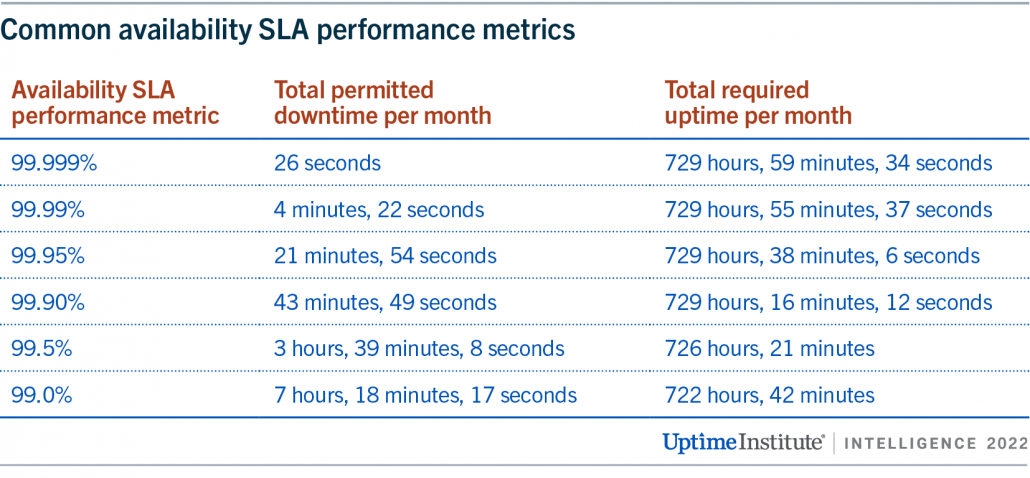
This is the most well-known component. Availability (or Uptime) is the percentage of time a service is operational and accessible. It is typically expressed in "nines."
Uptime SLA Explained: 99.9% vs 99.99% Availability | Webalert Blog
This article from the Webalert Blog provides a clear table and explanation of what the 'nines' of uptime actually mean in terms of allowed downtime. This is crucial for understanding the real-world impact of SLA percentages.
Read the sections 'What Is an Uptime SLA?' and 'The Downtime Math: What Each Tier Allows'. Pay close attention to the formula for availability and the table showing downtime for different SLA tiers.
From the reading, the key formula to remember is:
Here is a visual summary of common uptime guarantees and their corresponding allowed downtime per month.
B. Performance Metrics
A service can be "up" but still unusable due to poor performance. A strong SLA includes guarantees for performance metrics beyond simple availability.
Understanding SLAs: What 99.9% Uptime Really Means - Oqitor
The Oqitor article goes beyond uptime to explain other 'silent killers' of application performance. These definitions are essential for a complete answer on SLA components.
Read the sections 'Beyond Uptime: The Critical Components of a Robust Service Level Agreement' and 'Latency, Jitter, and Packet Loss'. Focus on the definitions of these three key performance metrics.
Based on the reading, key performance metrics to include in an SLA are:
- Latency: The delay for a data packet to travel from source to destination. High latency causes lag.
- Jitter: The variation in latency over time. High jitter causes choppy voice and video calls.
- Packet Loss: The percentage of data packets that fail to reach their destination. High packet loss can make applications unusable.
- Response Time: The time taken for the service to respond to a user request (e.g., API call, page load).
C. Service Restoration (MTTR) and Support
When an outage occurs, how quickly is the service restored? This is a critical component that defines the provider's operational capability.
The most important metric here is Mean Time to Repair (MTTR), which is the average time taken to repair a failed component and restore service. This is often confused with Mean Time to Respond (which is just the time to acknowledge an issue). A strong SLA guarantees a specific MTTR (e.g., 4 hours).
Additionally, the SLA will define the level of customer support, such as:
- Availability (e.g., 24/7/365).
- Channels (e.g., phone, email, web portal).
- Response time for support tickets.
D. Penalties and Remedies
This is the "consequence" part of the SLA. If the provider fails to meet a guaranteed objective (like uptime or MTTR), there must be a remedy.
- Penalty/Remedy: The most common remedy is a service credit, where the customer receives a discount on their next bill (e.g., 10% of the monthly fee).
- Termination Clause: The SLA should also define the conditions under which the customer can terminate the contract without penalty due to repeated or severe SLA failures.
E. Exclusions
The "fine print" of an SLA is in its exclusions—the situations where the SLA guarantees do not apply. For a complete exam answer, you must mention these. Common exclusions include:
- Planned Maintenance: Downtime during a pre-announced maintenance window is typically not counted against the uptime SLA. A good SLA will limit the frequency and duration of these windows.
- Force Majeure: Often called "Act of God" clauses, these excuse the provider from liability for events beyond their control, such as natural disasters, wars, or major third-party fiber cuts.
- Customer-Caused Issues: If the outage is due to the customer's own misconfiguration, code, or failure to follow provider recommendations, the SLA is void for that incident.
3. Summary: Standard vs. Enterprise-Grade SLA
To consolidate these concepts, the following table contrasts a weak, provider-focused SLA with a strong, customer-focused SLA across the components we've discussed. This is a perfect format for exam revision.
| Feature | Standard (Provider-Focused) SLA | Enterprise-Grade (Customer-Focused) SLA |
|---|---|---|
| Uptime | 99.9% (allows ~8.76 hours of downtime/year). | 99.99% or higher. Includes performance guarantees (latency, jitter). |
| MTTR | "Best Effort" or not defined. | Financially-backed 4-hour MTTR guarantee. |
| Penalties | Small, fixed credit (e.g., 5% of monthly cost). Must be requested. | Escalating credits (up to 100% of cost) based on outage duration. Applied automatically. |
| Exclusions | Broad list including vaguely defined maintenance windows. | Narrowly defined exclusions. Maintenance requires long notice and occurs in off-peak hours. |
| Monitoring | Customer must detect and report outages. | Provider performs proactive monitoring with automated customer alerts. |
This table is adapted from the "Comparing the Reality" section of the Oqitor article (LINK).
Conclusion
In this lesson, we have thoroughly defined the Service Level Agreement and its key components, providing you with the structured knowledge needed for your exams.
Key Takeaways:
- An SLA is a formal contract specifying service levels and penalties. It builds on SLIs (metrics) and SLOs (internal targets) by adding consequences.
- The core components of an SLA are Availability (Uptime), Performance Metrics (latency, jitter, packet loss), Service Restoration (MTTR), Penalties (service credits), and Exclusions (planned maintenance, force majeure).
- The real value of an SLA is in the details. A high uptime percentage is meaningless without strong guarantees for performance, fast repair times, and meaningful penalties.
Preview of the Next Lesson:
Now that you understand the components of an SLA, our next lesson will focus on a specific, practical skill required by your syllabus. We will take the concept of availability and learn how to perform the associated calculations. The next learning outcome is: Calculate service downtime given an SLA uptime percentage (e.g., downtime per month for 99.9% uptime).